
Chicken Layer Feed: When to Switch, What to Buy, How Much Hens Eat
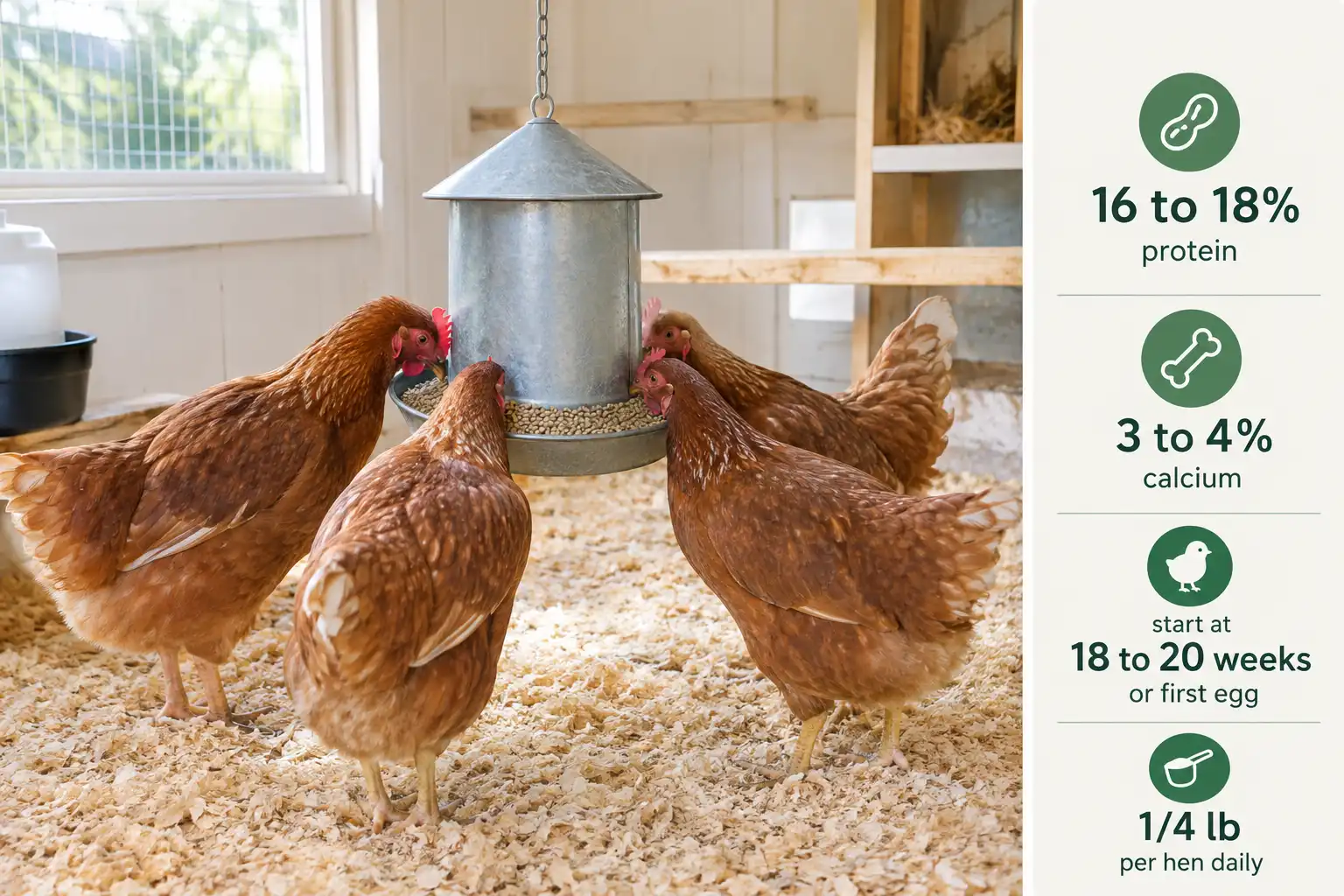
Chicken layer feed carries the extra calcium a laying hen needs to build eggshells. Start it too early and it harms young birds. Here is what to buy, when to switch, and how much your hens will eat.
Laying hens need extra calcium, so they eat chicken layer feed. It has 16 to 18 percent protein and 3 to 4 percent calcium. Switch pullets at 18 to 20 weeks or first egg, never before 16 weeks.
What Chicken Layer Feed Is and What the Tag Should Show
Layer feed is a complete ration for hens that are laying eggs. It is the last of three rations in a flock’s feeding schedule from hatch to hen. Calcium is the big change. UF/IFAS Extension notes that a pullet’s calcium need rises at least fourfold once she starts laying. Nearly all of that extra calcium goes into eggshells.
The ingredients are familiar. Pacific Northwest Extension (Oregon State, Washington State, and the University of Idaho) lists corn, barley, or wheat for energy. Soybean or canola meal adds protein, while limestone, fat, and a vitamin and mineral premix round it out.
Targets for laying hens differ between Texas A&M AgriLife Extension and two other extension services, so we give all three:
| Source | Protein | Calcium |
|---|---|---|
| Texas A&M AgriLife Extension | 16 to 18% | 3.5% |
| Alabama Extension (Auburn University) | 16% or more | 3 to 4% |
| Pacific Northwest Extension | About 16% | 3 to 4% |
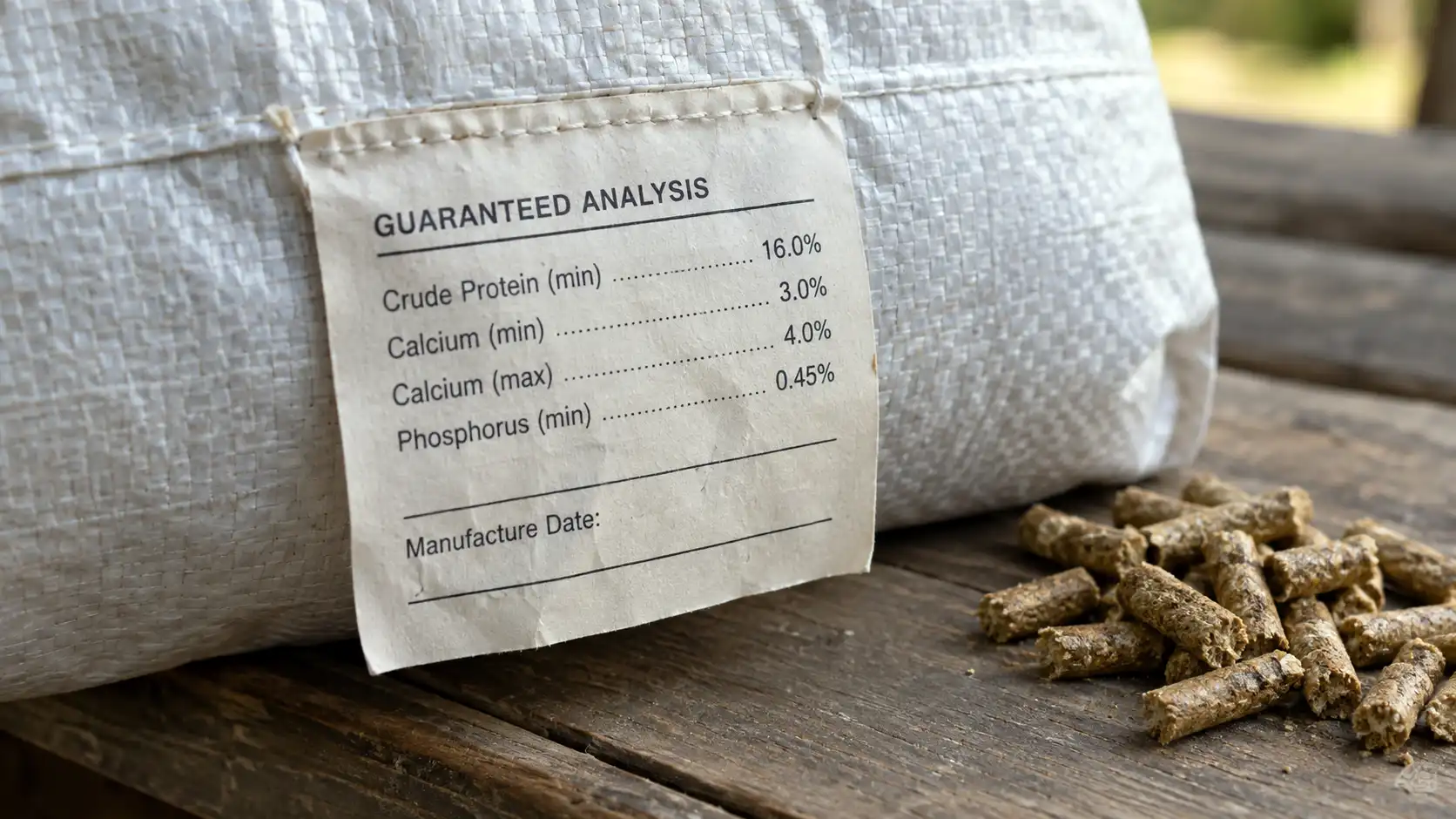
Alabama Extension also lists 0.4 to 0.5 percent phosphorus for laying hens, because a hen needs it to use calcium. On the bag, read the guaranteed analysis. Alabama Extension says most tags list protein, fat, and fiber. A layer feed tag should also show calcium and phosphorus.
When to Switch Chicks to Layer Feed
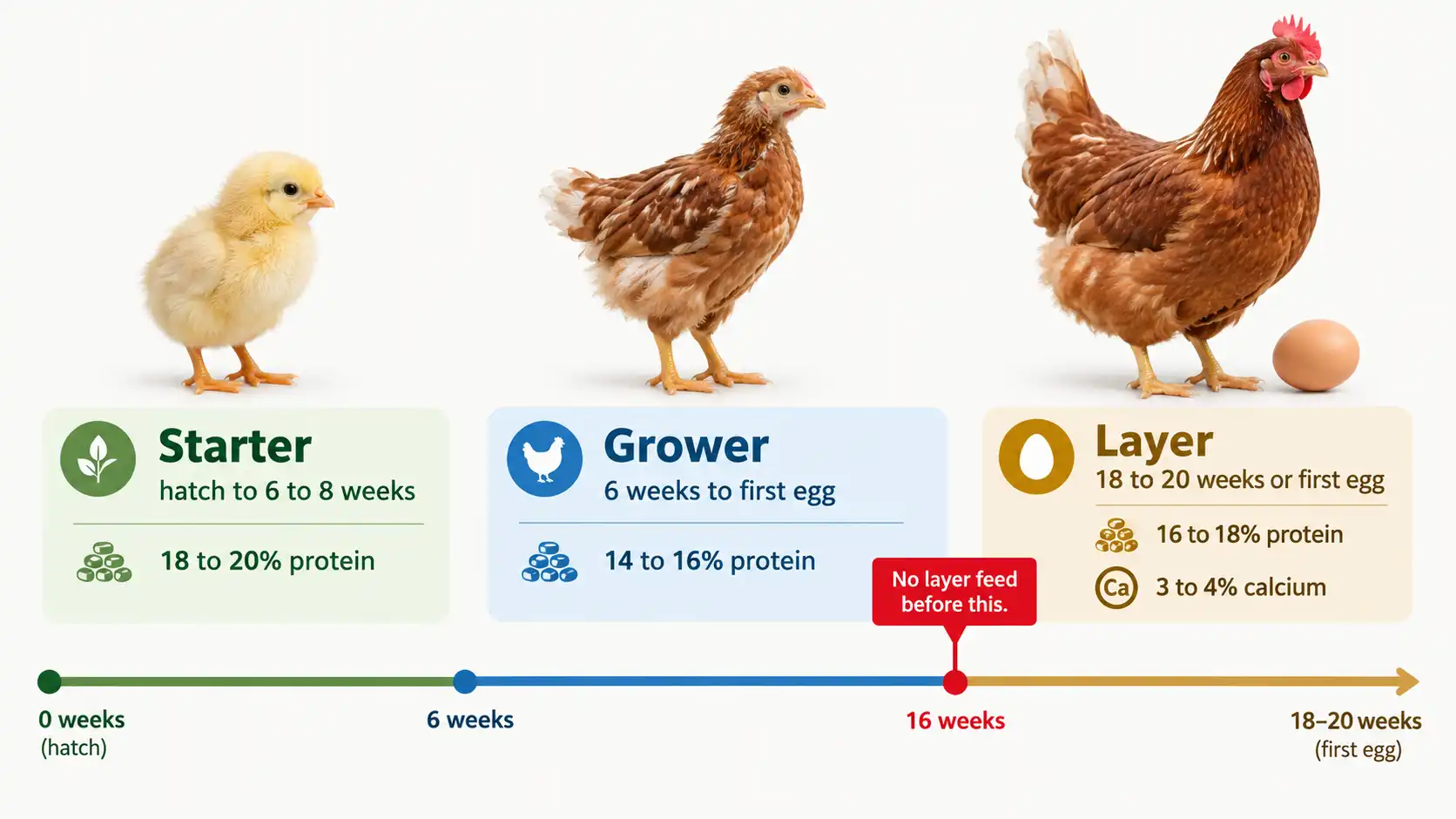
Switch pullets to layer feed at 18 to 20 weeks or the first egg, whichever comes first. Never switch before 16 weeks. Pacific Northwest Extension sets that window, and Texas A&M AgriLife Extension adds the 16-week floor. So when can chicks eat layer feed? Never as chicks, and never as pullets under 16 weeks.
The floor matters because layer feed’s calcium is wrong for young birds. UF/IFAS warns that a high-calcium diet throws off a young bird’s calcium-to-phosphorus ratio, so illness and death rates climb.
Breed and season move the date, too. UF/IFAS puts first eggs at 18 to 22 weeks, while Alabama Extension puts most pullets at 20 to 25 weeks. Slower breeds, such as Rhode Island Reds, Plymouth Rocks, and Jersey Giants, can start later still.
Until then, pullets stay on chick starter and grower rations. Both extension services lay out the schedule for laying breeds:
| Stage | Pacific Northwest Extension | Texas A&M AgriLife Extension |
|---|---|---|
| Starter | Hatch to about 6 weeks, 18 to 20% protein | Hatch to 8 weeks, 18% protein |
| Grower or developer | About 6 weeks to first egg: grower 15 to 16%, developer 14 to 15% protein | 8 weeks to first egg, 16% protein |
| Layer | 18 to 20 weeks or first egg, whichever comes first: about 16% protein, 3 to 4% calcium | First egg, never under 16 weeks: 16 to 18% protein, 3.5% calcium |
Pacific Northwest Extension treats grower and developer feeds as interchangeable.
What Is the Best Chicken Feed for Laying Eggs?
The best chicken feed for laying eggs is a complete layer ration labeled for laying hens. Feed it as nearly all they eat. Alabama Extension notes that complete feeds labeled for laying hens meet the needs of most small-flock layers. So brand matters less than four checks that any chicken feed for laying hens should pass:
- Protein and calcium. The tag should fall inside the ranges in the table above.
- Form. Most feeds for layer chickens come as pellets or crumbles, and Alabama Extension says adult hens waste more crumbles.
- Ingredients. Skip fish meal, which can flavor eggs, and cottonseed meal, which can turn whites green, per Alabama Extension.
- Date. A fresh bag beats a cheap one, as the section on buying feed on sale shows.
Some labels matter less than they look. Alabama Extension finds vegetarian and regular layer feeds nearly identical in nutrients. Pacific Northwest Extension doubts that breeder feeds earn their extra cost in small flocks.
What about 16 versus 18 percent protein? Here the sources split. Pacific Northwest Extension describes layer feed at about 16 percent, while Alabama Extension advises around 18 percent for steady laying. Scratch and scraps also dilute a complete feed, Pacific Northwest Extension notes. So if your hens get extras, the higher end makes more sense.
How Much Layer Feed Hens Eat and How Long a 50 lb Bag Lasts
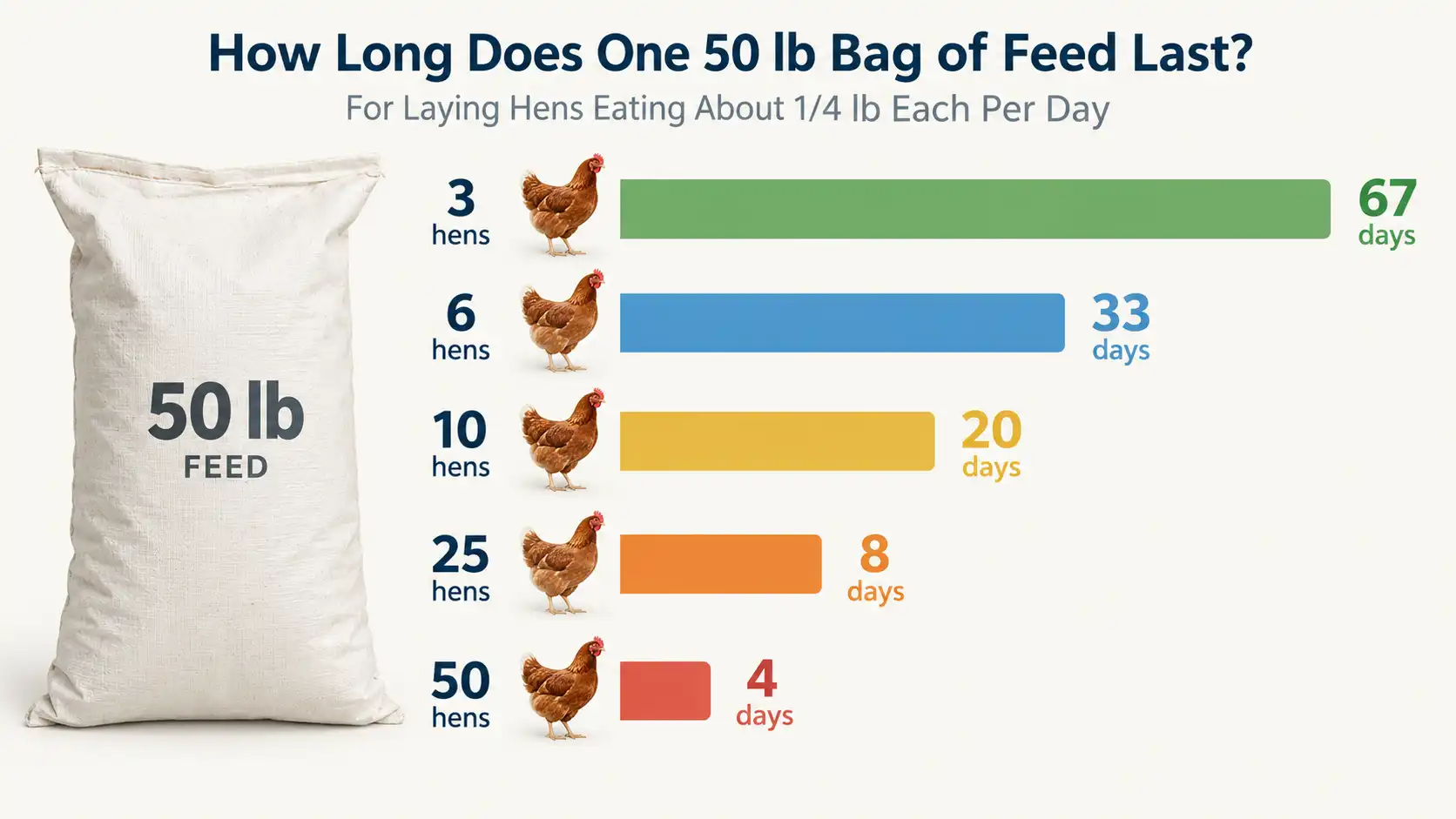
A laying hen eats about a quarter pound (4 ounces) of layer feed a day. Alabama Extension gives a range of 3.5 to 5.3 ounces (100 to 150 grams) per laying hen a day. It works from 0.25 pound. By its math, 10 laying hens empty a 50 lb chicken feed bag in about 20 days. Here is the same math for other flock sizes:
| Laying hens | Feed per day | Feed per 30 days | One 50 lb bag lasts |
|---|---|---|---|
| 3 | 0.75 lb | 22.5 lb | About 67 days |
| 6 | 1.5 lb | 45 lb | About 33 days |
| 10 | 2.5 lb | 75 lb | 20 days |
| 25 | 6.25 lb | 187.5 lb | 8 days |
| 50 | 12.5 lb | 375 lb | 4 days |
At the top of that range, 10 laying hens finish a bag in about 15 days.
What Feed Costs per Dozen Eggs
Feed is most of a backyard flock’s cost, Alabama Extension notes, so price your own eggs this way:
Feed cost per dozen = (bag price ÷ 50) × pounds of feed per week ÷ dozens collected per week
Say 6 laying hens eat 10.5 pounds a week, Alabama Extension’s figure, and lay 30 eggs (use your own count). Each of those 2.5 dozen takes 4.2 pounds of feed. So every $10 of bag price adds about 84 cents to each dozen’s feed cost.
Buying Chicken Feed on Sale: Check the Date First
A sale bag saves money only if your hens finish it while it is fresh. Extension limits on feed age run from two weeks to three months. Heat, humidity, and when the clock starts explain most of the gap:
| Source | Limit | Counted from |
|---|---|---|
| UF/IFAS Extension | 2 weeks before mold becomes a risk | Storage on the farm |
| NC State Extension | 3 weeks, sooner in hot, humid weather (written for duck feed) | Manufacture date |
| Pacific Northwest Extension | 2 months, kept cool and dry | Storage |
| Alabama Extension | 3 months | Manufacture date |
In a humid climate or a damp shed, plan around the short end. The bag table above shows who that hits. Only flocks of 15 or more laying hens finish a 50 lb bag inside two weeks. Three laying hens need about 67 days. So a smaller bag at a higher price per pound can cost less once you count spoiled feed.
Before you buy, and once you get home:
- Find the manufacture date on the bag. Alabama Extension says to ask the seller if it is missing.
- Store feed in a covered, solid container, such as a lidded trash can, as Pacific Northwest Extension advises.
- Keep it dry, out of direct sun, and away from rodents and insects, per Alabama Extension.
- Throw out feed that gets wet. UF/IFAS warns that mold toxins can cut laying and thin shells.
Oyster Shell, Grit, and Treats with Layer Feed
Hens on a complete layer feed may not need oyster shell, but it does no harm. Alabama Extension calls it probably unnecessary with a high-quality layer diet, yet cheap and safe to offer. Still, Pacific Northwest Extension says some high-producing hens need it, so watch the eggs. Shells that crack easily or feel rough like sandpaper suggest adding it. Offer free-choice oyster shell in a separate feeder, so each hen takes what she needs. UF/IFAS adds that larger calcium particles release slowly, which may help shell formation overnight.
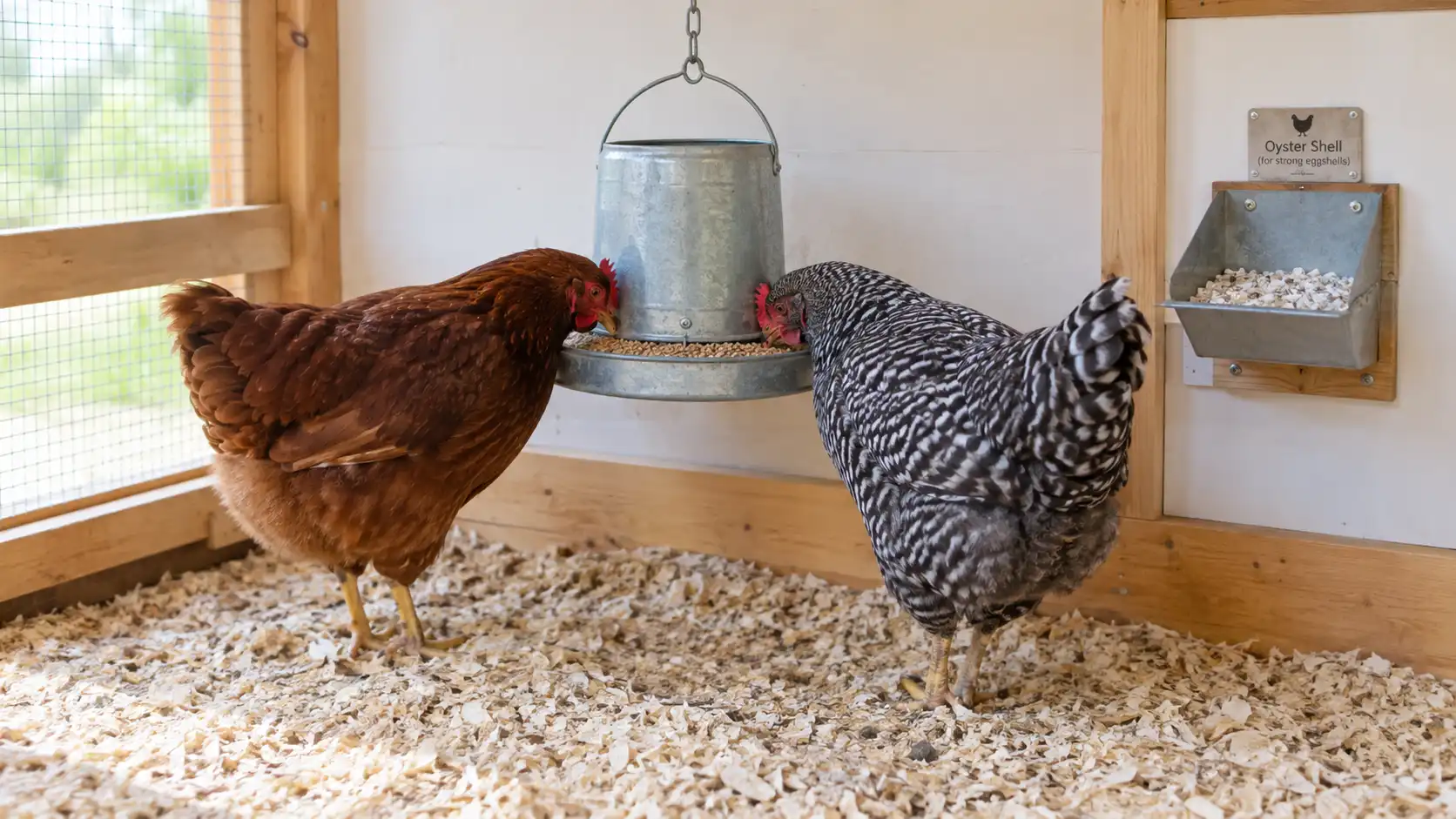
Grit depends on what else hens eat. Alabama Extension says hens on milled commercial feed don’t need it. However, Pacific Northwest Extension advises insoluble grit whenever you feed scratch grains, unless hens can find small stones outdoors. Oyster shell can’t replace grit, because it is too soft to grind.
Treats split the sources most. Texas A&M says to feed no corn, milo, or other feeds alongside the laying ration. Alabama Extension says to use extras sparingly or not at all, and never to mix scratch into the feed. Pacific Northwest Extension allows scratch up to what hens clean up in about 20 minutes. It puts that at 10 to 15 percent of daily intake. For 6 laying hens eating 1.5 pounds a day, that cap is about 2.4 to 3.6 ounces.
Feeding a Mixed Flock of Hens, Roosters, and Pullets
Roosters can usually eat the same layer feed as the hens. Alabama Extension advises feeding roosters the hens’ diet in most backyard flocks. It notes that the extra protein and calcium only rarely affect a rooster’s kidneys. As it advises, keep clean drinking water in front of roosters at all times.
Pullets and chicks change the answer, because Texas A&M rules out layer feed for pullets under 16 weeks. For that flock, Pacific Northwest Extension points to an all-purpose ration, often labeled all-flock. It serves as the sole feed for chickens of every age, from hatch through laying. Laying hens on it need free-choice oyster shell, though, because all-purpose feed generally lacks the calcium for proper shells.
Once the youngest birds reach laying age, you have two options. Move everyone to layer feed, or stay on all-purpose feed with oyster shell on the side.
Can Ducks Eat Chicken Layer Feed?
Laying ducks can, because their needs sit close to a laying hen’s. NC State Extension lists 16 percent protein and 2.9 percent calcium for laying and breeder ducks. It also allows free-choice oyster shell. It starts ducks on layer feed about a month before the first egg.
Three limits apply, though. First, NC State calls feed made for ducks ideal and treats chicken feed as a fallback. Second, it warns that some broiler feeds carry medications without FDA approval for ducks. Read the tag, and ask a poultry veterinarian before feeding any medicated feed. Third, ducklings need a different ration: NC State’s starter for ducklings up to 2 weeks runs 20 percent protein with under 1 percent calcium.
NC State also calls ducks extremely sensitive to mold toxins. So the freshness limits above matter even more in a duck flock.
Organic Layer Feed: What the Label Must Mean
Organic chicken feeds follow a federal standard, so the word on the bag is more than marketing. The USDA National Organic Program sets the feed rule in 7 CFR 205.237. Organic livestock must get a total ration of organic agricultural products from certified operations. The rule lets mills add approved synthetic vitamins and minerals. However, it bars feed containing any antibiotic, including ionophores, along with poultry slaughter by-products and supplements beyond nutritional need.
The feed is only half of it. To sell eggs as organic, hens must be under organic management from their second day of life. That rule sits in 7 CFR 205.236. The farm also needs certification, unless it qualifies for the program’s small-farm exemption. A USDA-accredited certifier, which in some states is the state department of agriculture, can confirm which rules fit your flock. Because the organic clock starts at day two, line up certified organic feed before the chicks arrive.
Nutrition differs less than price. Alabama Extension finds organic and conventional layer diets similar in makeup but considerably more expensive. Pacific Northwest Extension adds that organic rules restrict synthetic amino acids. That makes organic feeds harder to formulate, and they can fall short of optimal nutrition for laying hens. A non-GMO or natural claim, meanwhile, is not an organic claim.
How to Make Chicken Feed for Laying Hens at Home
You can, but homemade feed must match a complete layer ration, and Alabama Extension calls that challenging for most keepers. You need to know both what hens require and what each ingredient delivers. An imbalanced mix can do lasting harm, so Alabama Extension advises talking with someone trained in poultry nutrition first. Texas A&M AgriLife Extension goes further and recommends only all-in-one manufactured feeds for small laying flocks.
Grain alone won’t do. UF/IFAS warns that whole grains, scratch, and table scraps leave a laying hen’s diet imbalanced. It also lists details any layer ration has to get right:
- Methionine, the amino acid most often short in laying rations
- Vitamin D in the D3 form, since birds use D2 poorly
- Calcium from ground limestone or oyster shell, never dolomitic limestone, which blocks calcium uptake
- Salt in a narrow band, since too little brings feather pecking and too much is toxic
If you still want DIY chicken feed, keep the process tight:
- Get a formula built for your ingredients from a poultry nutritionist or your county extension office.
- Use a layer vitamin and mineral premix at the rate on its label.
- Weigh every ingredient instead of scooping by volume.
- Mix only what your hens eat in about two weeks, the UF/IFAS mold window, and store it like bagged feed.
Troubleshooting Layer Feed Problems
Rule out illness before you blame the feed. Call a poultry veterinarian or your state veterinarian the same day for any of these:
- Hens that stop eating or drinking
- Sudden deaths
- A sharp drop in laying
- A sudden run of soft-shelled or misshapen eggs
You can also reach USDA’s toll-free line at 1-866-536-7593. UF/IFAS lists several diseases that cut laying as poor feed does. It also advises sending sick or recently dead birds to a state diagnostic lab. The law requires reporting some poultry diseases.
If the flock is otherwise healthy, check the feed:
| Problem | What to check | Source |
|---|---|---|
| Thin or rough shells | Too little calcium, such as all-purpose feed with no oyster shell, or moldy feed | Pacific Northwest Extension, UF/IFAS |
| Fewer eggs | Hens out of feed or water for hours, too much scratch, days under about 14 hours of light | UF/IFAS |
| Feather pecking | Too little salt or protein, crowded feeders | UF/IFAS, Alabama Extension |
| Feed on the floor | Crumbles instead of pellets, feeders set too low | Alabama Extension |
| Musty or caked feed | Mold, which cuts laying and thins shells, so throw it out | UF/IFAS |
To cut spillage, set feeder troughs level with the hens’ backs, as Texas A&M and Pacific Northwest Extension both advise. Pacific Northwest Extension also calls for at least 4 linear inches of feeder space per adult hen. That means at least 40 inches for 10 laying hens. Check that figure when you shop for feeders that limit waste.
FAQs about Chicken Layer Feed
Should laying hens have feed available all day?
Yes, Alabama Extension advises free access to layer feed, though twice-daily meals work if hens finish each within an hour. Pacific Northwest Extension warns that poorly managed meal feeding can cut laying.
Does layer feed contain medication?
Usually not, because feed medications show up mainly in some starter rations, per Pacific Northwest Extension. Any medicated feed says so on its label, and that label, or your veterinarian, governs its use.
Can free-ranging hens skip layer feed?
No, pasture supplements layer feed but can’t replace it for laying hens. Pacific Northwest Extension says pasture feeds hens best in spring and summer and adds little in late fall and winter.
Is fermented layer feed better than dry feed?
Not necessarily: Alabama Extension says fermenting can aid digestion and water intake, but wet feed carries costs. It attracts insects, especially in summer, spoils quickly, and makes feeders harder to keep clean.
Can I feed eggshells instead of oyster shell?
Yes, dried eggshells are another calcium source for laying hens. Alabama Extension suggests drying them in the sun for 1 to 2 days, or 10 minutes in a 350°F oven.
Key Points for Your Flock
Read the tag before the price. A layer feed for laying hens shows 16 to 18 percent protein and 3 to 4 percent calcium. Its tag should also carry a recent manufacture date. Switch pullets at 18 to 20 weeks or the first egg, never before 16 weeks. Then buy bags your flock can finish while the feed is fresh. If hens go off feed or laying drops fast, call a veterinarian before you change the ration.