
Contract Broiler Farming: What to Read Before You Sign
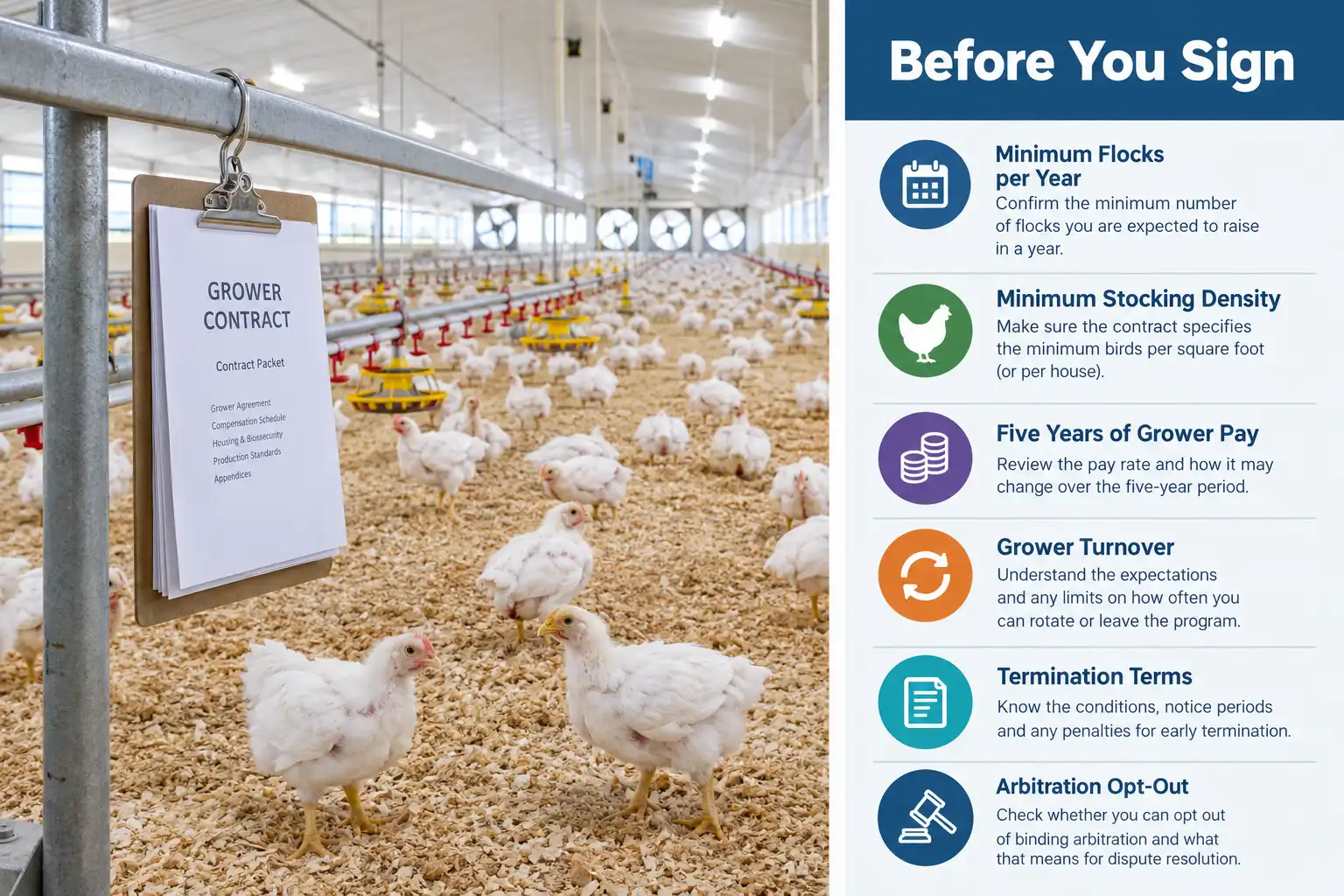
A broiler contract sets how many flocks you get, how the company pays you, and whether your house loan pencils out. In contract broiler farming, the company writes those terms. Here is what to read, what federal rules require, and the numbers to run first.
Before you sign up for contract broiler farming, read the contract and the Live Poultry Dealer Disclosure Document. Check minimum flocks per year, stocking density, five years of grower pay, grower turnover, termination terms, and the arbitration opt-out.
What a Contract Broiler Farming Agreement Covers
A grower contract splits the business in two. The company owns the birds and feed, while you own the houses and the debt. Growers call that company the integrator; federal rules call it the live poultry dealer.
| Item | Usually supplied by |
|---|---|
| Chicks and feed | Company |
| Veterinary services and a field technician | Company |
| Land, houses, and equipment | Grower |
| Labor, electricity, water, and repairs | Grower |
| Litter and dead-bird disposal | Grower |
| Heating fuel | Varies by contract |
Heating fuel is a common split point. USDA’s Agricultural Marketing Service (AMS), which enforces the Packers and Stockyards Act, describes growers as typically paying for utilities and fuel. Yet University of Maryland Extension notes that Delmarva companies furnish propane. So read the inputs clause line by line.
This model runs almost the whole industry. Contract operations raised 97 percent of US broilers in 2011, per the USDA Economic Research Service. Your choices are often narrow, too. In a USDA survey cited by AMS, about a quarter of growers had only one company close enough to grow for.
As a result, few growers negotiate terms line by line. Instead, the paperwork’s value is what it tells you before you borrow. And if no company within hauling distance is adding growers, finding a poultry company to grow for comes before any contract review.
When the Company Must Give You the Disclosure Document
A broiler company must give you a Live Poultry Dealer Disclosure Document along with the contract. The deadline depends on whether you must build or upgrade. The requirement comes from the AMS Transparency in Poultry Grower Contracting and Tournaments rule, in effect since February 12, 2024.
- Renewal, revision, or a contract on existing houses: at least 14 calendar days before the company signs. You may waive up to 7 of those days.
- New houses: at the same time as the housing specifications, plus a letter of intent a lender can rely on.
- Required upgrades: at the same time as the modified specifications, again with a letter of intent.
Small companies get one exemption. Those slaughtering fewer than 2 million live pounds of broilers a week can skip the 14-day rule on existing houses. However, they still owe the full packet whenever they ask you to build or upgrade.
The AMS rule FAQ adds a useful detail. Your contract must state the minimum flocks per year and the minimum stocking density. AMS says those minimums cannot be softened with words like “approximately” or “anticipates.”
What the Disclosure Document Shows, Page by Page
The document opens with a cover page of contract basics, then moves to history, policies, and pay data. Read each part with one question in mind.
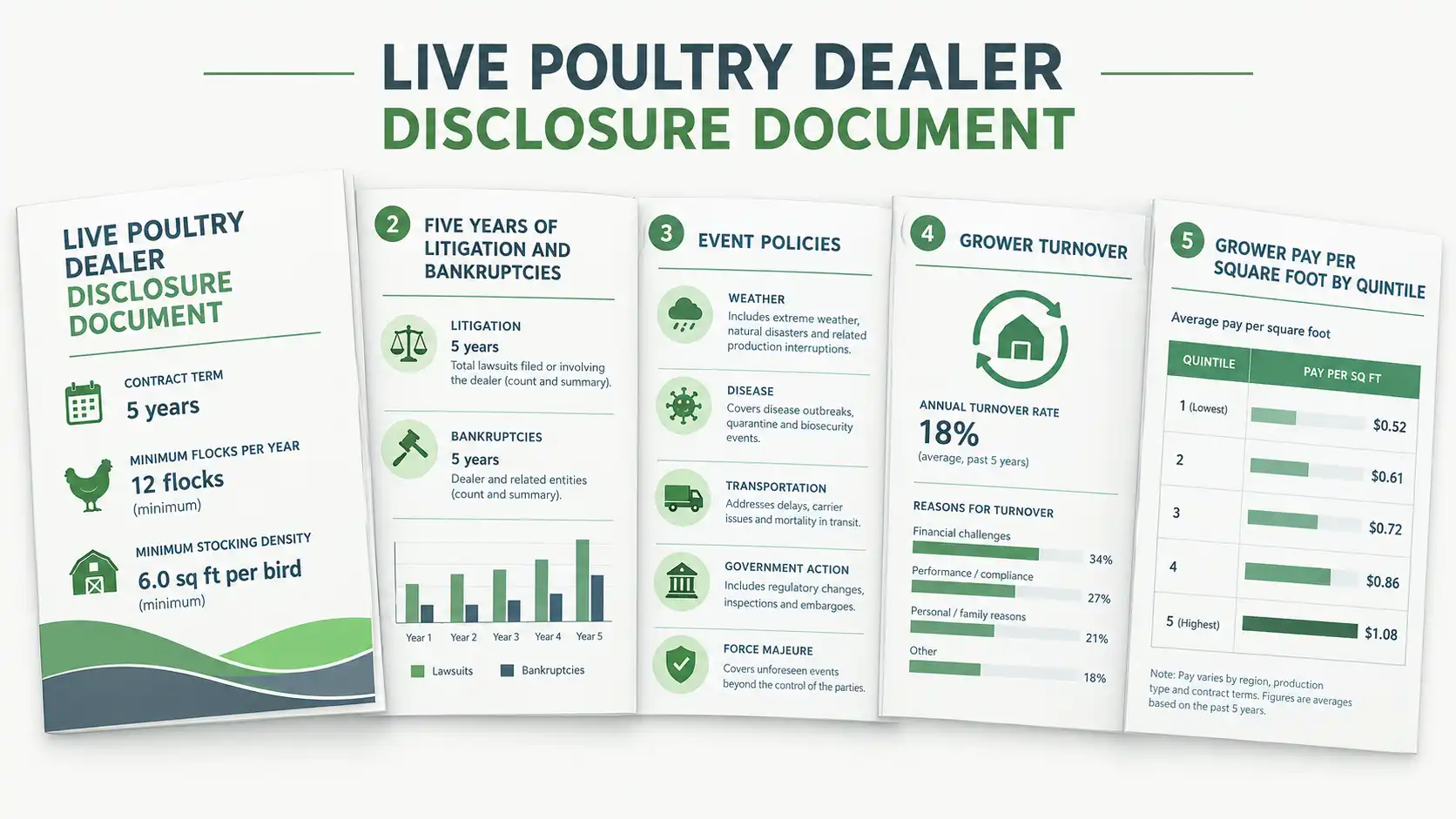
| Section | What it shows | What to check |
|---|---|---|
| Cover page | Contract length, minimum flocks per year, minimum stocking density | Does the term cover your loan? |
| Litigation | Lawsuits with broiler growers over the past 5 years | Who sued, and over what |
| Bankruptcy | Filings by the company or related firms over 5 years | Any recent filing |
| Sale of farm | Policy on selling your farm or assigning the contract | Can a buyer get a contract? |
| Event policies | Layout time, sick flocks, disasters, depopulation, feed outages, feed complaints | Any “no policy exists” entries |
| Turnover | Grower turnover, last year and 5-year average, company and local complex | Complex rate versus company rate |
| Grower pay | 5 years of average gross pay per square foot, by housing tier and quintile | The bottom two quintiles |
| Costs | Grower variable cost data and a local extension contact | Call that office |
Policies on sick flocks and depopulation cover your pay, not disease reporting. A suspected avian influenza case still goes to your state veterinarian or USDA at 1-866-536-7593, whatever the contract says. So learn the avian influenza signs and reporting rules before your first flock arrives.
Where the Federal Rules Stand in October 2026
The disclosure rule still applies in October 2026, but USDA plans to propose rescinding it, and a second grower pay rule is on hold.
Disclosure rule. USDA’s 2026 regulatory agenda, published in the Federal Register in August 2026, lists a proposal to remove it, targeted for October 2026. Until a final rescission takes effect, companies must still provide the document.
Grower pay rule. The Poultry Grower Payment Systems and Capital Improvement Systems rule would bar companies from cutting pay based on tournament rank. It would also add an upgrade disclosure. However, USDA delayed its effective date to December 31, 2027, and the same agenda lists its withdrawal.
Older protections. The 90-day termination notice, the arbitration opt-out, and the three-day cancellation right predate both rules.
So plan around today’s requirements without counting on them lasting. If the disclosure rule ends, ask for the same tables in writing anyway. A company that will not share five years of grower pay has answered a question, too.
How Tournament Pay Works
Most broiler growers earn under a tournament. The company ranks your flock against other growers who sold birds in the same period, and your base pay moves up or down. AMS describes per-flock pay as a function of three things: the pay rate, farm weight, and feed consumed. Growers with a lower cost per pound than the group average earn above the base rate. Growers with higher costs earn less.

Because of that, your pay depends partly on who shares your settlement week. University of Maryland Extension points out that a grower who markets birds alongside several above-average producers may miss a bonus, or even take a cut. Inputs matter too. Chick quality, breeder flock age, and feed deliveries come from the company, not from you.
The spread shows up in income. The USDA Economic Research Service reported a 2020 median household income of $106,694 for contract broiler growers, above the $80,060 median for all farm households. Yet the gap between growers at the 20th and 80th percentiles was $170,871, wider than for other farm households. Both figures include off-farm income.
Pay per pound varies as well. In USDA’s 2011 grower survey, cited by AMS, median pay was 5.55 cents per pound of farm weight. The bottom tenth of growers earned under 4.32 cents. So ask for a sample settlement sheet, and the formula behind it, before you sign.
What Each Flock’s Paperwork Must Show
Under the 2024 rule, a company running a tournament owes you two sets of facts for every flock. First, within 24 hours of chick delivery, it must tell you:
- The stocking density of the placement
- Breed names and ratios, plus male and female ratios if the company sexed the chicks
- The breeder facility identifier and breeder flock age
- Any known health problems in the breeder flock or the chicks
- Any pay adjustments tied to those inputs
Then, at settlement, the ranking sheet must show the same input data for every grower in your group, without names. It also lists each grower’s housing specification and how many times each farm ran completely out of feed for 12 hours or more.
Separately, the company must pay you by the close of the 15th day after the end of the week of slaughter, per the AMS summary of growers’ rights. Keep every settlement sheet and scale ticket. That way, if inputs look uneven across flocks, you have a record to show an attorney or AMS.
Contract Length Versus Loan Length
The biggest single risk is a contract shorter than the loan on your houses. In its 2023 rule, AMS noted that contract terms rarely run long enough to cover debt repayment, and some last only one flock. Meanwhile, a broiler house has little use or resale value outside poultry.
The sums are large. Mississippi State University Extension used $375,000 per 25,000-square-foot house in a 2022 analysis, about $15 per square foot. AMS estimated nearly $500,000 per house in 2023. And most companies want several houses on each farm.
Longer guarantees do exist for new construction. In its 2017 budget, University of Maryland Extension described new Delmarva houses carrying a guaranteed 15-year contract, matched to a 15-year loan. Still, a guarantee covers only what the contract says. So check three things:
- The contract term against your loan term, year for year
- Whether the company can tie renewal to new upgrades
- The minimum flocks per year in every year of the term
Lenders read the same paperwork. That is why the company must hand you a letter of intent you can take to a bank. AMS also notes that banks commonly require a buyer to hold a company contract before financing a farm sale. So compare the contract term with the repayment schedule before you settle on financing for poultry houses.
Upgrades a Company Can Require
A company can require new equipment or house upgrades during your contract, but the contract must say so up front. That disclosure duty comes from the Packers and Stockyards Act itself.
When an upgrade costs $12,500 or more per house, not counting maintenance or repair, AMS weighs several tests to judge whether the demand is fair:
- Whether you had a choice in making it
- Whether the company used coercion, retaliation, or threats
- Whether all similar growers face the same requirement
- Whether you can reasonably recoup the cost
- Whether you got a reasonable time to do the work
- Whether the company offered incentives to replace equipment it approved earlier
The 2024 rule adds paperwork. Modified housing specifications must arrive with a new Disclosure Document, the revised contract, and a letter of intent. Also, if five years of past pay no longer reflect what the new tier will earn, the company must add pay projections by quintile and explain why.
Before you sign, ask how often the complex has changed its housing specifications. Then ask whether pay rates rise with each house tier and equipment level. An upgrade without a higher rate or more flocks only adds debt.
Termination, Suspension, and Breach Terms
Federal rules set minimum terms for how a grower contract can end or pause. The AMS summary of growers’ rights lists them, and your contract should match or beat each one.
| Clause | What federal rules say |
|---|---|
| Termination or non-renewal by the company | At least 90 days’ written notice, with reasons, effective date, and any appeal rights |
| Termination by you | 90 days’ written notice to the company |
| Suspension of bird deliveries | AMS weighs whether you got written notice of why and when deliveries resume, unless a disaster or emergency prevented it |
| Claimed breach | A reasonable period to fix it, after written notice naming the term breached and how to cure it |
| Performance improvement plan | The contract must say whether one exists and how growers get on and off it |
Read the breach clause closely. AMS also considers whether a claimed breach affects food safety or animal welfare, so biosecurity and bird care terms carry extra weight.
Then compare the contract’s own grounds for ending the deal with this list. Vague grounds, such as an undefined “company standards” clause, give the company wide room to act.
Arbitration and Your Right to Cancel
You can decline an arbitration clause, and you can cancel a signed contract within three business days. Both rights come from the Packers and Stockyards Act.
If the contract includes arbitration, it must let you opt out. It must also describe the costs, the process, and any limits on your remedies. AMS warns that choosing arbitration means giving up a lawsuit for damages and a jury trial. Also, parties usually pay arbitration fees up front, and those fees can far exceed court filing fees.
The cancellation right runs three business days after signing, unless the contract allows longer. Note where disputes land, too. A lawsuit belongs in the federal judicial district where you raise the birds. However, the contract may name another state’s law, unless your state forbids that.
Because you make both choices at signing, have an attorney who handles poultry contracts review the signature page before you initial anything.
Numbers to Run Before You Sign
Run your budget at the contract’s minimum flocks per year and the bottom pay quintiles, not the company’s expected average. Two formulas cover most of it:
- Annual grower pay = total house square feet x pay per square foot per flock x flocks per year
- Cushion = grower pay plus other farm income, minus cash costs and loan payments
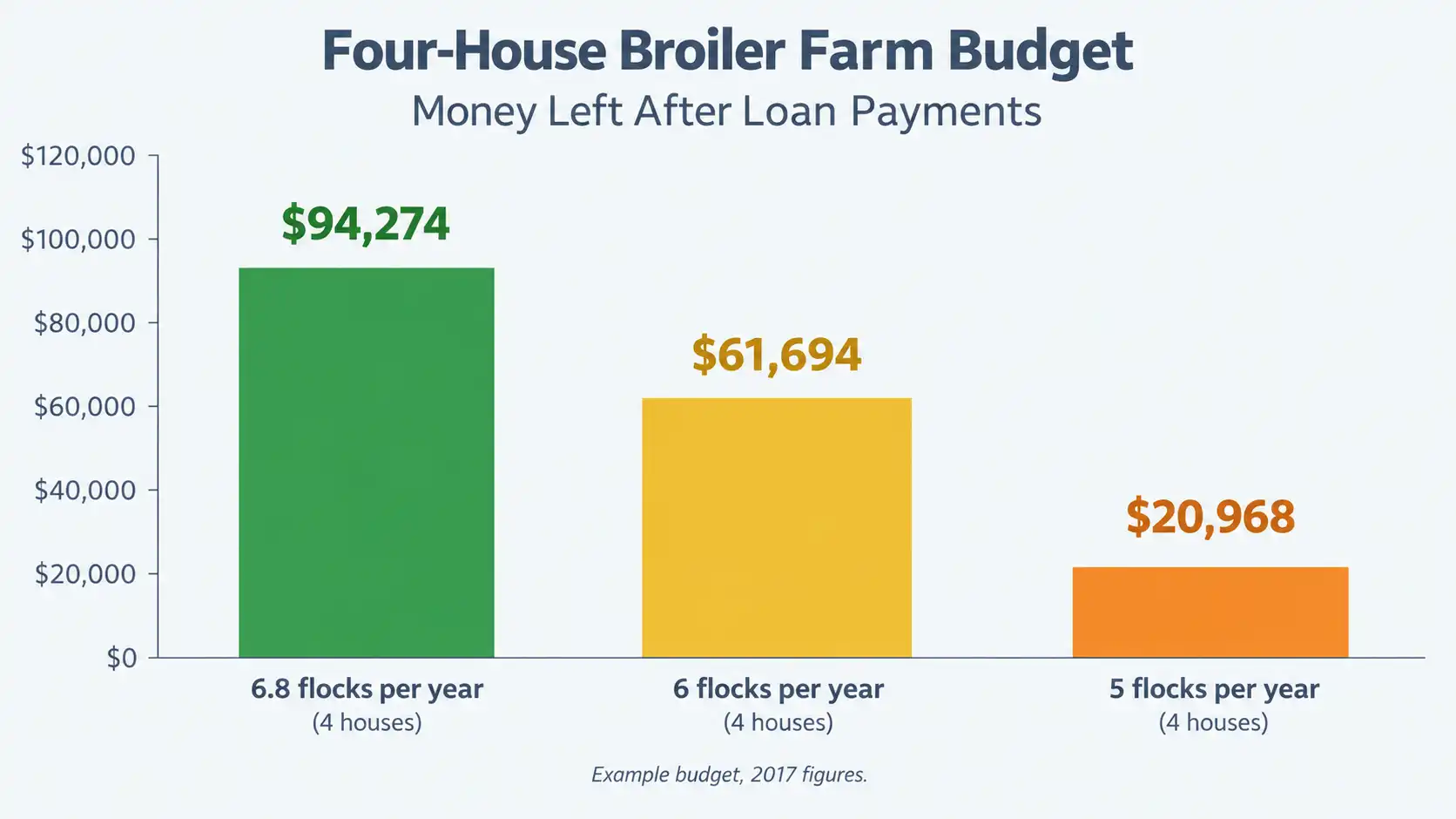
A 2017 budget from University of Maryland Extension shows how fast that cushion shrinks. It assumed four 36,000-square-foot houses of small broilers grown 35 to 40 days at 0.8 square feet per bird. Pay was $0.33 per square foot per flock, with a 15-year loan at 5.5 percent. The first column below is that budget. The other two rerun it with fewer flocks, using the same per-flock costs.
| Line item | 6.8 flocks (UMD budget) | 6 flocks | 5 flocks |
|---|---|---|---|
| Grower pay | $323,136 | $285,120 | $237,600 |
| Electricity and cleanout (per flock) | $46,200 | $40,764 | $33,970 |
| Other cash costs | $27,400 | $27,400 | $27,400 |
| Litter sales (held level) | $4,320 | $4,320 | $4,320 |
| Loan payments | $159,582 | $159,582 | $159,582 |
| Left after loan payments | $94,274 | $61,694 | $20,968 |
Losing 1.8 flocks a year cuts the cushion by more than three quarters. And that cushion must also pay you, because the budget leaves out the owner’s labor.
These are 2017 figures, and both build costs and pay rates have changed since. So treat the table as a method, not a forecast. Swap in your builder’s bids, your loan rate, the contract’s minimum flocks, and the bottom two quintiles from the Disclosure Document.
Who to Show the Contract To
Show the contract and Disclosure Document to an agricultural attorney, your lender, and an accountant before signing. Federal rules protect your right to do so, even when the contract has a confidentiality clause.
That right covers federal and state agencies, financial advisors and lenders, legal advisors, accountants, other growers for the same company, and your immediate family or business associates. The company must also help you find translation help if you need it.
Talk to current growers at the same complex, too. Ask how often flocks ran below the contract minimum, how long layouts between flocks lasted, and when the last upgrade demand came. Then call the extension office named in the Disclosure Document, which must list one for local grower cost data.
Before building, also check county permits and setbacks, since a house you cannot permit makes the contract moot.
If you believe a company has broken these rules, AMS takes complaints at farmerfairness.gov or 1-833-342-5773. This guide explains the rules in general terms. Only an attorney can read your actual contract against them.
Red Flags in a Grower Contract
Most contract problems show up on paper before the first flock arrives. Watch for these:
| Red flag | Why it matters |
|---|---|
| Minimum flocks written as “approximately” or “anticipated” | AMS says the minimums cannot be estimates |
| Contract term shorter than your loan | You carry debt with no guaranteed income |
| Disclosure Document handed over at signing | You lose the review window the rule requires |
| “No policy exists” for feed outages or sick flocks | You have no stated basis for an appeal |
| Local complex turnover above the company average | Growers there leave more often |
| Upgrade clause with no pay or flock change | New debt without new income |
| No arbitration opt-out on the signature page | Federal law requires that choice |
| Sale-of-farm policy with no stated criteria | Selling the farm may stall |
Raise each one in writing before you sign. University of Maryland Extension advises getting firm written answers about the company’s role and expectations first, because a written answer is something you, your lender, and your attorney can rely on.
FAQs about Broiler Grower Contracts
How long do I have to review a broiler contract?
You get at least 14 calendar days before the company signs a renewal or a contract on existing houses. You may waive up to 7 days, and contracts requiring new houses come with the documents alongside the housing specifications.
Can I cancel a poultry contract after signing?
Yes, within three business days after signing, unless the contract allows a later date. After that, the contract’s termination terms apply, and federal rules require at least 90 days’ written notice before the company ends or declines to renew it.
Do I have to accept arbitration in a broiler contract?
No: federal law lets you decline an arbitration clause, and the contract must explain the process, its costs, and any limits on your remedies. Choosing arbitration usually means giving up a court case and a jury trial.
How much do contract broiler growers earn?
Earnings vary more than most farm incomes. USDA ERS put the 2020 median household income for contract broiler growers, including off-farm income, at $106,694, with a $170,871 gap between the 20th and 80th percentiles.
Can a poultry company make me upgrade my chicken houses?
Yes, if the contract says it may require additional capital investments. USDA AMS judges upgrades of $12,500 or more per house against tests such as whether all similar growers must make them and whether you can recoup the cost.
What happens to my contract if I sell the farm?
A buyer usually needs the company to offer a new contract, and banks commonly require one before financing the sale. The Disclosure Document must explain the company’s sale and assignment policy, so read it before you build.
Is the Live Poultry Dealer Disclosure Document still required in 2026?
Yes, as of October 2026 the 2024 rule remains in effect. USDA has listed a proposal to rescind it, so ask for the same figures in writing even if the requirement ends.
What to Check Before You Sign
Get the contract and Disclosure Document early, and use the full review window. Build the budget on the contract’s minimum flocks and the bottom two pay quintiles. Then match the contract term to your loan, and get upgrade, termination, and sale-of-farm terms in writing.
Finally, have an attorney and your lender read the whole packet before you commit to a house loan. If two companies operate near you, compare their turnover and pay tables side by side.