Organic Poultry Certification: Rules, Costs, and Timeline
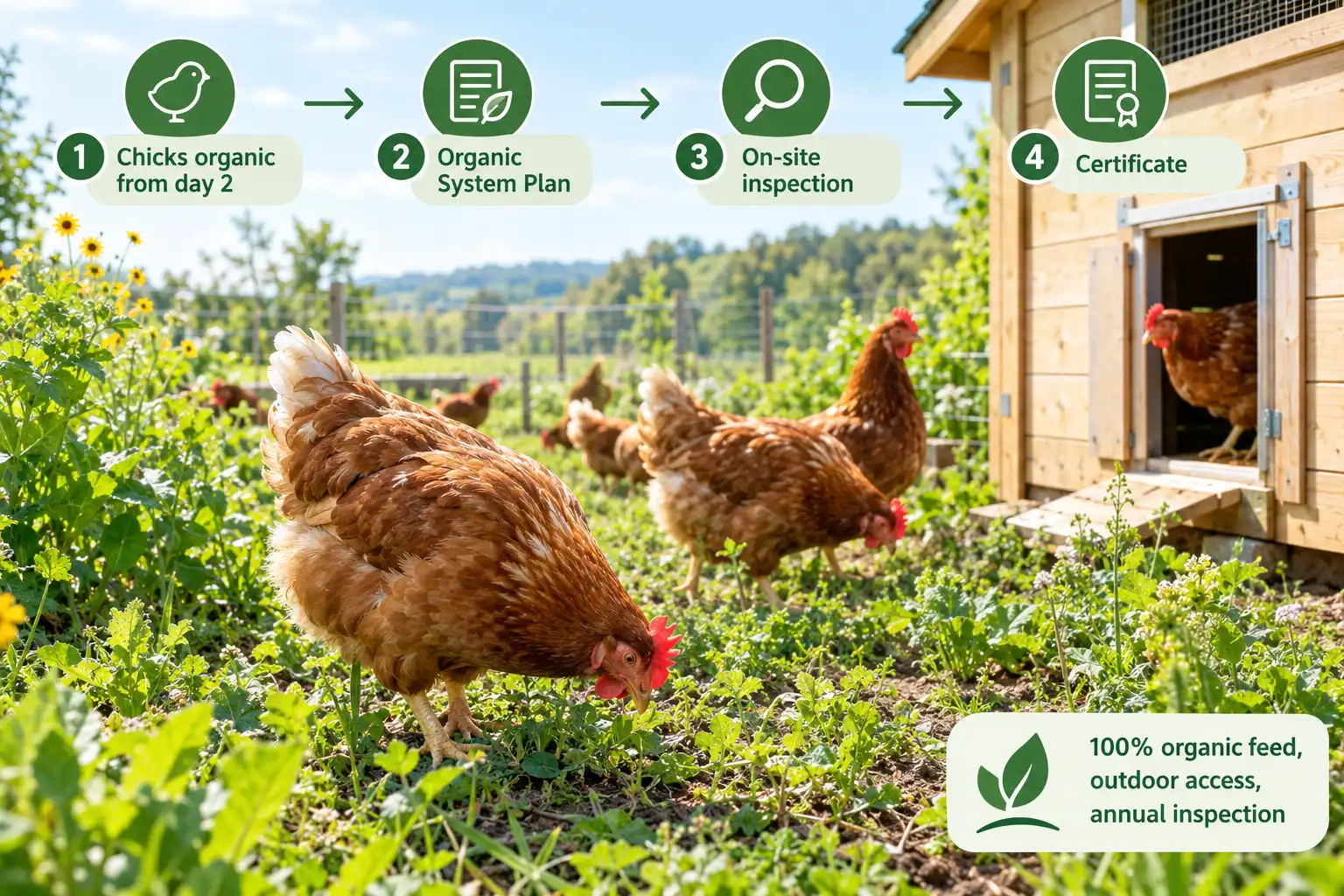
Organic poultry certification lets a farm sell eggs or meat as USDA organic. In return, the farm follows federal rules on chick sourcing, feed, and bird health. It also meets set space limits for every flock, indoors and out.
Organic poultry certification requires chicks raised organically from day 2, all-organic feed, no antibiotics, and outdoor access. Expect about 90 to 120 days from application to certificate, and fees from a few hundred to several thousand dollars yearly.
Who Needs Organic Certification
Any farm selling more than $5,000 a year in organic products must be certified before it calls those products organic. Under 7 CFR Part 205, the federal organic regulations, a USDA-accredited certifier issues the certificate, not USDA itself.
The $5,000 exemption for small flocks
Farms with $5,000 or less in yearly organic sales are exempt from certification, per 7 CFR 205.101 and 205.310. The exemption is narrower than it sounds, though. An exempt farm still follows every organic production rule and keeps records for at least 3 years. It also can’t use the USDA organic seal, call its eggs “certified organic,” or sell them as organic ingredients for someone else’s product.
So the exemption suits a farm stand. It does not suit a farm that wants grocery, restaurant, or wholesale buyers.
What gets certified
Certifiers work by scope. Your laying hens or broilers fall under the livestock scope. Growing your own feed adds a crop scope, and on-farm processing may add a handling scope. Ask your certifier which scopes your plan needs, because cost share later pays per scope.
The rules below shape every other choice in running an organic flock, from the brooder to the processing date.
Where Organic Birds Must Come From
Organic layers, pullets, and broilers must be under organic management from their second day of life, under 7 CFR 205.236. For most farms, that means starting with day-old chicks. A conventional hatchery works, as long as the chicks get organic feed and organic care by day 2.
That rule closes a common shortcut. You can’t buy conventional started pullets or laying hens and convert them, because they missed organic management from day 2. Older birds qualify only when they come from a certified organic operation with a current certificate. So if you plan to buy pullets, find a certified organic pullet grower first.
Keep the hatchery invoice and delivery receipt for every batch, since they show the birds arrived as day-old chicks. When ordering day-old chicks, ask the hatchery to list the hatch date on the invoice.
Feed and Health Care Rules
Organic laying hens, pullets, and broilers eat a 100 percent organic ration. Under 7 CFR 205.237, every agricultural ingredient must be certified organic, pasture and forage included. Synthetic vitamins and minerals are allowed only when they appear on the National List of allowed substances.
That rules out medicated chick starter. Its anticoccidial drugs aren’t on the National List, and the feed rules ban ionophores by name. Ask your hatchery or poultry veterinarian how to control coccidiosis within organic rules, including whether a coccidiosis vaccine fits your flock.
Health care starts with prevention, and vaccines are among the allowed preventive practices. Antibiotics are another matter. A bird treated with antibiotics loses organic status permanently. Even so, 7 CFR 205.238 forbids withholding treatment to protect that status. So treat the bird, mark it, record it, and keep its eggs or meat out of organic sales.
Some practices are banned outright. University of Minnesota Extension lists debeaking, dubbing, caponizing, and beak trimming after 10 days of age as prohibited, along with induced molting.
Sudden deaths, birds that stop eating, or a sharp drop in egg production need a same-day call to your poultry veterinarian. Avian influenza must be reported, so call your state veterinarian or USDA at 1-866-536-7593, and keep your farm biosecurity plan current.
Housing and Outdoor Space Rules
The Organic Livestock and Poultry Standards (OLPS) set firm space, air, and light rules in 7 CFR 205.241. Each space limit comes two ways, by pounds of bird per square foot or by square feet per bird, and meeting either one complies.
Space limits by bird type
| Bird type and housing | Indoor maximum | Outdoor minimum |
|---|---|---|
| Laying hens, floor litter house | 3.0 lb of bird per sq ft, or 2.2 sq ft per hen | 1 sq ft per 2.25 lb, or 3.0 sq ft per hen |
| Laying hens, mobile or aviary house | 4.5 lb per sq ft, or 1.5 sq ft per hen | 1 sq ft per 2.25 lb, or 3.0 sq ft per hen |
| Laying hens, slatted or mesh floor | 3.75 lb per sq ft, or 1.8 sq ft per hen | 1 sq ft per 2.25 lb, or 3.0 sq ft per hen |
| Laying hens, other housing | 2.25 lb per sq ft, or 3.0 sq ft per hen | 1 sq ft per 2.25 lb, or 3.0 sq ft per hen |
| Pullets | 3.0 lb per sq ft, or 1.7 sq ft per pullet | 1 sq ft per 3.0 lb, or 1.7 sq ft per pullet |
| Broilers | 5.0 lb per sq ft, or 2.0 sq ft per broiler | 1 sq ft per 5.0 lb, or 2.0 sq ft per broiler |
Source: 7 CFR 205.241
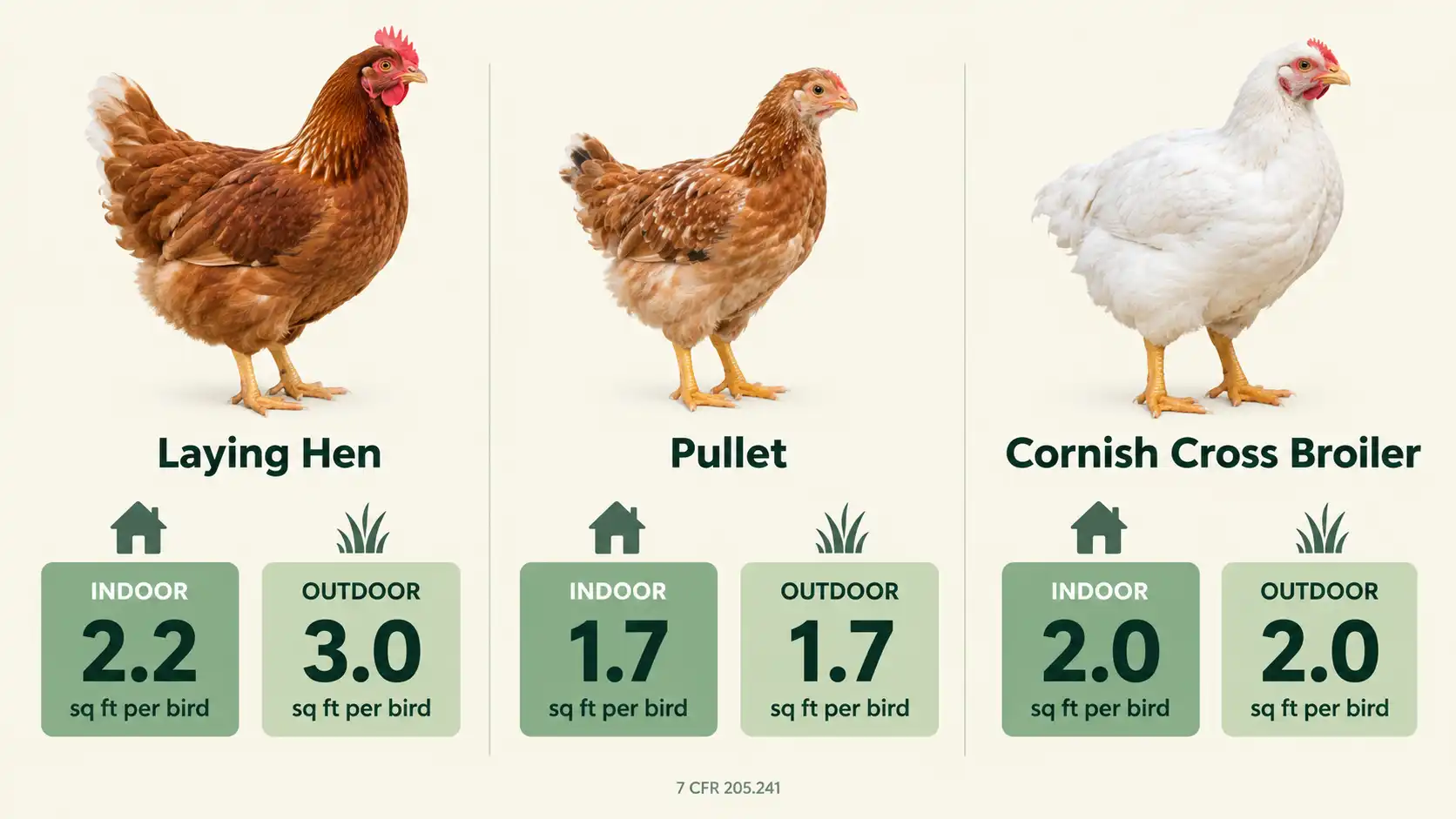
Indoor space counts flat areas the birds can use, not nest boxes. An enclosed porch counts as indoor space only if the birds can always reach it, and it never counts as outdoor space.
A new applicant must meet every limit from the start. University of Minnesota Extension notes that poultry farms certified before January 2025 have until January 2029 for broiler space, layer outdoor space, and exit rules. That grace period doesn’t cover a farm certifying in 2026. In May 2026, USDA said it was reviewing the rule and had made no decision. As of October 2026, no change has been announced, and any change would normally need new rulemaking. So plan to the current text.
Space math for a 500-hen flock
Take 500 laying hens in a floor litter house:
- Indoor floor: 500 hens x 2.2 sq ft = 1,100 sq ft of usable floor, nest boxes excluded.
- Outdoor area: 500 hens x 3.0 sq ft = 1,500 sq ft, with at least 75 percent soil (1,125 sq ft) under vegetation.
- Exits: 500 hens / 360 = about 1.4 linear ft of exit width, roughly 17 inches, spread so every hen can reach one.
- Perches: 500 hens x 6 inches = 3,000 inches, or 250 linear ft of perch.
The weight method can need less outdoor room for lighter hens. If your own hens average 4 lb (weigh a sample to find your number), 2,000 lb / 2.25 = about 889 sq ft. For 300 broilers, the per-bird figure gives 600 sq ft indoors and 600 sq ft outdoors. Size broiler space by weight only if the house still complies at the flock’s heaviest, just before processing.
Exits, perches, ammonia, and light
- Exits: Houses for laying hens, pullets, or broilers need at least 1 linear foot of exit per 360 birds, and never less than 1 foot. A certifier can approve less only when your plan proves every bird can reach the outdoors.
- Perches: Each laying hen gets 6 inches of perch, and all hens must be able to perch at once. In aviary housing, 55 percent must.
- Litter: Keep litter dry, with room to scratch and dust bathe. Fixed houses with slatted floors need at least 15 percent solid floor with litter.
- Ammonia: In any organic layer, pullet, or broiler house, measure ammonia at least weekly at bird head height. Above 20 ppm, add practices and monitoring. It must never exceed 25 ppm.
- Light: Laying hens may get up to 16 hours of continuous light a day, which leaves at least 8 hours of darkness. Dim the lights gradually at night.
- Outdoor area: Train young birds to go out early, provide shade, and keep at least 75 percent of the area as vegetated soil.
The outdoor area and vegetation rules take planning before the first flock arrives, because fencing and plantings come before the birds.
When birds may be kept inside
Continuous total confinement is prohibited. Still, temporary confinement is allowed when you record the dates and the reason. Under 7 CFR 205.241, laying hens, pullets, and broilers may be kept in for:
- Inclement weather, including air temperatures under 32°F or above 90°F
- Age: broilers in their first 4 weeks, and pullets in their first 16 weeks
- Risks to bird health, safety, or well-being
- Risks to soil or water quality
- Preventive health care, or treatment of illness or injury
- Sorting, shipping, or sale
- Nest box training, up to 5 weeks over a hen’s life
- Youth projects such as 4-H and FFA, from up to 1 week before a fair
The health and safety reason covers disease risk. So if you house birds during an avian influenza outbreak, record the dates and the reason for your inspector.
How to Get Certified, Step by Step
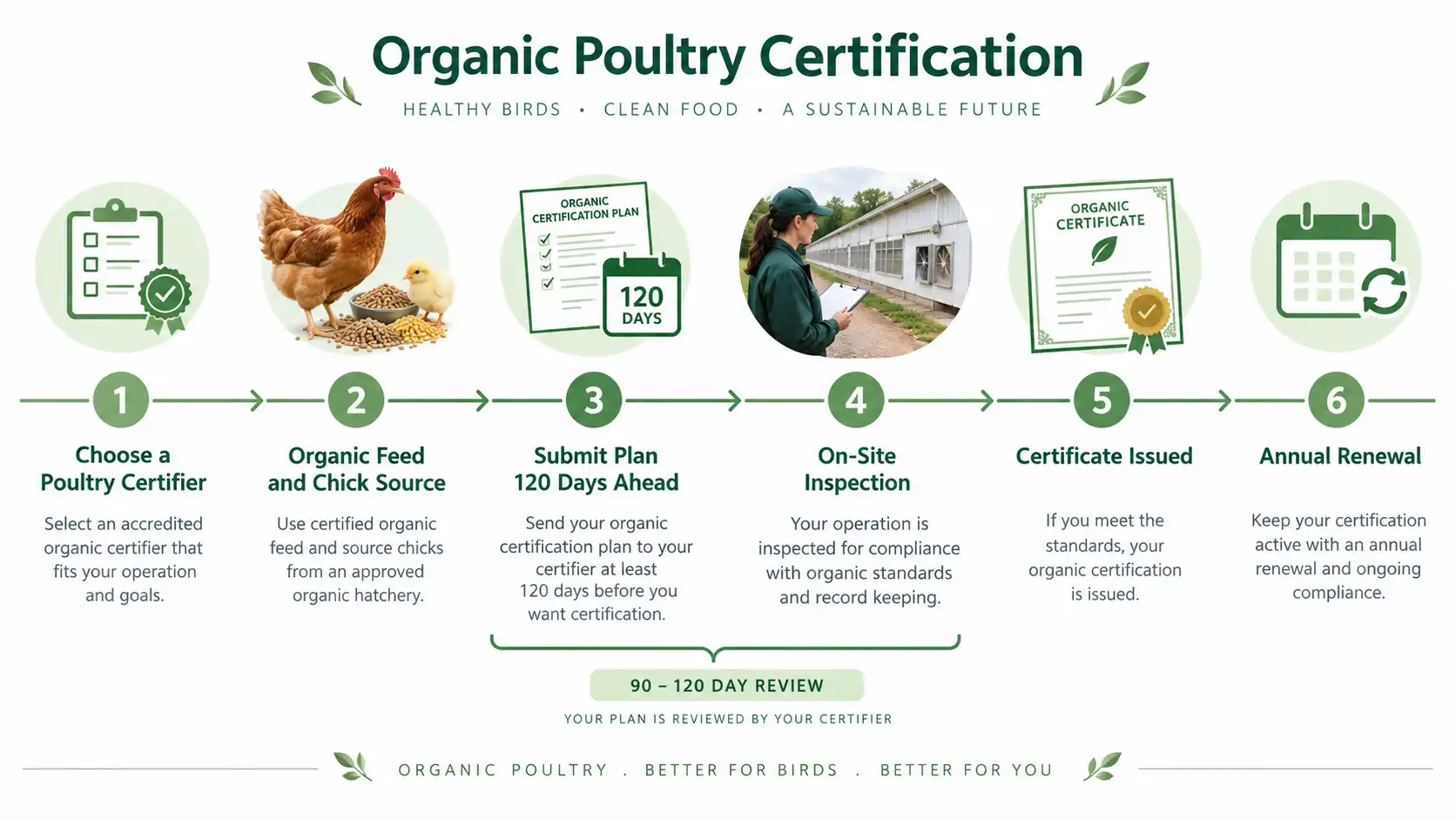
USDA AMS lays out five basic steps to certification. For a poultry farm, they run like this, with one more step at the end.
- Find a certifier that takes poultry. Not every certifier accepts livestock. The Texas Department of Agriculture, for one, isn’t taking new organic livestock applications. Search USDA’s list of accredited certifiers, then ask each one for its fee schedule and billing cycle, as USDA AMS advises.
- Write your Organic System Plan (OSP). The OSP covers chick sources, feed suppliers and rations, health practices, housing, an outdoor area map, records, and any processing. Every gap in it brings a follow-up question, so complete it fully.
- Submit the plan and fees. The certifier reviews your plan against the organic rules before it schedules a visit.
- Host the on-site inspection. An inspector checks the houses, outdoor areas, feed, and records against your plan.
- Receive the decision. The certifier reviews the plan and inspection report, then issues the certificate. Only then can you sell or label anything as organic.
- Renew every year. Certified farms go through an annual review and inspection. Keep records for at least 5 years, as 7 CFR 205.103 requires.
One land rule needs early attention. Land that grows organic crops, feed included, must be free of prohibited substances for 36 months, per USDA AMS. Ask your certifier whether your outdoor area needs that same history before you fence it.
How Long Certification Takes
Plan on about 90 to 120 days from a complete application to a certificate. The Texas Department of Agriculture gives new applicants that window, counted from receipt of fees and documents. Gaps in your paperwork add time, so submit a complete file.
Your first flock can arrive before the certificate, as long as it gets organic management from day 2 and you keep the records. However, you can’t sell its eggs or meat as organic until the certificate arrives. So work backward from your first planned sale:
| When | Step | Why it matters |
|---|---|---|
| 6 months before first sale | Choose a certifier that takes poultry, and request forms and fees | Livestock scopes and fees vary by certifier |
| Before the chicks arrive | Line up organic feed and a chick source, then draft the OSP | Organic management must start by day 2 |
| At least 120 days before first sale | Submit the complete application and fees | Review takes about 90 to 120 days |
| After the plan review | On-site inspection | The inspector checks houses, outdoor areas, and records |
| Before the first sale | Certificate issued | Nothing sells as organic before this date |
| Every year after | Renewal and inspection | Certification requires an annual review |
What Organic Certification Costs in 2026
USDA AMS puts certification costs at a few hundred to several thousand dollars a year. The total depends on the certifier and on the farm’s size, type, and complexity. Most bills combine an application fee, an annual renewal fee, an assessment on production or sales, and inspection fees.
Public fee schedules show how that works. The Washington State Department of Agriculture sets its fees in state rule, in effect since January 2024:
| Washington fee | Amount |
|---|---|
| New application | $500 |
| Livestock producer inspection | $500 per inspection |
| Renewal, up to $25,000 in organic sales | $250 |
| Renewal, $25,001 to $50,000 | $380 |
| Renewal, $50,001 to $75,000 | $570 |
| Renewal, $75,001 to $100,000 | $760 |
| Late renewal | $100 to $600, rising each month |
Treat this as a benchmark, not a quote. Private certifiers set their own fees, so compare schedules before you apply.
Certification fees are only part of the bill, though. Organic feed, outdoor fencing, and house changes add to it, and cost share doesn’t cover equipment, materials, or supplies. Get quotes early when sourcing certified organic feed, because the ration runs every day of the flock’s life.
Getting Up to 75 Percent Back Through Cost Share
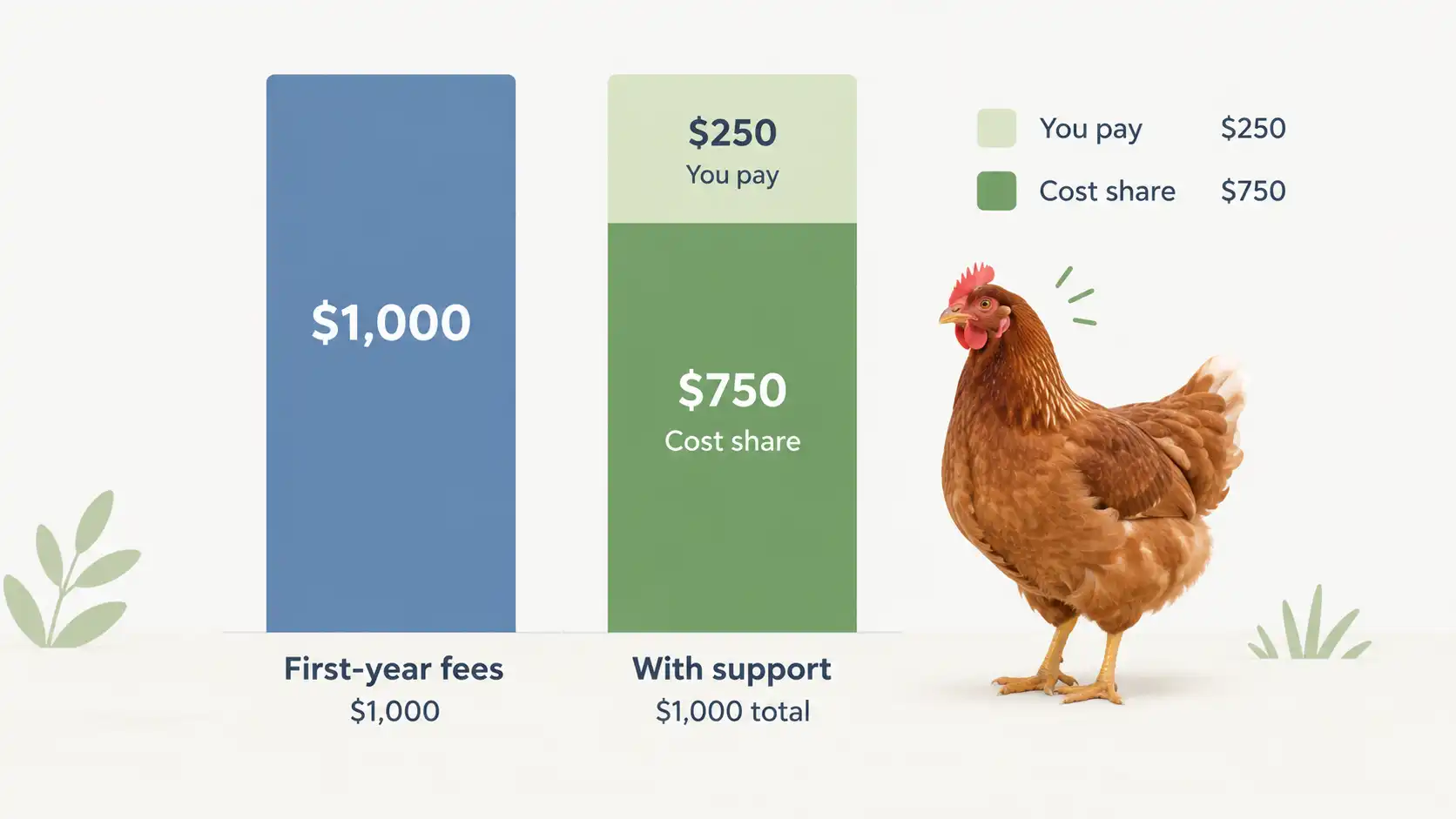
The Organic Certification Cost Share Program (OCCSP), run by USDA FSA, reimburses up to 75 percent of certification costs. It caps payments at $750 per scope each program year. Scopes include crops, livestock, wild crops, handling, and state organic program fees.
According to FSA’s June 2026 fact sheet, the 2025 program year covers fees paid from October 1, 2024, through September 30, 2025. The 2026 year covers October 1, 2025, through September 30, 2026. Applications for both are due December 31, 2026, and funds go first come, first served.
Eligible costs include application fees, inspection costs, inspector travel, user fees, sales assessments, and postage. Late fees, transitional certification fees, and equipment don’t qualify. Apply at your FSA county office or a participating state agency, with your certificate and an itemized invoice.
Here is the math using the Washington benchmark:
| Year 1 | Year 2, up to $25,000 sales | Year 2, $50,001 to $75,000 sales | |
|---|---|---|---|
| Fees paid | $1,000 | $750 | $1,070 |
| 75 percent of fees | $750 | $562.50 | $802.50 |
| Reimbursed ($750 cap) | $750 | $562.50 | $750 |
| Your net cost | $250 | $187.50 | $320 |
Cost share pays only after you’re certified and have paid, so budget the full fees up front.
Selling Organic Eggs and Meat
Only certified products can carry the USDA organic seal or be sold as certified organic. The rules also follow the product off the farm. Under 7 CFR Part 205, any operation that handles organic products, slaughter and packing included, must be certified unless an exemption applies.
In practice, that means:
- Broilers: Send organic broilers to a processor certified for organic handling, or make sure your certified plan covers your own on-farm processing.
- Eggs: Pack organic eggs under your certified plan, with records that trace each case back to its flock.
- Labels: Show your certifier any organic label before you print it.
Organic rules add to food safety law. They never replace it. Federal poultry processing exemptions, USDA inspection, and state egg sale rules all still apply. So check with your certifier and your state department of agriculture before you plan on-farm processing or egg sales.
Why Applications Stall or Certification Is Lost
These are the failure points to watch:
- Conventional started pullets. Birds without organic management from day 2 never produce organic eggs.
- One wrong feed delivery. A bag of conventional or medicated feed breaks the 100 percent organic rule. Keep the tag and invoice for every load.
- Gaps in records. Missing chick invoices, feed receipts, health logs, or confinement logs leave the inspector nothing to verify.
- An outdoor area that doesn’t count. Enclosed porches never count, and soil with no vegetative cover suited to the season fails the outdoor rule.
- High ammonia. Readings over 25 ppm in a layer, pullet, or broiler house break the rule, and so do missing weekly readings.
- Treated birds left in organic sales. Treat sick birds, then mark them and pull their eggs or meat from organic sales.
- Confinement without a recorded reason. Every stretch indoors needs dates and a reason that fits the rule.
- A late renewal. Late fees add cost, and cost share won’t reimburse them.
Frequently Asked Questions
Can I convert my existing hens to organic?
No, organic eggs must come from hens managed organically since their second day of life, so adult hens or started pullets from a conventional farm never qualify. Start with day-old chicks or certified organic pullets.
How long does organic poultry certification take?
Plan on about 90 to 120 days from a complete application to a certificate, the window the Texas Department of Agriculture gives new applicants. Missing documents or slow replies to your certifier add time.
Do I need certification to sell a few organic eggs?
Not if your organic sales stay at $5,000 a year or less. You must still follow the organic rules and keep records for 3 years, but you can’t use the USDA organic seal.
Can organic chickens ever be kept indoors?
Yes, laying hens, pullets, and broilers may stay in for recorded reasons, such as air below 32°F or above 90°F, or disease risk. Continuous total confinement is prohibited, so outdoor access resumes once the reason ends.
Can I vaccinate organic chickens?
Yes, vaccines are among the preventive practices the organic rules allow. Ask your poultry veterinarian or hatchery which vaccines fit your flock, and list each one in your Organic System Plan.
What happens if an organic hen needs antibiotics?
Treat her, because withholding treatment to protect organic status is prohibited. She permanently loses organic status, so mark her, record the treatment, and keep her eggs out of organic sales.
Does organic certification need renewing every year?
Yes, certified farms go through an annual review and on-site inspection. Renewal fees often scale with organic sales, and cost share currently reimburses up to 75 percent of eligible fees, capped at $750 per scope.
Where to Start
Choose a certifier that takes poultry this month, and request its forms and fee schedule. Then work backward from your first planned sale: submit a complete plan at least 120 days ahead, and order chicks only once organic feed is lined up. If you already paid certification fees for 2025 or 2026, file for cost share before December 31, 2026.