
How Long Do Farm Fresh Eggs Last? Fridge, Counter, and Freezer Times
Farm fresh eggs start out fresher than store eggs, but storage decides how long that lead lasts. Here is how long farm fresh eggs last in the fridge, on the counter, and in the freezer, with the federal guidance behind each number.
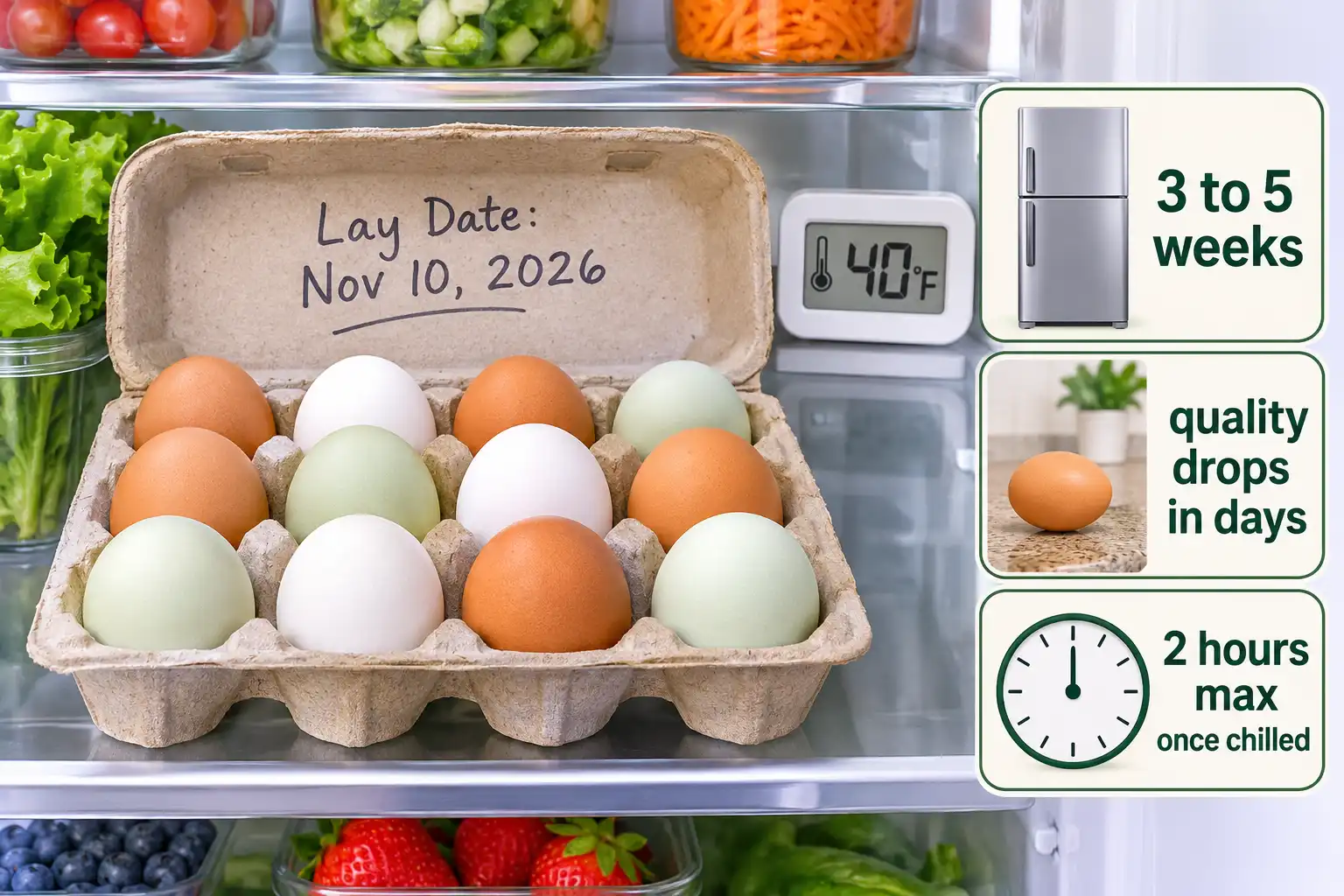
Farm fresh eggs last 3 to 5 weeks in a refrigerator at 40°F or below, per USDA FSIS, and often longer when chilled from the day of lay. At room temperature, egg quality drops within days.
How Long Do Farm Fresh Eggs Last in the Fridge?
Plan on 3 to 5 weeks. USDA FSIS gives that range for raw shell eggs kept in a home refrigerator at 40°F or below.
That window is conservative for eggs from your own laying hens. FSIS writes its advice around store eggs, and a store carton’s sell-by date can fall up to 30 days after packing. So a store egg may be weeks old before it reaches your kitchen.
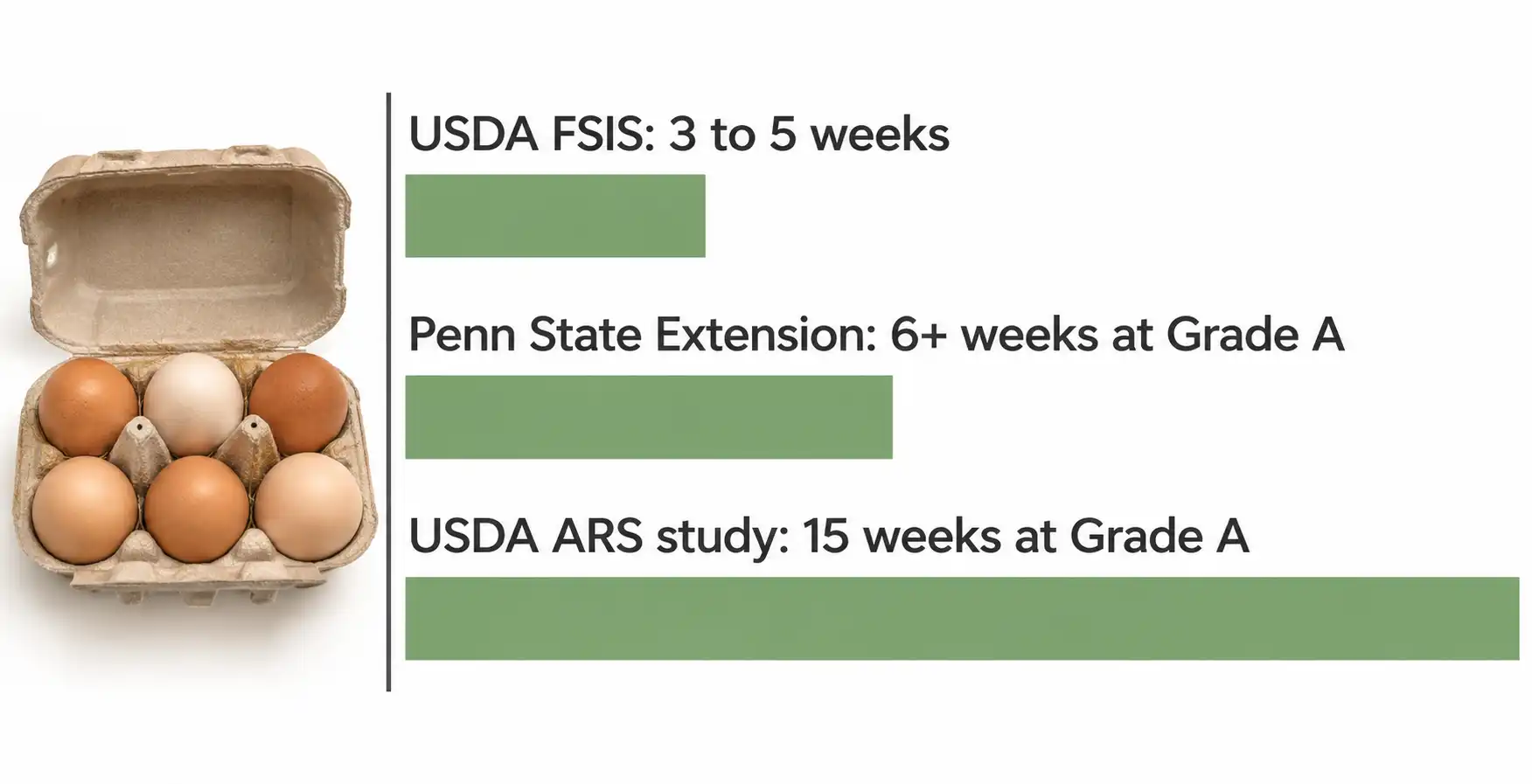
Eggs from a backyard flock skip that delay. Penn State Extension says small-flock eggs held in their carton in a 45°F cooler should stay Grade A for at least six weeks. Research from the USDA Agricultural Research Service went further. In a 2018 Poultry Science study of 5,400 eggs, refrigerated eggs were still Grade A after 15 weeks, washed or not.
Keep in mind that grade measures quality: a firm white, a rounded yolk, and a small air cell. It isn’t a safety guarantee. Still, a cold egg changes slowly, and that is the reason to refrigerate.
Know more: When Do Chickens Start Laying Eggs? Age, Daily Rate, and Laying Years
Why Do Sources Give Different Fridge Times?
Each source measured a different kind of egg under different conditions. Match the figure to your situation.
| Source | Fridge figure | Eggs it describes | What it measures |
|---|---|---|---|
| USDA FSIS | 3 to 5 weeks | Raw shell eggs in a home fridge at 40°F or below | Home use window, counted from purchase |
| Penn State Extension | Grade A for at least 6 weeks | Small-flock eggs in their carton at 45°F | Quality grade in a cooler |
| USDA ARS, Poultry Science (2018) | Grade A after 15 weeks | Commercial eggs held at 39°F from collection | Quality grade in a lab trial |
We don’t average these figures. Instead, use the FSIS window of 3 to 5 weeks for planning, and treat the longer figures as a margin. That margin helps when a carton ends up at the back of the shelf. But it isn’t a reason to stretch every carton to four months.
Do Fresh Eggs Need to Be Refrigerated?
Yes. In the United States, both USDA FSIS and the FDA tell consumers to keep eggs in a refrigerator at 40°F or below. The CDC gives backyard flock owners the same advice: refrigerate eggs after collection to keep them fresh and slow bacterial growth.
The concern is Salmonella. CDC notes that backyard poultry can carry it even when the birds look healthy, and eggshells can pick it up from droppings or the nest. Cold storage slows any bacteria present. It also slows the quality loss that starts the day a hen lays the egg.
Large egg farms have no choice. Under FDA’s Egg Safety Rule (21 CFR Part 118), producers with 3,000 or more laying hens must hold eggs at or below 45°F starting 36 hours after lay. Farms with fewer than 3,000 hens, or those selling every egg directly to consumers, fall outside that rule. State laws fill the gap, and USDA ARS describes them as a patchwork that varies by state.
For a home flock, the FDA standard makes a useful benchmark. So get each day’s eggs into the fridge the same day you collect them.
How Long Do Fresh Eggs Last Without Refrigeration?
No US agency publishes a safe countertop time for farm fresh eggs. USDA and FDA guidance assumes eggs stay cold, so research on room temperature storage is thin. The countertop times passed around online, often two or three weeks, don’t come from either agency.
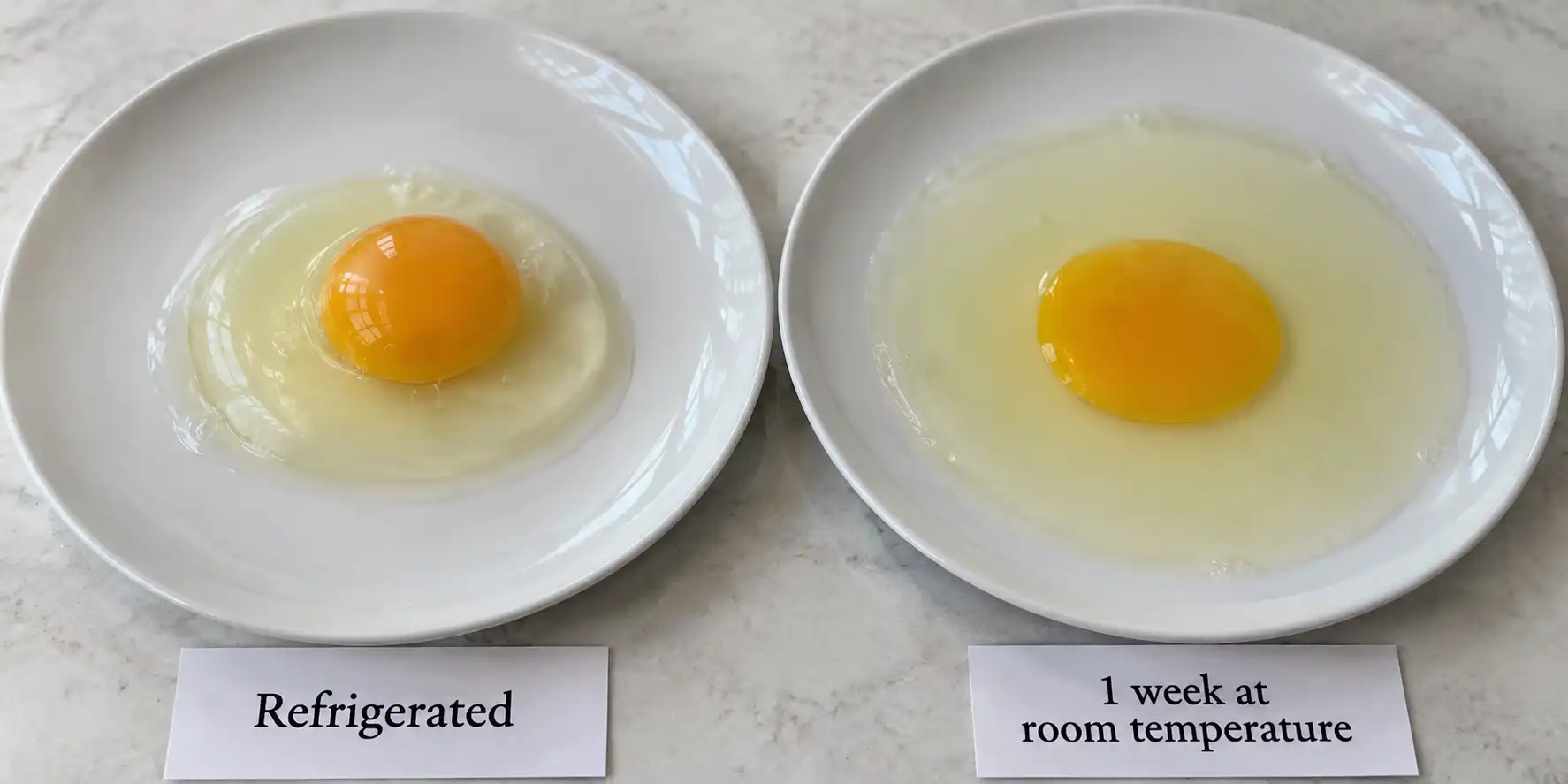
What the research does show is fast quality loss. In the USDA ARS study, unwashed eggs kept at 72°F dropped from Grade AA to nearly Grade B in one week. Less than 24 hours at that temperature changed yolk shape more than 15 weeks in the fridge did. Over the trial, those eggs also lost about 15 percent of their weight.
Penn State Extension reports the same pattern for small flocks. Eggs held at 65°F or warmer can drop as much as one grade per day.
You’ll see the loss when you crack the egg. The white runs thin, the yolk flattens and breaks easily, and the air cell grows. However, the ARS study measured quality, not illness, so it sets no safety limit either way. In short, an egg on the counter ages in days what a chilled egg ages in weeks.
How Long Can Fresh Eggs Sit Out?
Once an egg has been refrigerated, it can sit out no more than 2 hours. USDA FSIS sets that limit because a cold egg sweats at room temperature, and the moisture helps bacteria move into the egg.
Heat shortens the clock. FDA advises refrigerating eggs within 2 hours of purchase, or within 1 hour when it’s above 90°F outside. That matters for eggs carried home from a summer market or left on a picnic table.
Freshly laid eggs are a different case, since they start out warm from the hen. Penn State Extension recommends collecting at least twice a day, because most laying flocks lay the bulk of their eggs by 10 a.m. Then move the eggs to cold storage soon after.
| Egg situation | Limit | Source |
|---|---|---|
| Collected, never chilled | Refrigerate after collection | CDC |
| Chilled, at room temperature | 2 hours | USDA FSIS |
| Chilled, above 90°F | 1 hour | FDA |
Past those limits, the egg is outside federal guidance, so the cautious choice is to throw it out.
Does Washing Change How Long Eggs Last?
Washing removes the cuticle, also called the bloom, and that matters most at room temperature. The cuticle is a thin coating that covers the shell’s pores as the hen lays the egg. It’s the main reason most of the European Union sells eggs unwashed and unrefrigerated, per USDA ARS.
But the cuticle is a weak shield. ARS researchers note that it dries and wears off after laying. In their study, washing made no difference to quality once eggs went into the fridge. Washed and unwashed eggs at 39°F also lost weight at the same rate.
So the rule is about order, not about skipping the fridge:
- Leave clean eggs unwashed and refrigerate them as they are.
- Dry-clean light dirt with fine sandpaper, a brush, or a cloth, as CDC suggests.
- Never wash warm eggs in cold water. CDC warns that colder water can pull bacteria into the egg.
- If you must wet-wash, Penn State Extension calls for water at 90°F or higher and at least 20°F warmer than the egg, with an approved egg-cleaning compound used per its label. Never let eggs soak.
- Refrigerate washed eggs right away and keep them cold.
Commercial plants must wash and sanitize USDA-graded eggs, per USDA FSIS. That’s one more reason store eggs need to stay refrigerated.

How to Store Farm Fresh Eggs So They Last
Collect often, keep eggs cold, and use the oldest first. These steps put that into practice.
- Collect at least twice a day. Eggs left in the nest get dirty or crack, per CDC and Penn State Extension.
- Sort as you collect. CDC says to throw away cracked eggs. Penn State Extension takes a narrower view: an egg with a cracked shell but an intact membrane shouldn’t be sold, though it can be used if cooked right after collection. For a home kitchen, CDC’s rule is the simpler one. Penn State also says to discard every leaking egg.
- Dry-clean only what needs it. Clean eggs store best untouched.
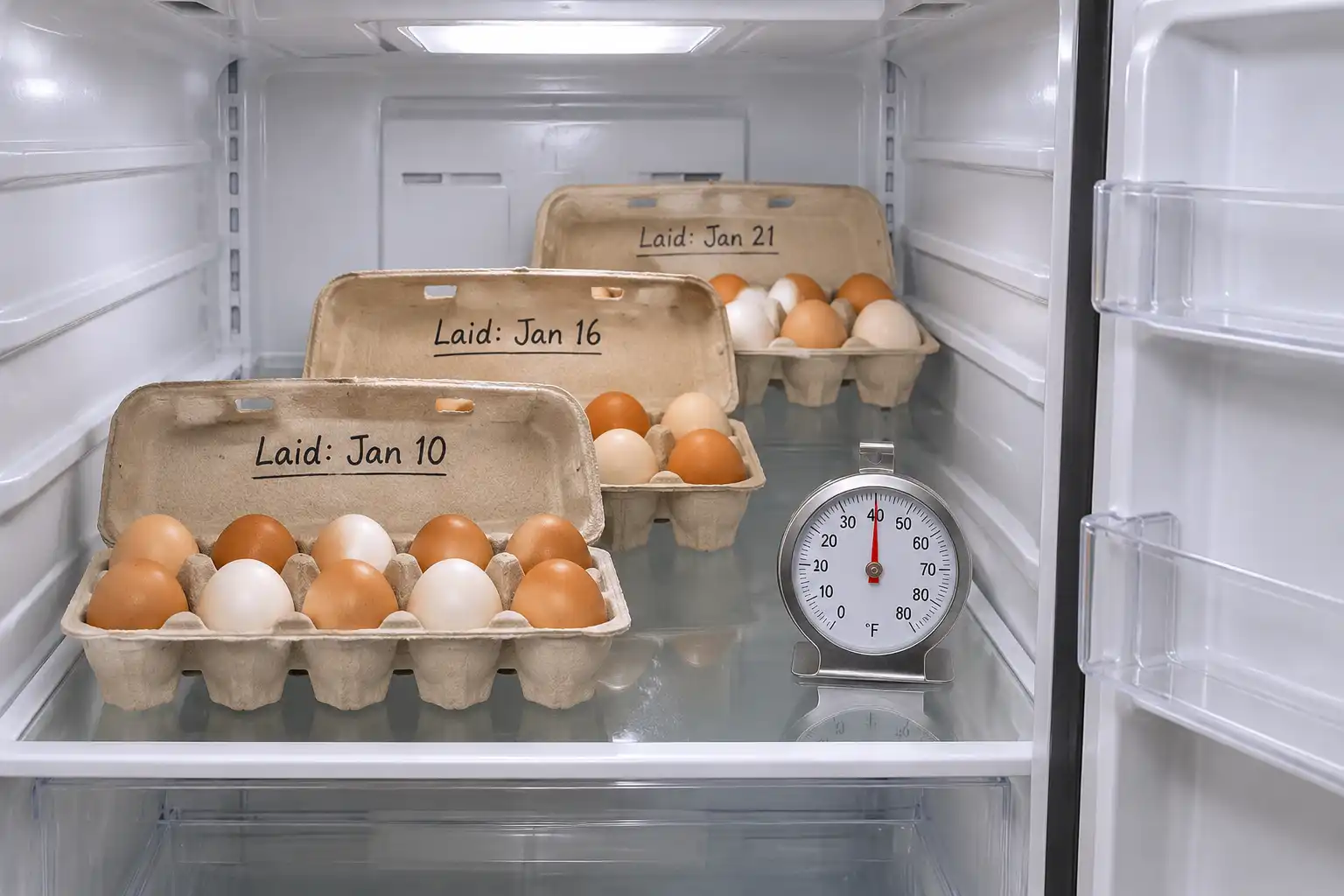
- Date every carton. Write the lay date on the lid, so you never have to guess an egg’s age.
- Store pointed end down. Penn State Extension recommends large end up, which keeps the air cell at the top.
- Use an inside shelf. FSIS says to keep eggs in their carton in the coldest part of the fridge, not the door. FDA suggests a refrigerator thermometer to confirm 40°F or below.
- Rotate. Move new cartons to the back and use the oldest first.
Clean nest boxes for laying hens cut down the cleaning in step 3. Our guide to collecting and cleaning eggs covers that routine in more detail, and our egg storage supplies page compares cartons and racks.
How Many Cartons Will Your Fridge Need to Hold?
Your peak carton count equals your weekly surplus times the weeks you keep each carton. Use your own numbers, because lay rates change with breed, age, season, and daylight.
- Weekly surplus (dozens) = eggs your hens lay per week ÷ 12, minus the dozens your household uses per week
- Cartons on hand at peak = weekly surplus × weeks you store each carton
For example, say your hens lay 48 eggs a week and your household uses 2 dozen. That’s 4 dozen laid, minus 2 used, for a surplus of 2 dozen a week. Then multiply by your storage window:
| Weeks each carton is stored | Cartons on hand at peak (2 dozen surplus a week) |
|---|---|
| 3 (FSIS low end) | 6 |
| 5 (FSIS high end) | 10 |
| 6 (Penn State Grade A figure) | 12 |
If the count tops what your fridge holds, you have three outlets: freeze eggs, give them away, or sell them. Selling brings in state licensing and labeling rules, so check our guide to rules for selling eggs first. A dedicated second fridge also works for a flock with a steady surplus.
How Can You Tell If a Fresh Egg Is Still Good?
Crack it into a separate bowl and smell it. USDA FSIS says a spoiled egg has an unpleasant odor, raw or cooked, and an unusual look is another warning sign. A separate bowl also keeps one bad egg out of the batter.
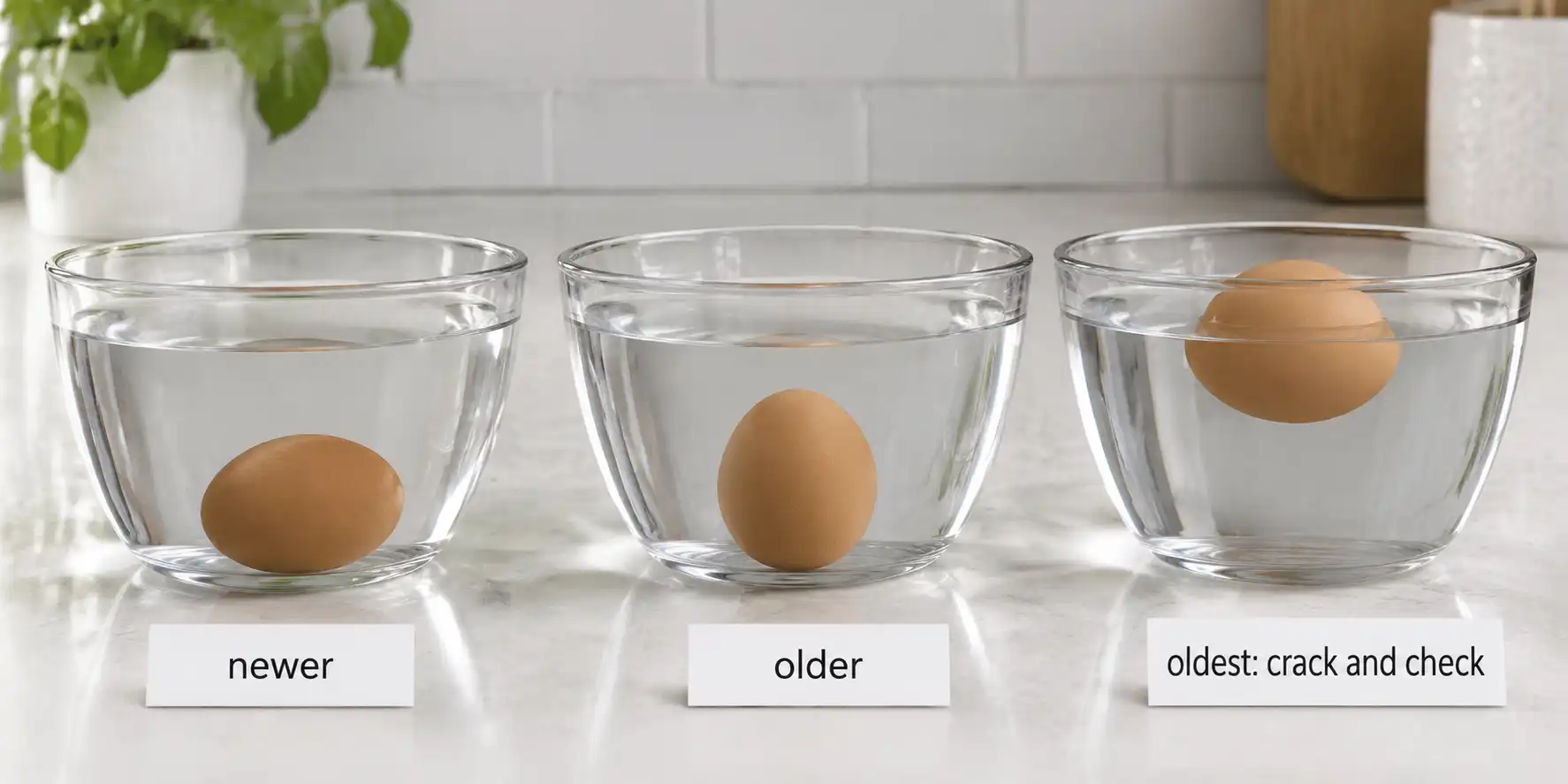
The float test tells you age, not safety. As an egg ages, moisture escapes through the shell and the air cell grows. FSIS notes that an egg can float once that air cell gets large enough. A floater is older and lower in quality, but FSIS says it may still be safe.
| In a bowl of water, the egg… | What it tells you |
|---|---|
| Rests on its side at the bottom | Small air cell, newer egg |
| Stands on its narrow end at the bottom | Larger air cell, older egg |
| Floats | Large air cell, oldest egg; crack and smell it before use |
Run the float test just before cooking, not before storage, because FSIS advises against getting eggs wet before you store them. Still, a dated carton tells you more than any water test.
Can You Freeze Farm Fresh Eggs?
Yes, but only out of the shell. USDA FSIS says not to freeze eggs in the shell, and to beat yolks and whites together before freezing whole eggs. Raw egg whites keep up to 12 months frozen, while yolks on their own don’t freeze well, per FSIS.
Freeze in small, labeled portions, so you thaw only what a recipe needs. Write the date and the number of eggs on each container.
Hard-cooked eggs have a shorter life than raw ones. FSIS says to refrigerate them within 2 hours of cooking and use them within one week, and FDA gives the same one-week limit. Don’t freeze them either, since FSIS advises against freezing hard-cooked eggs.
For any dish made with your eggs, FDA advises cooking it to 160°F, checked with a food thermometer.
When Should Farm Eggs Not Be Eaten?
Skip eggs from a sick flock, or from hens on medication, until a veterinarian or the product label clears them. Freshness doesn’t change that.
Hens on medication. Whether eggs can be eaten during or after treatment depends on the product. Not every drug is approved for laying hens, and the label or your poultry veterinarian sets any waiting period. We don’t publish those times.
A sudden drop in laying. USDA APHIS lists a drop in egg production, or soft-shelled and misshapen eggs, among the signs of avian influenza. Its list also includes sudden deaths, low energy and appetite, and swelling or purple color on the comb and wattles. Several other problems look similar, so only a veterinarian or a state diagnostic lab can confirm the cause.
If you see those signs, call your poultry veterinarian, your state veterinarian, or USDA at 1-866-536-7593 the same day. Avian influenza must be reported. Don’t move birds or eggs off the property while you wait, and see our avian influenza guide for flock owners for what happens next. This reflects APHIS guidance as of November 2026.
Eggs for sale. State rules cover licensing, grading, labeling, and cold storage for small sellers. Contact your state department of agriculture before the first sale.
Finally, protect the people who handle the eggs. CDC advises washing your hands with soap and water after collecting eggs or touching anything in the coop. Our page on Salmonella safety around backyard birds covers children and household routines.
FAQs About Farm Fresh Eggs Last
Do unwashed farm eggs last longer in the fridge?
Not by much, because cold storage matters far more than washing. In a USDA ARS study, washed and unwashed eggs held at 39°F stayed Grade A for 15 weeks and lost weight at the same rate.
Can I put farm eggs back in the fridge after leaving them out?
Yes, if they sat out less than 2 hours, or less than 1 hour above 90°F. Past that, the cautious choice is to discard them, because chilled eggs sweat as they warm and the moisture helps bacteria in.
Why are my fresh eggs watery when I crack them?
Warm storage is the usual cause. Penn State Extension says eggs held at 65°F or warmer can drop as much as one grade a day, so thin whites and flat yolks often mean eggs sat out too long.
Are eggs from my backyard hens safer than store eggs?
Not automatically. CDC notes that backyard poultry can carry Salmonella even when they look healthy, so home eggs need cold storage, clean handling, and full cooking, with egg dishes cooked to 160°F.
Can I keep farm eggs on the counter if I use them within a week?
You can, but no US agency endorses it, and you give up quality fast. In the USDA ARS study, unwashed eggs at 72°F fell from Grade AA to nearly Grade B within one week.
Should farm fresh eggs be stored pointed end down?
Yes, store them pointed end down in their carton. Penn State Extension recommends large end up for small-flock eggs, which keeps the air cell on top, in storage held at 40 to 45°F.
How long do hard-boiled farm eggs last?
Hard-cooked eggs last one week in the refrigerator, per USDA FSIS and FDA. Refrigerate them within 2 hours of cooking, and don’t freeze them, since FSIS advises against freezing hard-cooked eggs.
Do I need a license to sell my extra eggs?
Often, yes, but the rules come from your state. FDA’s Egg Safety Rule doesn’t cover farms under 3,000 hens, so your state department of agriculture sets licensing, labeling, and cold storage rules for small sellers.
Putting This Into Practice
Refrigerate farm fresh eggs the day you collect them, at 40°F or below, and keep them cold from then on. Date every carton and use the oldest first. Plan on the USDA FSIS window of 3 to 5 weeks, knowing that eggs chilled from the day of lay often hold quality longer. Treat the countertop as a short stop, not as storage.