
How to Start a Poultry Farm: A Step-by-Step Plan
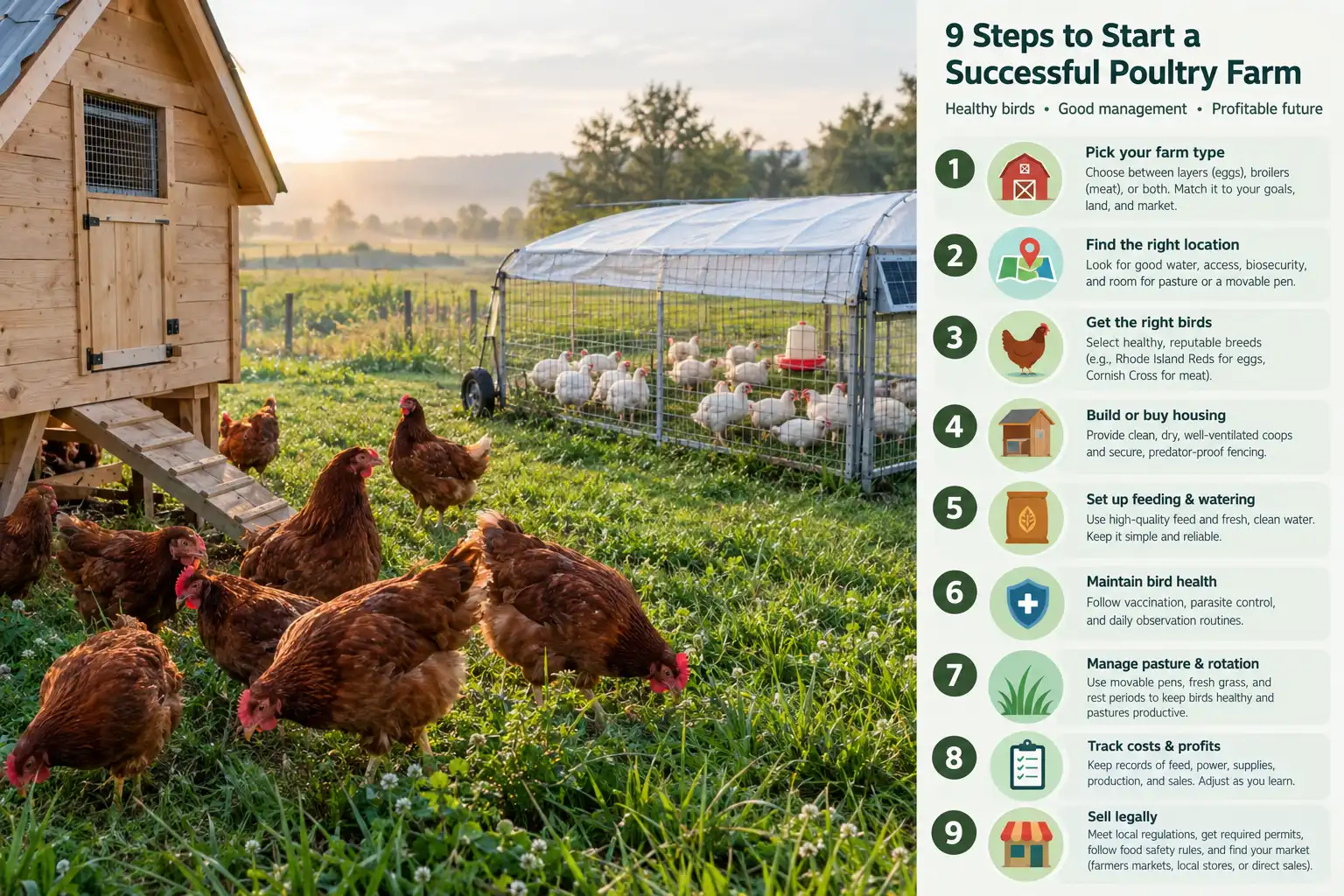
The decisions that shape a poultry farm come before the first chick arrives: what you’ll raise, who will buy it, and which rules apply. This plan shows how to start a poultry farm in nine steps, with the figures and federal rules for each.
To start a poultry farm, pick eggs, meat birds, or contract broilers, then check zoning and sales rules. Next, write a business plan, secure financing, build housing, set up biosecurity, buy NPIP chicks, and line up legal processing.
How to Start a Poultry Farm in 9 Steps
Work through the steps in order. Each answer shapes the next one, so a skipped step usually turns into rework.
Step 1: Choose Your Farm Type and Your Buyer
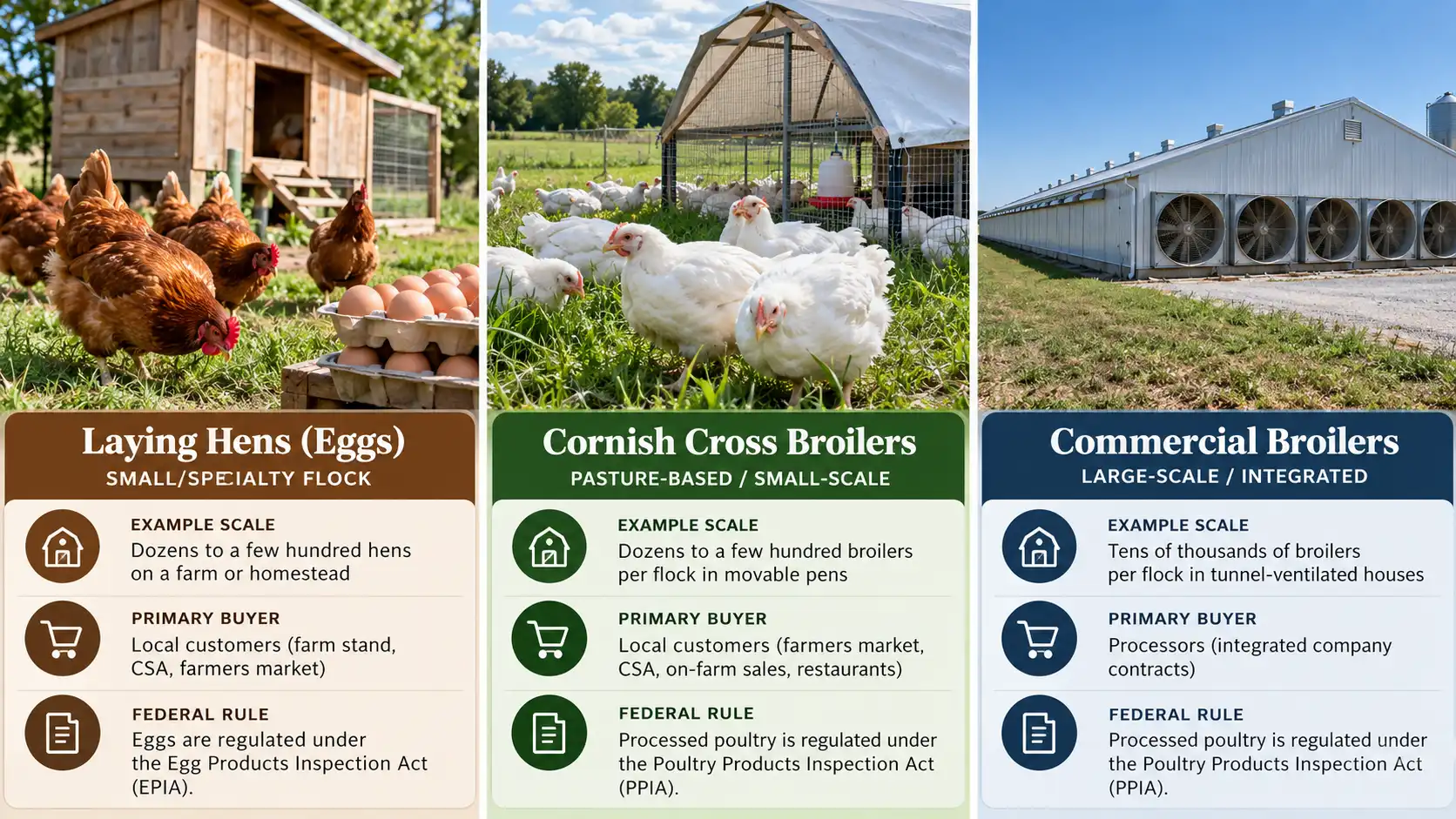
Most new US poultry farms follow one of three paths: a small egg farm, pasture-raised meat birds, or contract broiler growing. Each path has its own buyer, scale, and rulebook. So compare the types of chicken farms before anything else.
Contract growing dominates meat chicken production. Contract operations raised 97 percent of US broilers in USDA’s 2011 farm survey, per a USDA Economic Research Service report. That means anyone who wants to grow broilers at commercial scale starts by finding a company to grow for. Egg and pasture broiler farms, by contrast, usually sell direct to households, markets, stores, and restaurants.
| Farm type | Example start | Who buys | Federal rule to check |
|---|---|---|---|
| Small egg farm | 100 laying hens | Households, markets, stores | USDA registration above 3,000 laying hens that grade and pack |
| Pasture broiler farm | 100 Cornish Cross chicks per batch | Households, restaurants | FSIS 1,000 and 20,000 bird processing exemptions |
| Contract broiler farm | Broiler houses built to a company’s specifications | One poultry company (integrator) | AMS contract and disclosure rules |
Here’s a simple decision rule. If you have local buyers and modest capital, start with eggs or pasture broilers. If you want one buyer and can carry a large building loan, contract growing fits better.
Step 2: Check Zoning, Registration, and Sales Rules
Start with zoning and permit checks before you buy land, birds, or a coop. Zoning decides whether you can keep poultry at all, how many birds, and whether roosters are allowed. Your county planning office answers those questions. Your state department of agriculture, meanwhile, handles flock registration and the rules for selling eggs and meat.
University of Maryland Extension advises checking local, county, state, and federal zoning and environmental rules first. It also suggests calling your county extension office before you plan a flock. Many states require premises registration too. Maryland, for example, requires every poultry premises to register with its department of agriculture, per the same bulletin.
Get written answers to three questions before you spend money:
- How many birds, and which kinds, does zoning allow on this property?
- Does the state require flock or premises registration?
- What does the state require before you sell eggs or uninspected poultry meat?
Step 3: Write a Chicken Farming Business Plan
A chicken farming business plan answers four questions: what you’ll sell, to whom, at what price, and what it costs to produce. Keep it short, but put an actual number on every line.
Build the plan around five parts:
- Market: your buyers, your price per dozen or per pound, and how much they’ll take each week
- Production: bird numbers, batches per year, and output per week
- Costs: chicks, feed, processing, packaging, labor, and housing
- Cash flow: the months of spending before the first sale
- Rules: zoning, registration, processing exemption, and labels
Feed drives the budget. UMD Extension puts feed at about 70 percent of the cost of a small laying hen or broiler flock. So the core formula for an egg farm looks like this:
Cost per dozen = (feed + other costs for a period) ÷ dozens of eggs sold in that period
Also, line up buyers first. UMD Extension advises getting customers to commit, even with a deposit, before you raise meat birds.
Step 4: Price Your Startup Costs and Line Up Financing
Startup cost depends on the farm type. For a 100-hen laying flock, the UMD Extension small flock budget (posted in 2022) lists a $1,000 coop. It adds $500 for electric poultry netting and $100 for feeders and waterers. Its companion budget for 100 Cornish Cross broilers lists $500 for two pasture pens. Prices change, so get current quotes.
The bigger cost is the wait. A brown-egg pullet eats about 50 pounds of starter and grower feed from day-old to 18 weeks, per UMD Extension. For 100 pullets, that’s about 5,000 pounds of feed, or 100 fifty-pound bags, before the first egg.
Financing comes next. The Farm Service Agency’s October 2025 loan chart lists these USDA options:
- Direct operating loans up to $400,000, with terms of 1 to 7 years, for poultry, equipment, and feed
- Direct farm ownership loans up to $600,000, with terms up to 40 years, for land and buildings
- Microloans up to $50,000 each for operating costs or a farm purchase
- A down payment program for beginning farmers buying land
Limits can change with a new farm bill, so confirm them with your local FSA office. Then weigh FSA terms against other startup cost and financing options before you borrow.
Step 5: Size Housing and Equipment to Your Flock
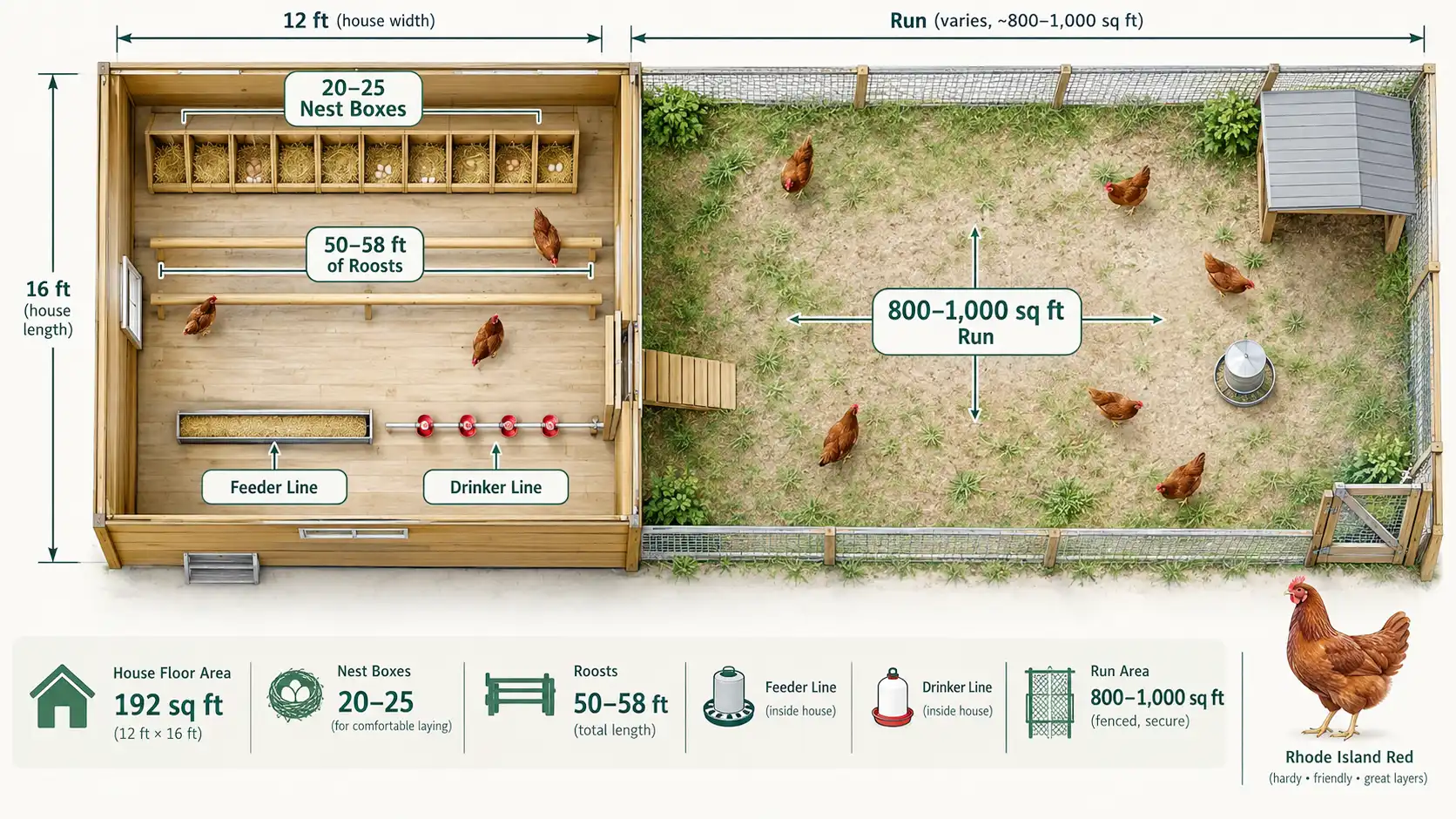
Size the house from the bird count, not the other way around. UMD Extension lists 1.5 square feet per laying hen inside the house and 8 in an outside run. For hens of large breeds, it raises those to 2 and 10 square feet. Treat these as minimums, not targets.
Here’s that math carried through for a 100-hen laying flock:
| Item | Per laying hen (UMD Extension) | For 100 laying hens |
|---|---|---|
| House floor | 1.5 to 2 sq ft | 150 to 200 sq ft |
| Outside run | 8 to 10 sq ft | 800 to 1,000 sq ft |
| Nest boxes, 12 by 12 inches | 1 per 4 to 5 hens | 20 to 25 boxes |
| Roost | 6 to 7 inches | 50 to 58 feet |
| Feeder space | 2 to 3 inches | 17 to 25 feet |
| Drinker space | 2 to 3 inches | 17 to 25 feet |
A 12 by 16 foot house gives 192 square feet, which fits 100 laying hens at these figures. Next, put the lights on a timer. UMD Extension says 14 hours of natural plus added light a day keeps laying hens producing all year. Finally, cover windows with half-inch hardware cloth, as UMD Extension advises, to keep out predators and rodents.
Step 6: Set Up Biosecurity Before the Birds Arrive
Biosecurity keeps disease off the farm, and fall and spring migration raise the stakes. USDA APHIS was still confirming highly pathogenic avian influenza (HPAI) in late October 2026. Cases hit commercial and backyard flocks in several states during fall migration.
UMD Extension’s biosecurity list starts with these habits:
- Buy healthy birds from a clean source
- Keep the flock confined in pens, pasture coops, or fencing
- Keep equipment from other flocks off your farm
- Hold new birds and birds back from shows apart for at least 3 weeks
- Wear clothes and boots that never leave the property
- Control rats, mice, and insects
Write these into a farm biosecurity plan before the chicks arrive.
Then learn the warning signs. USDA APHIS lists sudden deaths, birds that stop eating, and a drop in egg production. Soft or misshapen eggs and a swollen or purple comb and wattles are on its list too. Avian influenza must be reported, so call your state veterinarian or USDA at 1-866-536-7593 the same day. Don’t move birds off the farm while you wait. Many poultry diseases look alike, so only a veterinarian or a state diagnostic lab can confirm the cause.
Step 7: Buy NPIP Chicks and Brood Them Safely
Buy chicks from a hatchery in the National Poultry Improvement Plan (NPIP). USDA APHIS describes NPIP as a voluntary federal and state program that tests and certifies hatcheries, breeding flocks, and chicks. UMD Extension recommends NPIP sources too. Also ask whether the chicks are vaccinated for Marek’s disease, since UMD Extension notes most suppliers sell vaccinated birds.
Next, match the bird to the job. UMD Extension says commercial Leghorns and brown sex-link hens lay up to 260 eggs a year. Purebred hens lay about 150. For meat, it notes Cornish Cross broilers reach 4 to 5 pounds in about 6 weeks.
Day-old chicks need steady heat. UMD Extension starts day-old chicks at 90 to 95°F in the first week. Then it lowers the brooder 5°F a week until the chicks are 5 weeks old. A heat lamp that falls or hangs too close to bedding can start a fire. So hang each lamp at least 18 inches above the litter, as UMD Extension advises, and secure it with a chain. A heat plate is another option.
Step 8: Plan Feed and Production for Your Flock Size
Feed by age and purpose. UMD Extension puts layer pullets on starter to 6 weeks, grower to 18 weeks, then layer feed. Broiler chicks get starter for 3 weeks, then finisher. Never give layer feed to young birds, because UMD Extension warns its calcium can cause bone problems and kidney failure.
Now carry the numbers to your flock. UMD Extension’s laying hen budgets assume 4 to 4.5 pounds of feed per dozen eggs. Its 100-hen budget uses a 70 percent rate of lay. For 100 laying hens:
- Eggs: 100 hens x 70 percent = 70 eggs a day, about 41 dozen a week
- Feed: 41 dozen x 4 to 4.5 pounds = about 164 to 185 pounds a week
- Bags: about 3.3 to 3.7 fifty-pound bags a week, or 14 to 16 a month
Meat birds work the same way. UMD Extension’s 100-bird budget grows Cornish Cross broilers to 5 pounds dressed weight in 8 weeks. It uses 2.2 pounds of feed per dressed pound. With 10 percent losses, a 100-chick batch gives about 450 dressed pounds from roughly 990 pounds of feed. That’s about 20 bags. Its 25-bird budget uses 3 pounds of feed per dressed pound, so plan some margin.
Both 100-bird budgets allow about 30 minutes of chores a day. Still, UMD Extension notes that small flock results vary widely, so treat these as starting estimates.
Step 9: Line Up Processing and Legal Sales
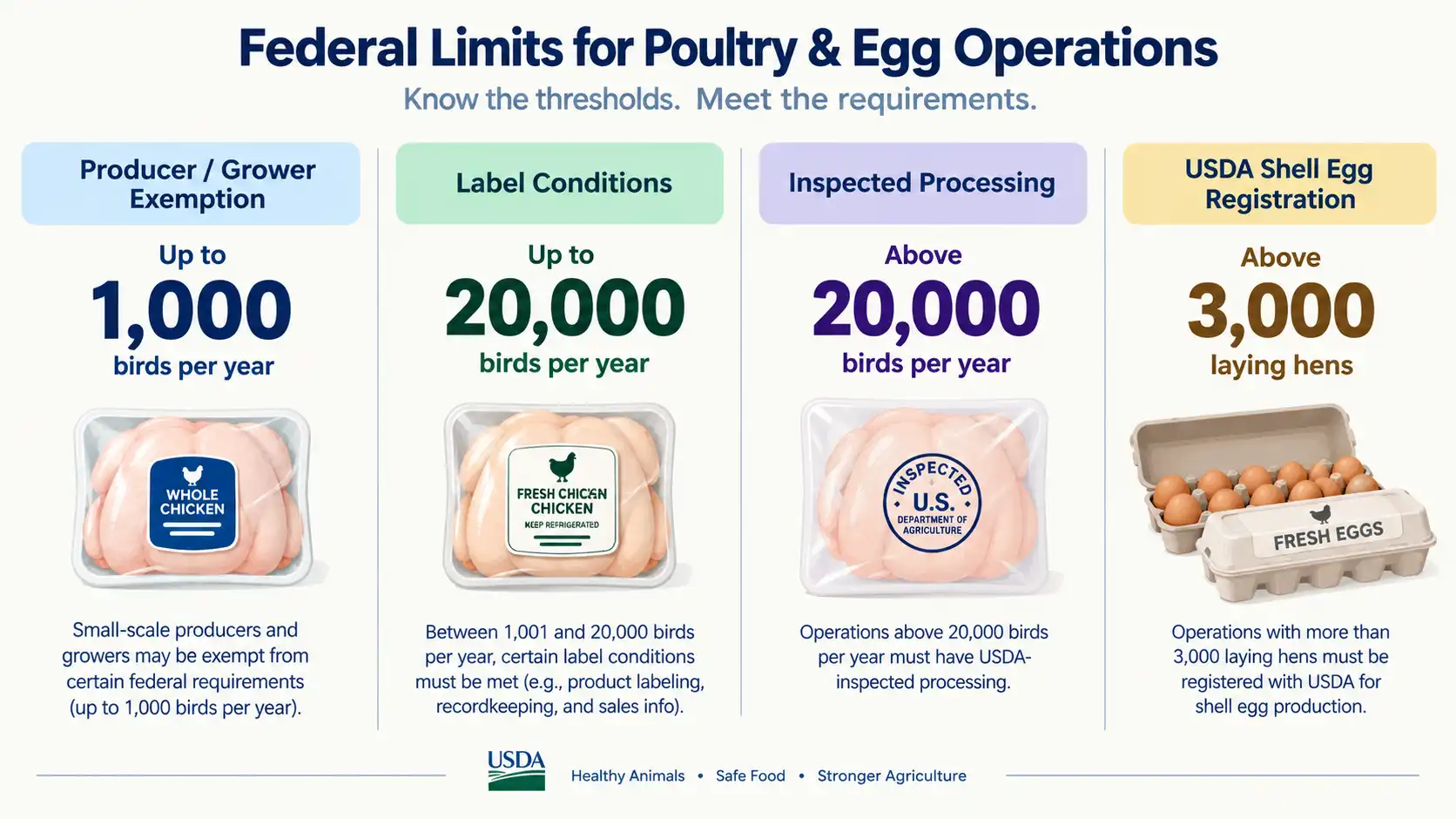
The Poultry Products Inspection Act requires inspection, but it exempts some small farms. Under FSIS exemption guidance, a farm may slaughter up to 1,000 healthy birds of its own raising each calendar year. A second producer/grower exemption reaches 20,000 birds, with added conditions such as the “Exempt P.L. 90-492” label statement. Exempt birds aren’t inspected, so sales generally stay inside your state. States can also set tighter rules.
Now run the processing check on your plan. Ten 100-chick Cornish Cross batches with 10 percent losses means about 900 birds a year, under the 1,000 limit. An eleventh batch brings you to 990, and a twelfth pushes you past it. So set your batch schedule against the rules for selling meat birds legally in your state.
Eggs follow separate rules. Farms with over 3,000 laying hens that grade and pack their own eggs must register with USDA AMS. Below that size, state rules apply. For example, UMD Extension’s 2013 bulletin describes Maryland rules for graded, sized, and labeled eggs held at 45°F or below.
Labels matter too. Organic labels need certification, or an exemption, under the National Organic Program, which USDA AMS runs.
The First 20 Weeks of a New Egg Flock
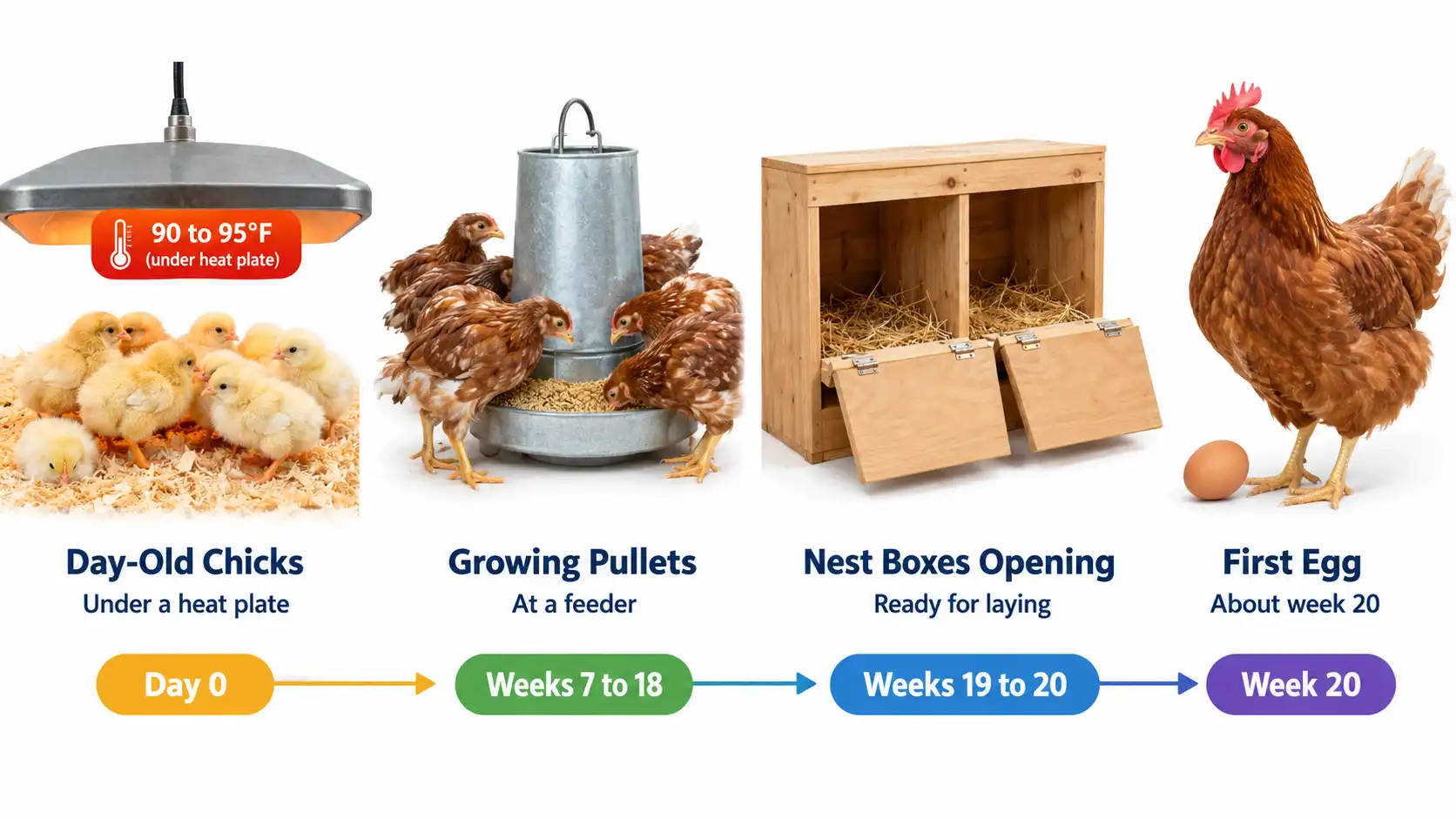
An egg farm spends about five months raising pullets before the first sale. This schedule follows brown-egg pullets bought as day-old chicks, with UMD Extension’s figures.
| Pullet age | What to do |
|---|---|
| Before arrival | Clean the house and set up the brooder, feeders, and waterers |
| Week 1 | Hold the brooder at 90 to 95°F |
| Weeks 2 to 5 | Lower the heat 5°F a week until the house reaches 70 to 75°F |
| Day-old to week 6 | Feed starter, about 4 pounds per pullet |
| Weeks 7 to 18 | Feed grower, about 46 pounds per pullet |
| Weeks 19 to 20 | Open the nest boxes and switch to layer feed |
| About week 20 | Expect first eggs and give 14 hours of light a day |
Want a shorter wait? UMD Extension notes you can also buy pullets at 18 to 22 weeks, ready to lay.
Starting a Contract Broiler Farm
A contract broiler farm starts with the company, not the land. The integrator owns the birds and supplies chicks and feed. You supply the houses, the labor, and the building loan. Pay usually depends on how your flock compares with other growers delivering to the same plant that week, per USDA ERS. So study how contract broiler growing pays before you sign.
The USDA AMS rules for live poultry dealers give you these protections:
- A written copy of the offered contract, with the house specifications
- The right to discuss terms with your lender, lawyer, accountant, other growers, and family
- A Live Poultry Dealer Disclosure Document at least 14 calendar days before signing, with projected grower pay
- Three business days after signing to cancel, or longer if the contract allows
- At least 90 days’ written notice before the company ends the contract
The disclosure rule took effect on February 12, 2024. Even so, these rules are shifting. USDA delayed a second rule on tournament pay and house upgrades to December 31, 2027. Its 2026 regulatory agenda also lists both rules for rescission, so confirm their status with AMS before you sign.
Scale matters too. USDA ERS found that farms with five or more houses produced over half of 2011 broiler output. Larger operations also earned better returns. At that size, FSA’s October 2025 chart lists guaranteed loans up to $2,343,000, adjusted for inflation each year.
Mistakes That Stall a New Chicken Farm Business
Each of these mistakes costs a new farm money, and each one has a cheap fix.
- Raising birds before finding buyers. Broilers reach market weight in weeks, not months. UMD Extension advises getting buyer commitments, even deposits, before the chicks arrive.
- Leaving out the months before income. A flock of 100 brown-egg pullets eats about 100 bags of feed before the first egg. Put that in the cash flow from day one.
- Outgrowing the processing exemption. Count every bird you process in the calendar year against the 1,000 and 20,000 bird limits, not just each batch.
- Signing a grower contract unread. Have a lender and a lawyer read the contract and disclosure document first. Then keep the three-day cancellation window in mind.
- Relaxing biosecurity during migration. UMD Extension names migratory birds and waterfowl as a source of avian influenza. So confinement and farm-only boots matter most in fall and spring.
- Growing broilers through summer heat. UMD Extension suggests raising meat birds in spring and fall, when cooler weather keeps them eating. In hot weather, plan shade, airflow, and water, because heavy broilers suffer from heat stress quickly.
FAQs about Starting a Poultry Farm
How much land do I need to start a chicken farm?
Using UMD Extension’s figures, 100 laying hens need 950 to 1,200 square feet for house and run, under 0.03 acre. Zoning, not land, often sets the limit, so check local rules first.
Do I need a license to sell eggs from my farm?
Your state sets the rules below 3,000 laying hens, and they can include registration, grading, and refrigeration. Above that size, USDA AMS also requires farms that grade and pack their own eggs to register.
Can I sell chickens I process on my own farm?
Yes, within limits: FSIS lets a farm slaughter up to 1,000 of its own healthy birds a year without inspection. A second exemption reaches 20,000 birds with added conditions, and states can set tighter rules.
Is contract broiler farming a good way to start?
It can be, but results vary, so read the company’s disclosure document first. USDA ERS found contract growers’ 2011 household incomes beat other farm households on average but ranged more widely.
How long before a new poultry farm earns money?
Meat birds pay back fastest, since UMD Extension puts Cornish Cross broilers at market weight in 6 to 8 weeks. Pullets start laying at about 20 weeks, so an egg farm carries five months of costs first.
Can I get a USDA loan to start a poultry farm?
Yes, the USDA Farm Service Agency makes direct loans to new and beginning farmers. Its October 2025 chart lists operating loans up to $400,000, $50,000 microloans, and down payment help for beginners.
Where to Start
Start on paper, not with birds. This week, confirm zoning and your state’s sales rules. Then price one example flock: 100 laying hens or a single 100-chick broiler batch. If the numbers work at your buyers’ prices, build the house first and order NPIP chicks second. Weighing contract growing instead? Ask the company for its disclosure document and house specifications before you meet a lender.