How Often Do Chickens Lay Eggs? Rate, Start Age, and Why They Stop

A laying hen rarely lays every single day. How often chickens lay eggs depends on the hen’s age, her breed, the season, and her health. Here is the laying pace from first egg to retirement, with the math for your own flock.
A healthy laying hen lays about one egg every 25 to 26 hours, so roughly 5 to 6 eggs a week at peak. US commercial layers averaged 288 eggs each in 2025, per USDA NASS. Backyard breeds usually lay fewer.
Sudden drop with sick birds? A sharp fall in egg production alongside deaths, low appetite, or swollen or purple combs and wattles is a warning sign of avian influenza. Call your state veterinarian or USDA at 1-866-536-7593 the same day, and keep the birds on your property.
How Often Do Chickens Lay Eggs?
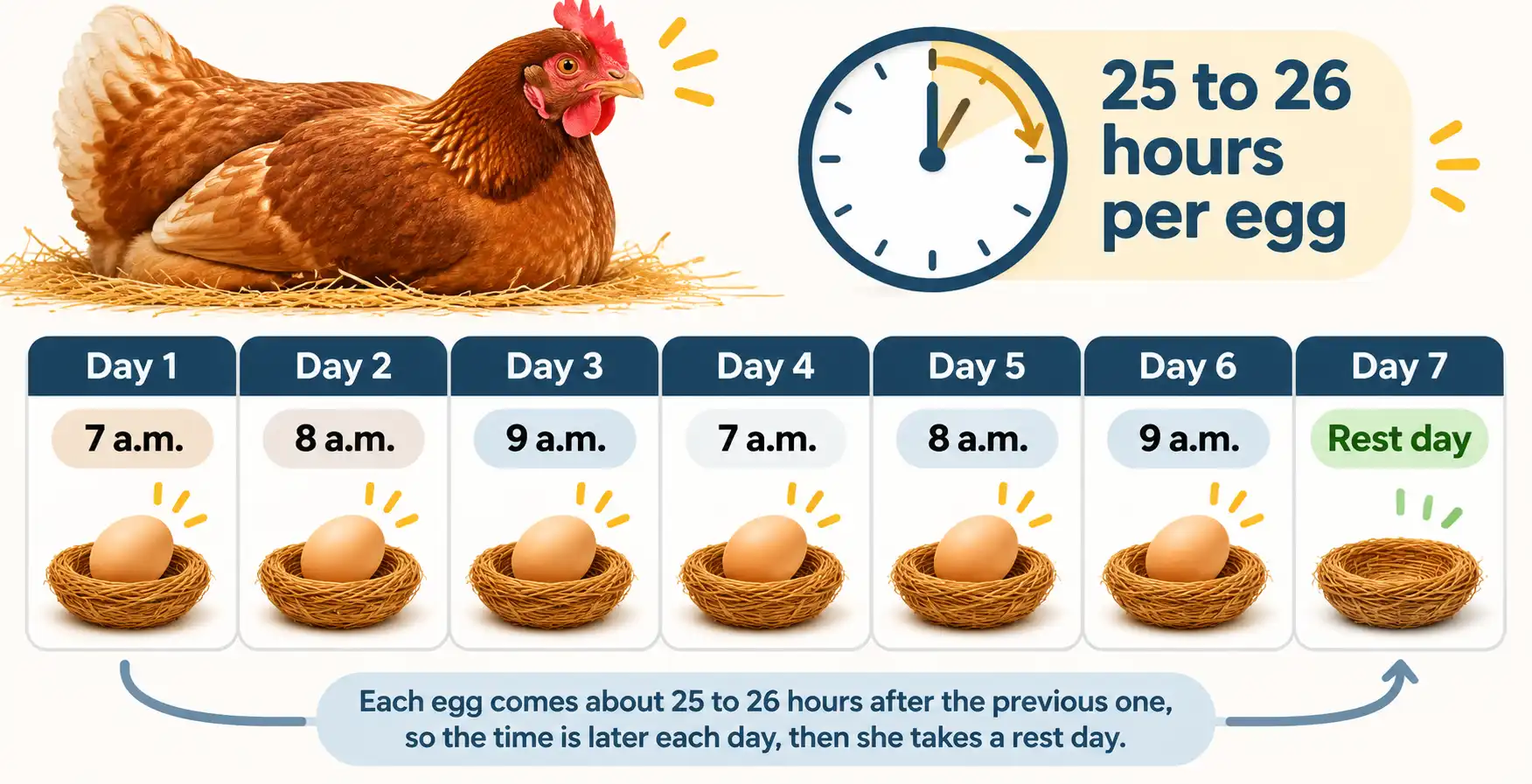
A laying hen at peak lays close to one egg a day, but not every day. University of Kentucky Extension puts egg formation at 25 to 26 hours, and about 20 of those hours go into the shell. Because each egg takes longer than a day, a hen lays a little later each morning.
The national average shows the real pace. USDA NASS reported 288 eggs per layer across US commercial flocks in 2025, counted from December 1, 2024, through November 30, 2025. That works out to about 5.5 eggs a week per hen, or 79 eggs a day from every 100 hens.
Backyard flocks usually lay fewer. Oregon State University Extension gives about 265 eggs a year as the average for a commercial Single Comb White Leghorn hen. It also says backyard breeds lay fewer, and the more exotic the breed, the lower the count. So if egg numbers matter most, compare high-producing laying breeds before you order chicks.
| Hen type and age | Eggs per hen a week | Eggs per hen a year | Source |
|---|---|---|---|
| US commercial layers, 2025 average | About 5.5 | 288 | USDA NASS |
| Commercial Leghorn hen, average | About 5 | About 265 | Oregon State Extension |
| Laying hen at peak, about 35 weeks old | About 6 (above 90 percent rate of lay) | Peak only, not yearly | Oregon State Extension |
| Backyard and heritage breeds | Fewer, and independent data is limited | Varies by breed | Oregon State Extension |
Why a Hen Skips Days
A hen skips days because she rarely starts a new egg late in the day. University of Kentucky Extension says the next yolk releases 30 to 75 minutes after she lays. However, hens almost never ovulate after 3 p.m. under normal daylight. So her laying time drifts later each day, and once it drifts too far, the next yolk waits until morning. That gap is her day off.
Poultry scientists call the run of eggs between rest days a clutch. Clutch length varies by breed, and Kentucky Extension notes that commercial layers tend to lay long clutches.
For example, a hen that lays at 7 a.m. Monday may lay near 8 a.m. Tuesday and 9 a.m. Wednesday. After several days, her next yolk would come too late in the afternoon. She then rests a day and starts a fresh clutch the next morning. In a healthy hen, an occasional missed day is normal.
When Do Chickens Start Laying Eggs?
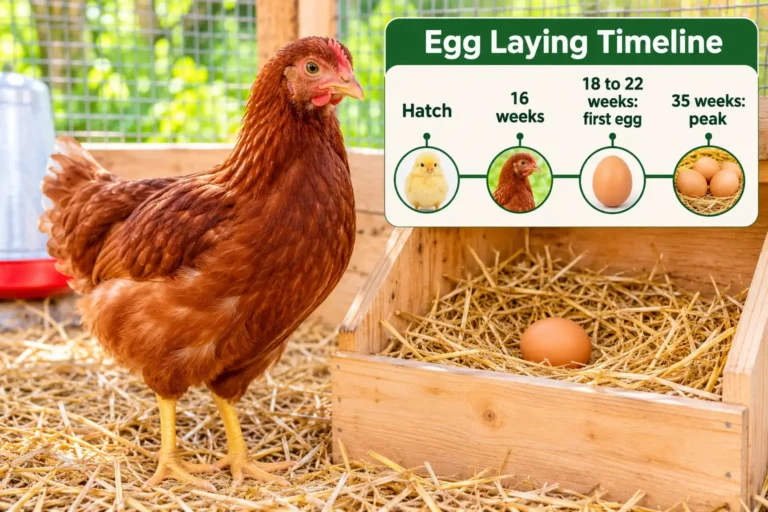
Most pullets lay their first egg at 18 to 22 weeks of age. Oregon State University Extension puts first eggs at 18 to 20 weeks. Meanwhile, University of Arizona Cooperative Extension gives 18 to 22 weeks, depending on breed. The two ranges overlap, so plan around the wider one.
Looks can fool you here. Arizona Extension notes that pullets may look fully grown at 14 to 16 weeks while their reproductive systems are still maturing. So a well-feathered 16-week-old pullet with no eggs yet is usually right on schedule.
Season shifts the start, too. Texas A&M AgriLife Extension gives growing pullets no added light until 18 weeks of age, then moves them to a 14-hour day. In practice, a pullet that reaches laying age in the short days of late fall may hold off until days lengthen, unless the coop has added light.
How Old Are Chickens When They Start Laying Eggs, by Breed?
Breed changes the start age, but independent data by breed is thin. Arizona Extension ties its 18 to 22 week range to breed without giving a breed-by-breed list. Hatchery catalogs often list a start age for each breed, but those are the hatchery’s own figures, not extension trial results.
As a working rule, give any pullet until about 22 weeks before you treat a late start as a problem. Also expect a later start when that age falls in the short days of winter.
Getting Pullets Ready for the First Egg
Two things need to be in place before the first egg: the right feed and enough nests.
First, hold off on layer feed. Texas A&M AgriLife Extension says not to feed layer feed to pullets under 16 weeks of age. It moves pullets to a laying ration of 16 to 18 percent protein with 3.5 percent calcium at the first egg. Our guide to layer feed protein and calcium covers the switch in detail.
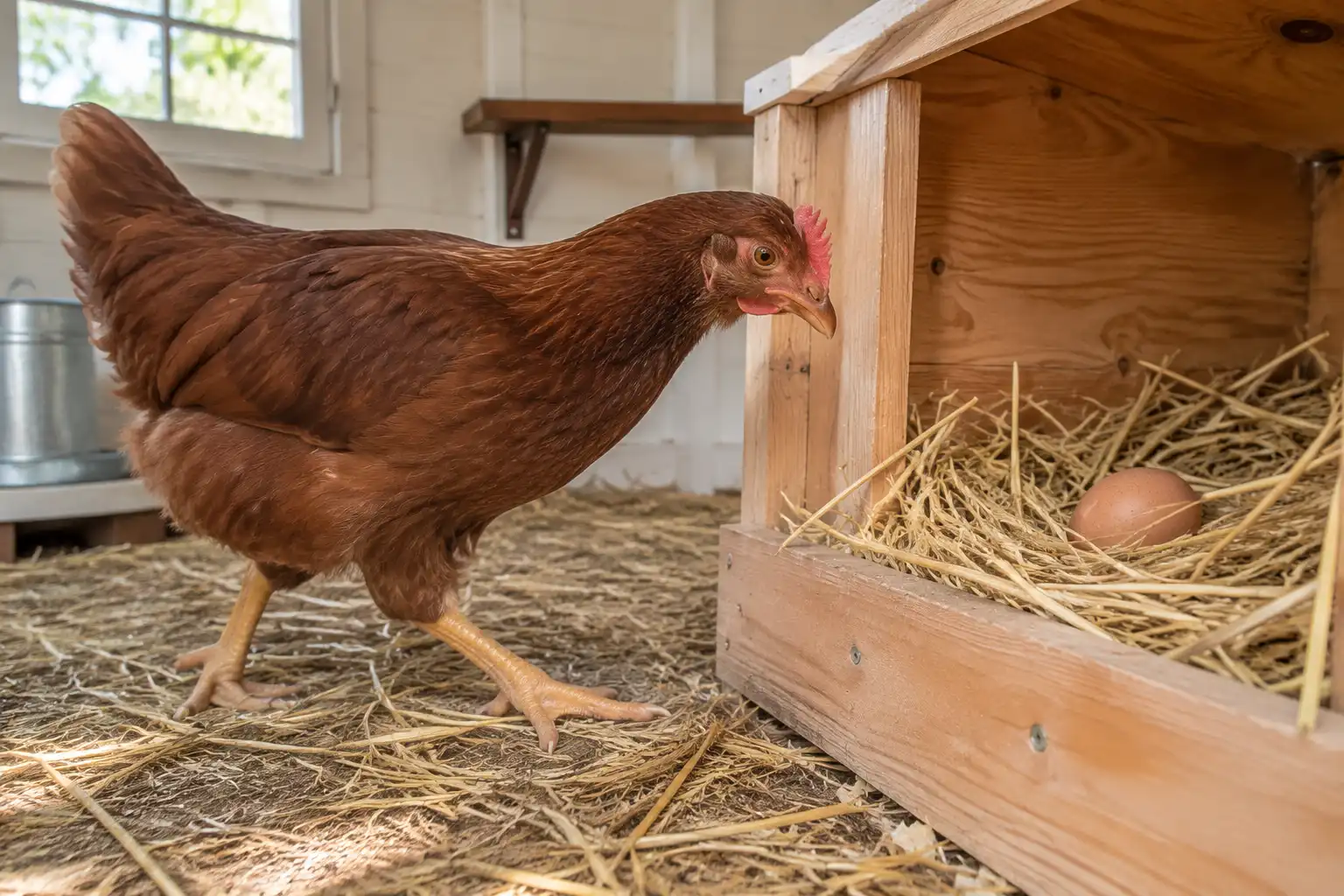
Next, set up nests early. Texas A&M and Arizona Extension both call for one nest box per four hens, so 8 pullets need 2 nest boxes. Arizona Extension adds that clean, easy-to-reach nests and a few fake eggs help keep hens from laying in hidden spots. A good nest box setup also cuts down on broken and dirty eggs.
For the full timeline from chick to first egg, see our section on raising pullets to point of lay.
Peak Laying and How Egg Numbers Change With Age
A hen lays the most eggs in her first laying year. Oregon State University Extension puts the peak at about 35 weeks of age, when a laying hen lays at a rate above 90 percent. That means about 9 eggs in 10 days from one hen, or 9 eggs a day from 10 hens. The peak lasts about 10 weeks, and then production slowly declines.
After that, the drop is gradual. Arizona Extension says most hens lay best in their first 1 to 2 years, then slow each year. By age 3 or 4, many lay only now and then. Oregon State adds that molts get more frequent and longer with age, and ovary and oviduct problems become more common.
| Hen age | What to expect | Source |
|---|---|---|
| 14 to 16 weeks | Pullet may look grown but is not laying yet | University of Arizona Extension |
| 18 to 22 weeks | First eggs | Oregon State (18 to 20 weeks), University of Arizona (18 to 22 weeks) |
| About 35 weeks | Peak, above 90 percent rate of lay, for about 10 weeks | Oregon State Extension |
| Years 1 to 2 | Best laying years, with a slow decline after peak | University of Arizona Extension |
| Years 2 to 3 | Laying declines | Oregon State Extension |
| Years 3 to 4 | Laying often becomes irregular | University of Arizona Extension |

How Long Do Chickens Lay Eggs?
Most hens lay well for 2 to 3 years, then lay fewer eggs each year after that. Oregon State Extension gives that 2 to 3 year window. However, slowing down is not the same as stopping, and some older hens still lay now and then.
A hen’s egg supply is fixed from the start. University of Kentucky Extension explains that a pullet chick hatches with all the ova she will ever have, and no new ones form later. Most of them never ovulate, so age and season set the pace long before that supply runs out.
Commercial timelines are shorter. Texas A&M AgriLife Extension advises replacing a laying flock with new pullets after 14 to 16 months of lay. That is a target for steady egg numbers, not the end of a hen’s laying life.
The research has a gap here. Published extension guidance gives little data on lifetime egg totals for backyard breeds, so lifetime counts quoted online are estimates.
So, for a steady supply, add a few young pullets every year or two. Arizona Extension recommends leaving coop space for younger birds in future years for this reason.
Why Do Chickens Stop Laying Eggs?
Hens most often stop laying because of shorter days, molting, broodiness, age, poor feed, stress, heat, or illness. Oregon State Extension names shorter days, disease, broodiness, poor nutrition, and stress as the most common triggers. Most of these are normal and pass. A sudden drop with sick birds is different, so it comes first.
When a Drop in Eggs Means a Same-Day Call
A sudden fall in egg production can be the first sign of disease, and Oregon State Extension says it often appears before other signs. USDA APHIS lists fewer eggs and soft-shelled or misshapen eggs among the signs of avian influenza and other serious bird diseases. Its list also includes sudden deaths, low energy or appetite, swelling of the head, comb, or wattles, and purple discoloration.
If you see these signs, report them the same day to your state veterinarian or to USDA at 1-866-536-7593. Don’t move birds off your property, and don’t try to handle a suspected case quietly at home. Many poultry diseases look alike, so only a poultry veterinarian or a state diagnostic lab can confirm the cause.
Timing matters this season. In its late October 2026 update, USDA APHIS counted avian influenza in 29 US flocks over 30 days, including 18 backyard flocks, as activity rose with fall migration (checked November 2026). Our page on bird flu signs and reporting covers biosecurity steps for small flocks.
Shorter Days
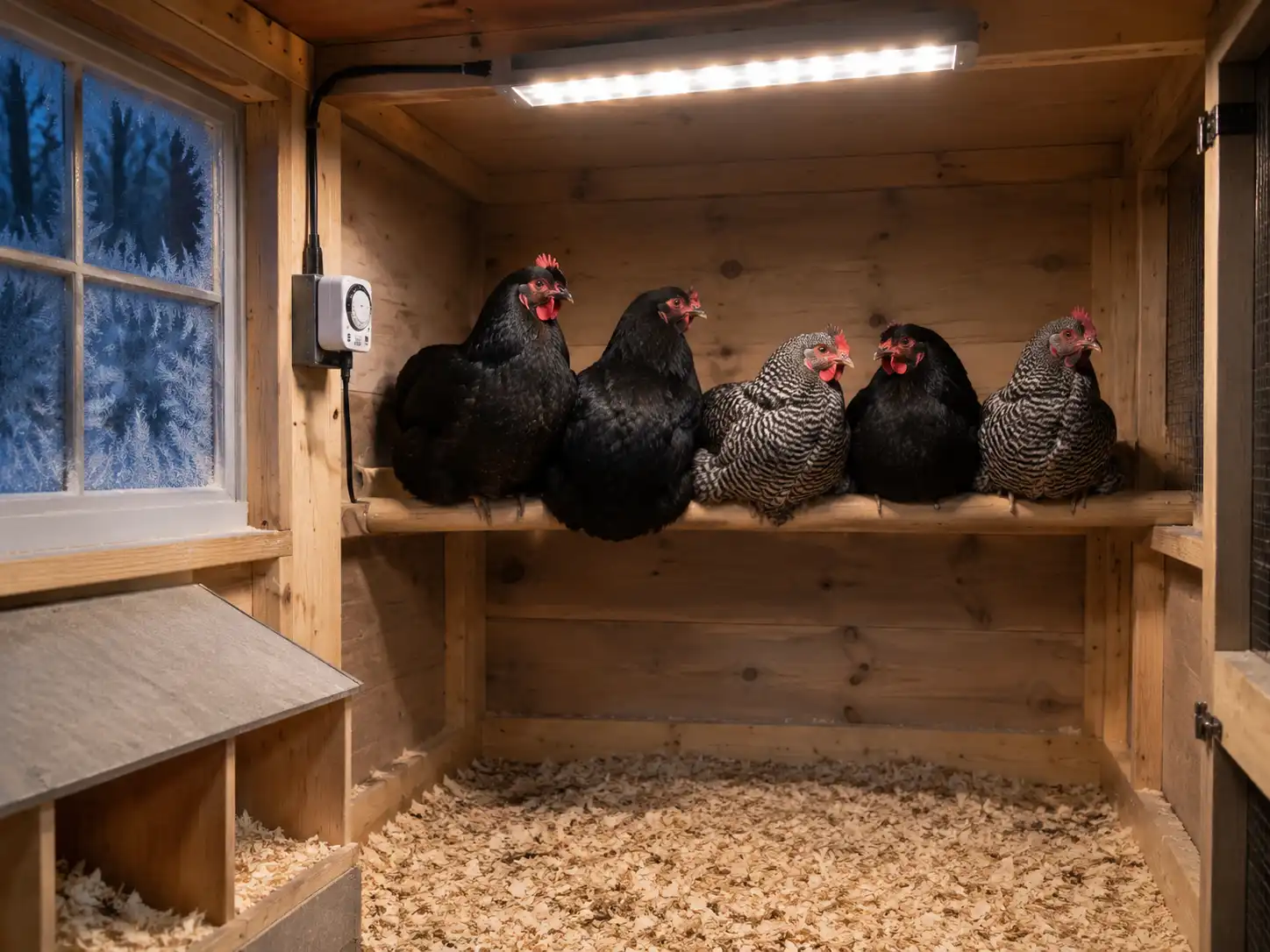
Shorter days are the most common reason a healthy flock slows in fall and winter. Oregon State Extension advises keeping the day above 12 hours, usually at 14 to 16 hours, to hold production in laying hens. Texas A&M AgriLife moves laying hens to 16 hours of light once the flock reaches 50 percent production.
The math is simple: added light equals your target day length minus natural daylight. For example, a coop with 10 hours of natural December daylight needs 4 hours of added light to reach 14 hours. Arizona Extension suggests adding that light in the early morning. It also says a 14 to 16 hour day doesn’t shorten a hen’s laying life when her diet, including calcium, is balanced.
Oregon State adds a few practical points. The light only needs to be bright enough to read a newspaper. A timer keeps it steady, because even a one-day lapse can set laying back. Mount any coop light securely and away from bedding. For fixture and timer choices, see our guide to supplemental coop lighting.
Molting
Molting pauses laying while a hen replaces her feathers. Arizona Extension says adult hens usually molt once a year, typically August through October, and the molt can last several months. Pullets hatched in spring or summer don’t molt their first fall.
During a molt, hens put their protein into new feathers. So Arizona Extension suggests a higher-protein layer feed or a protein supplement until the molt ends. The payoff comes afterward, since egg production and quality usually improve in a hen’s second laying cycle.
Under long artificial days, molts are often incomplete, per Oregon State Extension. For that reason, it recommends letting hens molt in their second winter by turning added lights off for about 6 weeks, then returning them to long days.
Broodiness
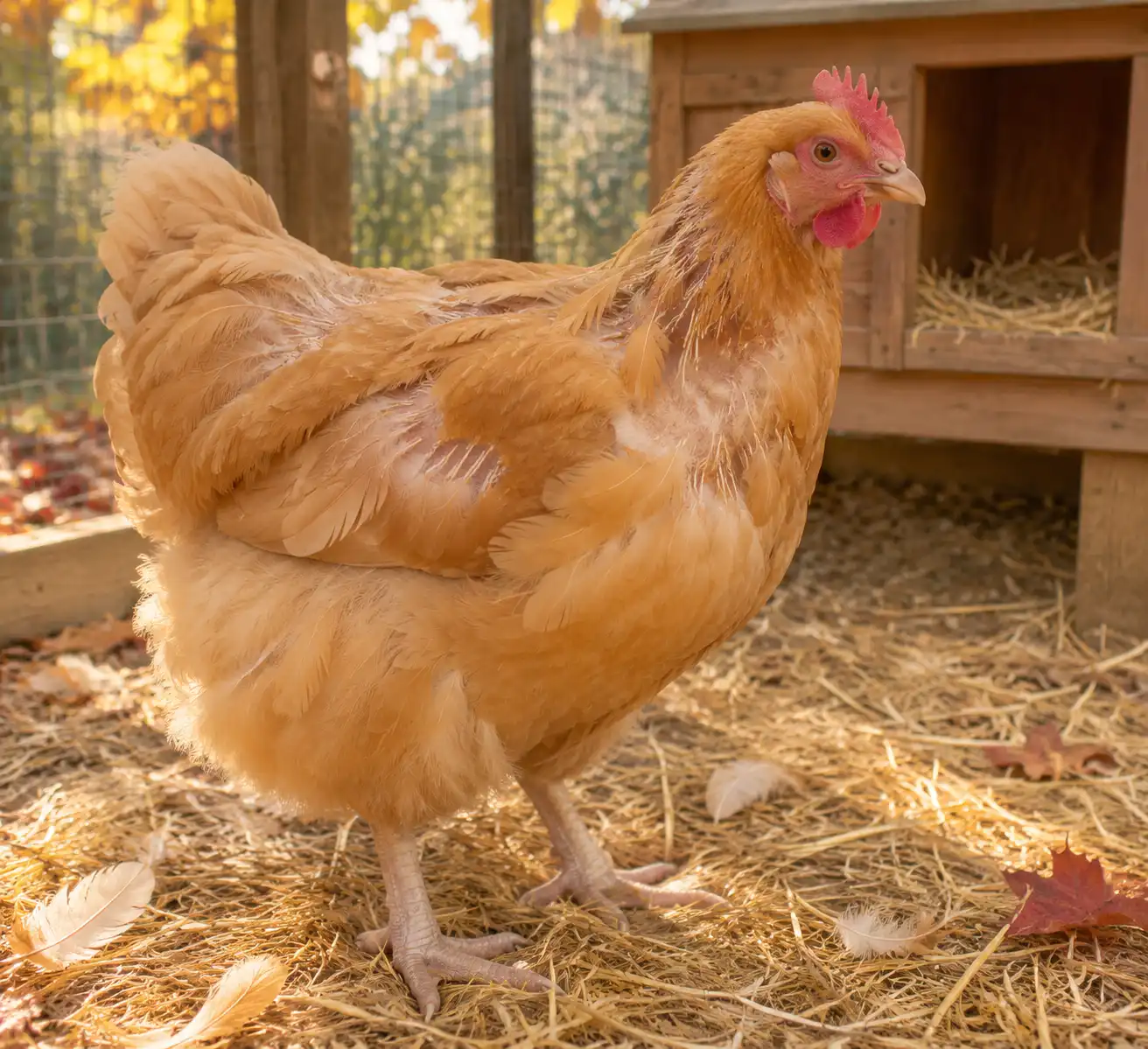
A broody hen stops laying so she can sit on eggs. Oregon State Extension notes that Cochins and Silkies go broody often, while Leghorns rarely do. Arizona Extension says broodiness usually comes in spring and can last 3 to 6 weeks. In summer, a broody hen can also lose weight and risk heat stroke.
To discourage it, collect eggs at least once a day, and Texas A&M AgriLife recommends twice. If a hen stays broody, Oregon State suggests keeping her off the nest for several days. Arizona Extension describes a wire-bottomed pen for about 3 to 7 days.
Age, Feed, Stress, and Heat
Age sets the long-term trend, as covered above. Feed, stress, and heat cause shorter dips.
Feed problems are common in backyard flocks. Oregon State Extension advises a complete layer ration fed free choice, with oyster shell in a separate feeder. It also limits treats to what hens finish in 15 minutes, because scratch and table scraps unbalance the diet. Starter and grower feeds lower laying, and medicated feeds can leave residues in eggs.
Stress also stops laying, since egg production isn’t something a hen needs to survive. Oregon State lists moving, handling, overheating, fright, and a lack of feed or water. Meanwhile, Arizona Extension notes that hens eat less in long hot spells, which leaves less energy for eggs. Shade, cool water, and fans or misters help.
Eggs Laid but Not Found
Sometimes hens are laying, but the eggs aren’t reaching your basket. Arizona Extension names two causes. Free-range hens may lay in hidden spots outdoors, so search the range or keep hens in until mid-morning.
Egg eating is the other. It often starts once a hen tastes a broken egg. To prevent it, Arizona Extension advises enough protein and calcium, frequent collection, soft nest bedding, and at least one nest box per four hens.
Quick Check: What the Pattern Points To
| What you see | Common cause | First step |
|---|---|---|
| Whole flock slows as fall days shorten, birds look healthy | Shorter days | Bring the day to 14 to 16 hours with timed light, or let hens rest |
| Feathers dropping across the flock in late summer or fall | Molt | Raise protein and wait for new feathers |
| One hen sits on the nest all day and puffs up | Broodiness | Collect eggs often and move her off the nest |
| Pullet past 22 weeks with no eggs | Still maturing, or short days | Check her age, daylight hours, and feed |
| Fewer eggs found, hens act normal | Hidden nests or egg eating | Check the range and collect more often |
| Sudden drop with deaths, swelling, or poor appetite | Possible disease | Call your state veterinarian or USDA at 1-866-536-7593 the same day |
How Many Eggs Will Your Flock Lay?
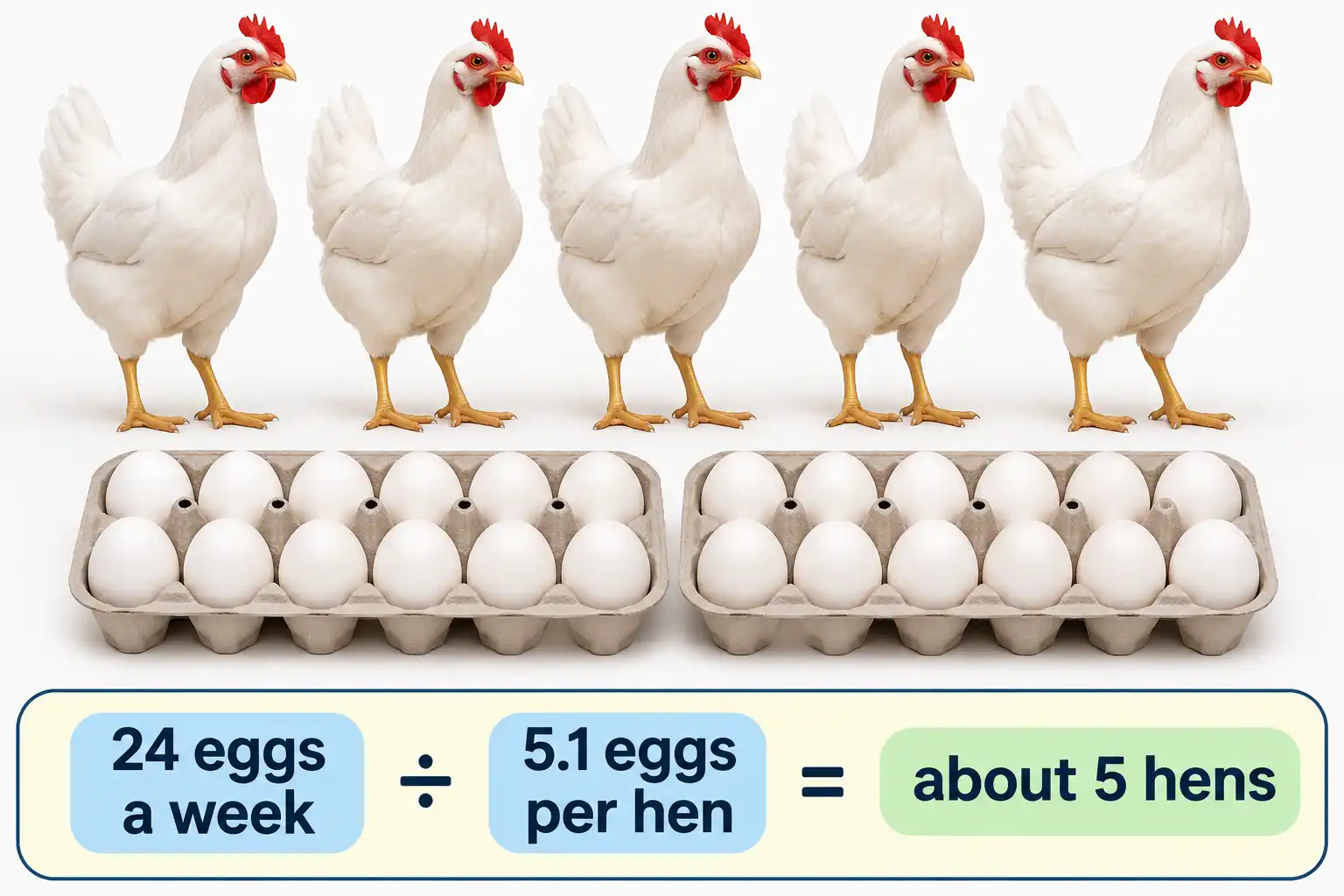
Divide the eggs you want each week by the eggs one hen lays each week. That gives the number of hens to plan for:
Hens needed = eggs wanted per week ÷ eggs per hen per week
Start with a published rate. Oregon State Extension’s 265 eggs a year for an average commercial Leghorn hen works out to about 5.1 eggs a week. So for a family that wants 2 dozen eggs a week, 24 ÷ 5.1 = 4.7, or 5 first-year Leghorn-type hens.
Backyard and heritage breeds need a different input. Independent production data for many of these breeds is limited, so use your own flock’s count once you have one. For example, if your hens average 4 eggs each a week (your number, not a published figure), 24 ÷ 4 = 6 hens.
| Eggs wanted per week | First-year Leghorn-type hens at about 5.1 eggs a week | Hens at an example rate of 4 eggs a week |
|---|---|---|
| 12 (1 dozen) | 3 | 3 |
| 18 (1.5 dozen) | 4 | 5 |
| 24 (2 dozen) | 5 | 6 |
| 36 (3 dozen) | 8 | 9 |
Daily output follows the same math. At the USDA NASS 2025 average of 288 eggs per commercial layer, 6 hens lay about 4.7 eggs a day, or about 33 a week. At Oregon State’s peak rate above 90 percent, the same 6 hens at about 35 weeks of age lay 5 or more eggs a day.
Then plan for the dips. Without added light, expect fewer eggs as fall days shorten. Also expect each hen to pause for her yearly molt, which Arizona Extension says can last several months. After her first 1 to 2 years, she will lay fewer eggs each year, so round your hen count up.
FAQs About Chickens Lay Eggs
Do hens need a rooster to lay eggs?
No, hens lay eggs without a rooster. A rooster only fertilizes eggs, which matters if you plan to hatch chicks, and many towns limit or ban roosters, so check local rules first.
Can a hen lay two eggs in one day?
Almost never, because each egg takes a hen about 25 to 26 hours to form, per University of Kentucky Extension. A double-yolk egg is one egg with two yolks, not two eggs laid.
What time of day do hens lay eggs?
Most hens lay in the morning and early afternoon. University of Kentucky Extension notes that hens almost never release a new yolk after 3 p.m., so a late egg usually ends a clutch.
Do chickens lay eggs in winter?
Many hens slow down or stop in winter as daylight shortens. Oregon State Extension says a day of 14 to 16 hours, with timed added light, keeps laying hens in production through winter.
How long does molting stop egg laying?
Molting can stop laying for up to several months, per University of Arizona Extension. Most adult hens molt once a year, usually August through October, then lay better in the next cycle.
At what age do hens stop laying for good?
There is no fixed age when hens stop for good. Oregon State Extension says hens lay well until 2 to 3 years old, and Arizona Extension says laying often turns irregular by age 3 or 4.
Key Points for Your Flock
Expect about 5 to 6 eggs a week from a high-producing hen at peak, and fewer from most backyard breeds. Give pullets until about 22 weeks, set one nest box per four hens, and switch to layer feed at the first egg. For winter eggs, hold the day at 14 to 16 hours with timed light. Add young pullets every year or two as older hens slow down. And if eggs drop suddenly while birds look sick, call your state veterinarian or USDA at 1-866-536-7593 that day.