Can Chickens Have Cucumbers? Skins, Peels, and How Much to Feed

Cucumbers pile up fast in a summer garden, and the peels land in the scrap bowl. Laying hens can have cucumbers, skins and peels included. Still, the amount, the prep, and a few bad cucumbers decide whether the treat helps or hurts.
Yes. Chickens can have cucumbers, including the flesh, seeds, skins, and peels. Wash the cucumber and cut it small. Keep all treats to 10 percent or less of an adult hen’s daily diet, per Colorado State University Extension.
Can Chickens Have Cucumbers Safely?
Yes, plain raw cucumber is a safe treat for adult hens. It just isn’t food in the nutritional sense.
USDA FoodData Central lists raw cucumber with peel at about 95 percent water. It carries about 0.65 grams of protein and 15 calories per 100 grams. That works out to well under 1 percent protein.
Compare that with what a hen actually needs. Mississippi State University Extension sets the minimum for laying hens at 16 percent protein and 3.0 percent calcium. University of Kentucky Extension says layer diets need at least 14 percent protein, and 16 percent is more common.
So an ounce of cucumber holds about one twenty-fifth of the protein in an ounce of layer feed. A hen that fills up on cucumber eats less of the feed that makes her eggs. That is the real risk with cucumbers, not toxicity.
For that reason, cucumber works best as a cool, crunchy extra. The hen’s main meal stays her complete ration. Our layer feed basics cover what that ration should contain at each age.
Can Chickens Have Cucumber Skins and Peels?
Yes, chickens can have cucumber skins and peels. Most hens eat them readily, especially in short pieces.
The peel does deserve one extra look, though. Cucumbers make a bitter compound called cucurbitacin. Nebraska Extension in Dodge County reports that it tends to sit in the darker green areas of the skin. It is also more common at the stem end than the blossom end. That is why people peel bitter cucumbers.
So the peel is where bitterness concentrates, if a cucumber has any. Nebraska Extension also notes that today’s hybrids carry far less cucurbitacin than wild cucumbers. A mild, normal-tasting cucumber has a mild, normal peel.
Cucumber peelings from your own kitchen are fine too, as long as they are fresh. Peelings that sat in a warm scrap bucket for a day or two are a different matter. The section on cucumbers to keep out of the run explains why.
Which Parts of a Cucumber Chickens Can Eat
Here is how each part of the plant and its leftovers stacks up for adult laying hens.
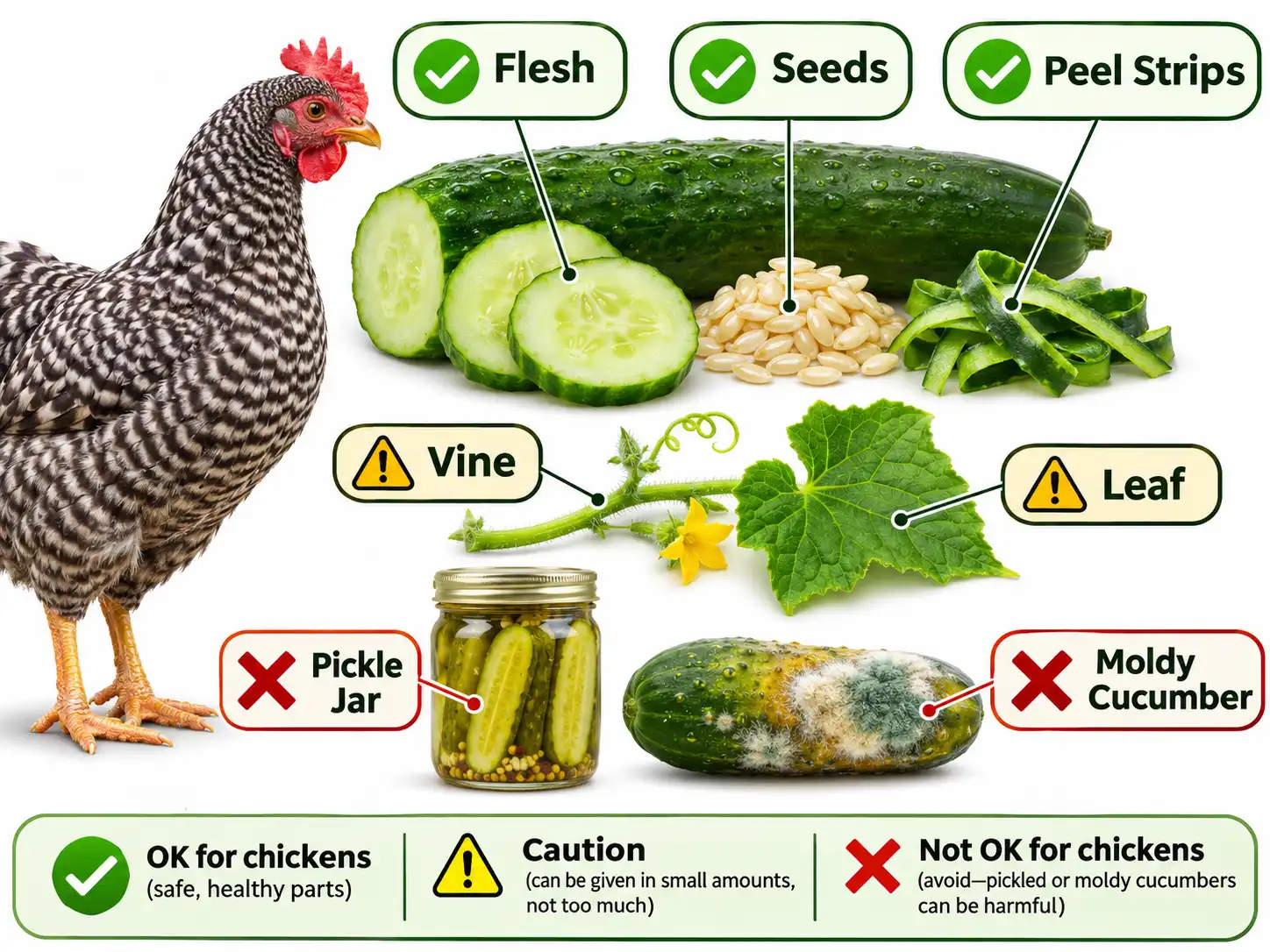
| Part | Feed it? | What to know |
|---|---|---|
| Flesh | Yes | About 95 percent water, so it is a light snack |
| Seeds | Yes | Soft seeds in a slicing cucumber are eaten with the flesh |
| Skins and peels | Yes | Wash before peeling; cut into short pieces |
| Overgrown yellow cucumbers | Yes, if sound | Firmer seeds and skin; skip any that are soft or moldy |
| Vines and leaves | Little research | Fibrous and prickly; never feed sprayed plants |
| Cooked plain cucumber | Yes | No oil, salt, or seasoning |
| Pickles | No | Salt brine |
| Cucumber salad | No | Onions, dressing, and salt |
| Very bitter cucumbers | No | High cucurbitacin |
| Moldy or rotting cucumbers | No | Spoilage risk |
Bitter Cucumbers: The One Peel to Throw Out
Throw out any cucumber that tastes strongly bitter, peel included. Don’t feed it to the flock.
Nebraska Extension in Lancaster County explains that heat, wide temperature swings, and dry soil can make cucumbers mildly bitter. Occasionally a plant produces extremely bitter fruit. In people, those cucumbers can cause severe stomach cramps and diarrhea lasting several days. The extension’s advice is to discard them.
Here is where the research runs thin. No extension study we found measures how cucurbitacin affects chickens. So the safe rule is simple: if a cucumber is too bitter for your table, it is too bitter for the run.
A quick check takes seconds. Before peeling, slice a thin piece from the stem end and taste it. If it is sharply bitter, the whole cucumber goes in the trash, not the compost the hens can reach.
If birds seem unwell after eating any scrap, call a poultry veterinarian. Many problems look alike from the outside. Sudden deaths, or several sick birds at once, call for a same-day report to your state veterinarian or USDA at 1-866-536-7593.
How Much Cucumber Chickens Can Have
An adult laying hen can have about half an ounce of treats a day, cucumber included. That figure comes from two extension numbers.
First, Colorado State University Extension says treats should make up no more than 10 percent of a hen’s daily diet. Then Mississippi State University Extension puts an average laying hen at 1/4 to 1/3 pound of feed a day. That is 4 to 5.3 ounces.
Ten percent of 4 to 5.3 ounces is 0.4 to 0.5 ounces per hen. Colorado State doesn’t say if that means weight or volume, so we use weight.
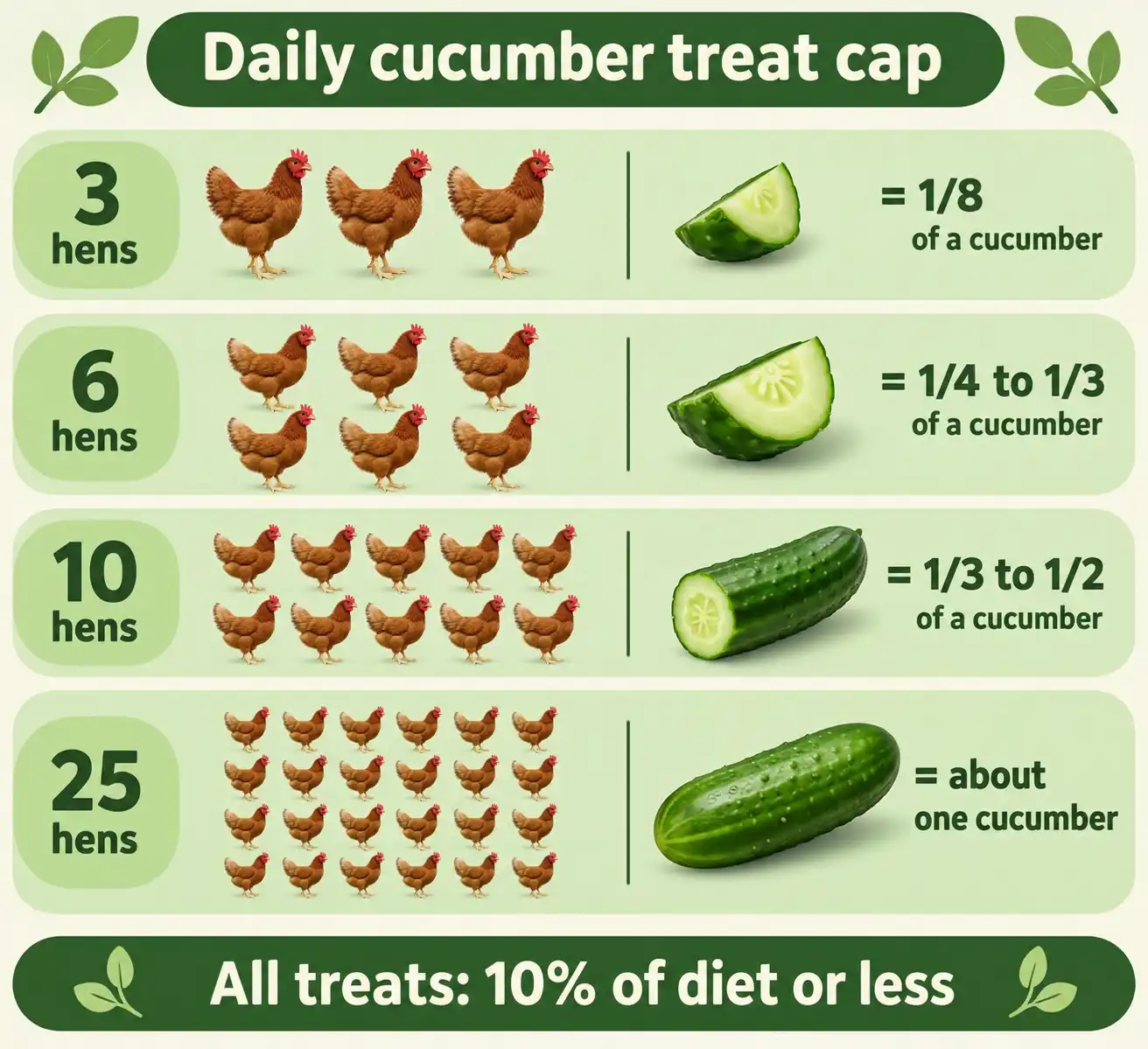
USDA FoodData Central weighs an 8 1/4 inch cucumber at about 301 grams, or 10.6 ounces. Here is the daily treat cap for common flock sizes:
| Laying hens | Feed per day | Treat cap per day | Cucumber equivalent |
|---|---|---|---|
| 3 | 12 to 16 oz | 1.2 to 1.6 oz | About 1/8 of a large cucumber |
| 6 | 1.5 to 2 lb | 2.4 to 3.2 oz | About 1/4 to 1/3 |
| 10 | 2.5 to 3.3 lb | 4 to 5.3 oz | About 1/3 to 1/2 |
| 25 | 6.3 to 8.3 lb | 10 to 13.3 oz | About 1 to 1 1/4 |
The cap covers every treat that day. Scratch, mealworms, and packaged chicken treats count against it too.
How Long to Leave Cucumber in the Run
Leave cucumber out only as long as the flock eats it quickly. The two extension sources set that window differently.
Colorado State University Extension says to offer no more than adult hens can finish in 5 to 10 minutes. Its reason is practical: leftover food draws nuisance animals. University of Kentucky Extension allows a little more time. It says table scraps and scratch grains together should be no more than the hens can finish in 20 minutes.
So the range runs from 5 to 20 minutes. Neither figure is wrong. They reflect different priorities.
If rats, raccoons, or wild birds visit your run, use the shorter Colorado State window. If pests aren’t a problem, the Kentucky window works. In both cases, pick up uneaten cucumber before dusk.
Watch the clock in the first few feedings. If the flock leaves cucumber behind after 10 minutes, cut the portion next time. Smaller pieces also disappear faster than a halved cucumber.
How to Prepare Cucumber Skins and Peels
Prep is quick. The washing steps follow the Colorado State University Extension guide to handling fresh produce, and each step has a reason.
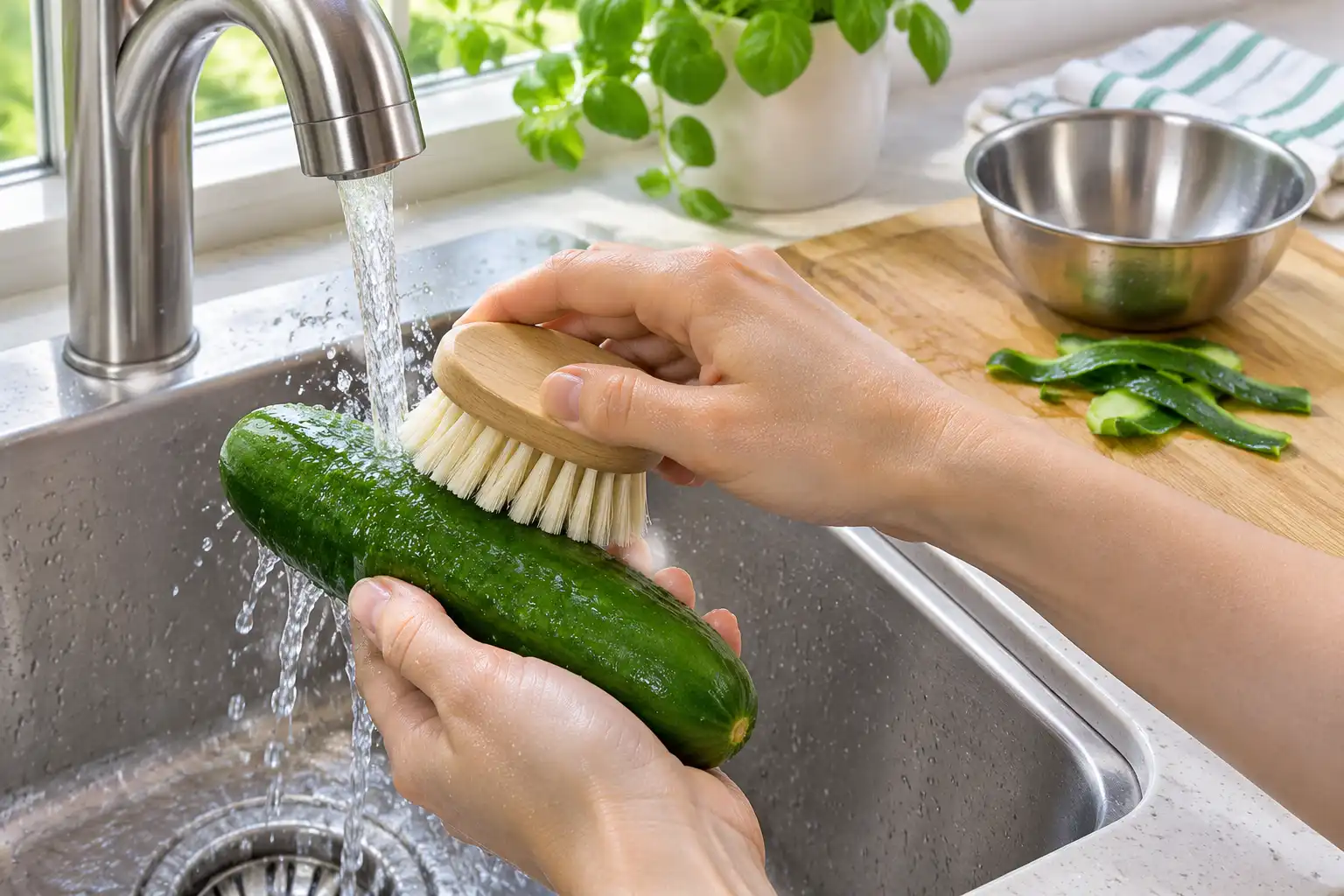
- Scrub the cucumber under running water before peeling. Colorado State University Extension advises scrubbing cucumbers with a vegetable brush, including the stem area, before peeling and cutting. Washing first keeps surface dirt off the knife and the cut flesh.
- Skip soap and produce washes. The same Colorado State guide says not to wash produce with soap, detergent, or bleach.
- Taste a thin slice from the stem end. That is where bitterness shows first. Discard the whole cucumber if it is sharply bitter.
- Cut peels into short pieces. Long ribbons get carried off and fought over. Short pieces let more hens get a share.
- Scatter the pieces or serve them on a clean dish. Scattering spreads the flock out. A dish makes leftovers easy to collect.
- Keep grit available. University of Kentucky Extension says grit helps chickens break down grass and greens, and that oyster shell is too soft to work as grit. Fibrous peels fall in the same group.
Our guide to grit for backyard hens explains sizes and how to offer it.
Do Cucumbers Help Chickens in Hot Weather?
Cucumbers help a little in hot weather, but they never replace the waterer. The numbers show why.
University of Kentucky Extension estimates that a laying hen drinks about a cup of water a day. Half an ounce of cucumber, the daily treat cap for one hen, holds just under half an ounce of water. That is roughly 6 percent of her daily water.
Mississippi State University Extension puts shade, ventilation, and drinking water cooler than the air first. Its poultry specialist adds that frozen treats can help hens stay cool, but they should supplement a balanced diet, not replace it.
So frozen cucumber fits as an extra. Freeze small chunks in a shallow pan of water and set the block in the shade. The hens peck at it as it melts.
Count it against the same treat cap. A large frozen block for six hens can quietly push past 10 percent.

Can Chicks Have Cucumbers?
Chicks can physically eat soft cucumber, but they gain little from it. Their diet has less room for low-protein extras than an adult hen’s does.
University of Kentucky Extension recommends a chick starter with 20 to 22 percent protein for chicks from hatch to 6 weeks. Cucumber carries well under 1 percent. Because chicks eat so little, even a small cucumber snack takes up a larger share of the day.
Published guidance on when to start treats is thin, and advice from hatcheries varies. With little research to go on, the cautious path keeps chick starter as nearly the whole diet through the brooding weeks.
If you do offer a taste, keep it tiny and soft. Peel the cucumber, mash or finely chop the flesh, and offer chick-size grit first. University of Kentucky Extension notes that commercial grit comes in chick and hen sizes.
Remove leftovers quickly so the brooder stays dry. Our notes on caring for young chicks cover the rest of the first weeks.
Cucumber Vines, Leaves, and Garden Scraps
Hens will pick at cucumber vines and leaves, but there is little published research on either. No extension source we checked lists them as toxic, and none covers them directly.
What is known points toward caution. The leaves and vines are fibrous and covered in prickly hairs. University of Kentucky Extension lists regularly adding green chops, lettuce, or other low nutrition ingredients to the diet as a common feeding mistake.
So treat spent vines as occasional foraging, not a meal. Chop them short if you toss them in the run, and keep grit available.
Pesticides change the picture. If you sprayed the plants, the product label governs whether and when animals can be on or near the treated area. Read it before pulling vines for the flock.
The same goes for cucumbers grown near a treated lawn or flower bed. When in doubt, compost the vines out of the hens’ reach.
Cucumbers to Keep Out of the Run
Six kinds of cucumber leftovers don’t belong in a chicken run:
- Pickles and brine. Colorado State University Extension says scraps should not be salty.
- Cucumber salads with onion. University of Kentucky Extension warns that strong flavors such as onion can carry into the eggs of laying hens.
- Dressed salads. Oil, vinegar dressings, and salt add little but trouble.
- Moldy cucumbers. Colorado State University Extension says scraps should not be moldy.
- Rotting cucumbers. University of Kentucky Extension says scraps should not be allowed to rot, or botulism might result.
- Very bitter cucumbers. High cucurbitacin, as covered above.
Salt matters more than it seems. University of Kentucky Extension notes that excess salt makes hens drink more and produce wet manure. Wet manure raises ammonia levels in the coop.
Rot matters most in summer. A scrap bucket left in the sun breaks down fast, so feed cucumber peels the day you cut them.
Keep the Scrap Bowl Out of the Kitchen Loop
Give the flock’s scrap bowl its own life outside the house. The reason is Salmonella, not the cucumber.
The CDC advises washing hands with soap and running water after touching poultry or anything in their space. That includes food and water containers. The CDC also says to clean equipment used for poultry outdoors, not inside the home.
A treat dish that goes from the run back to the kitchen sink breaks both rules. So set up a simple routine:
- Keep a dedicated scrap container for cucumber peels and other produce.
- Carry the scraps out, and leave the run dish outside.
- Rinse the run dish outside with a hose.
- Wash your hands after every trip to the run.
Healthy-looking birds can still carry Salmonella, so this applies to every flock. Children need extra supervision here. Our page on flock hygiene for families covers kids and backyard birds in more detail.
FAQs on Feeding Cucumbers to Laying Hens
Can chickens have cucumber peelings from the compost bucket?
Yes, if the peelings are fresh and show no mold or rot. Peelings that sat in a warm bucket for a day or more should stay in the compost, because spoiled scraps carry real risk for hens.
Do cucumbers help hens lay more eggs?
No, cucumber adds nothing to egg production because it is mostly water and very low in protein and calcium. Too much of it can lower laying by crowding out the layer feed that supports eggs.
Can chickens eat cucumber seeds?
Yes, hens eat the soft seeds in a slicing cucumber along with the flesh. Overgrown cucumbers have firmer seeds, which hens also eat, so keep grit available for the gizzard to grind them.
Are store-bought cucumber peels safe for chickens?
Yes, once you scrub the cucumber under running water before peeling, without soap or produce wash. Cut the peels into short pieces and count them toward the flock’s daily treat allowance.
Can chickens have cooked cucumber?
Yes, plain cooked cucumber is fine for adult hens as long as it has no oil, butter, salt, or seasoning. Cooking softens the peel, which can suit older hens, but it adds no nutrition to the treat.
How often can chickens have cucumbers?
Adult hens can have a little cucumber most days during summer. The limit is the daily treat cap of about half an ounce per hen, shared with all other treats.
Putting This Into Practice
Cucumber flesh, seeds, skins, and peels are all fine for adult laying hens. Wash before peeling, taste the stem end for bitterness, cut peels short, and offer grit. Hold all treats to about half an ounce per hen a day. For a flock of 6, that is about a quarter to a third of a large cucumber. Our treats and foraging guidance shows how other garden scraps fit the same allowance.