Can Chickens Eat Bread? Safe Types, Daily Limits, and What to Avoid
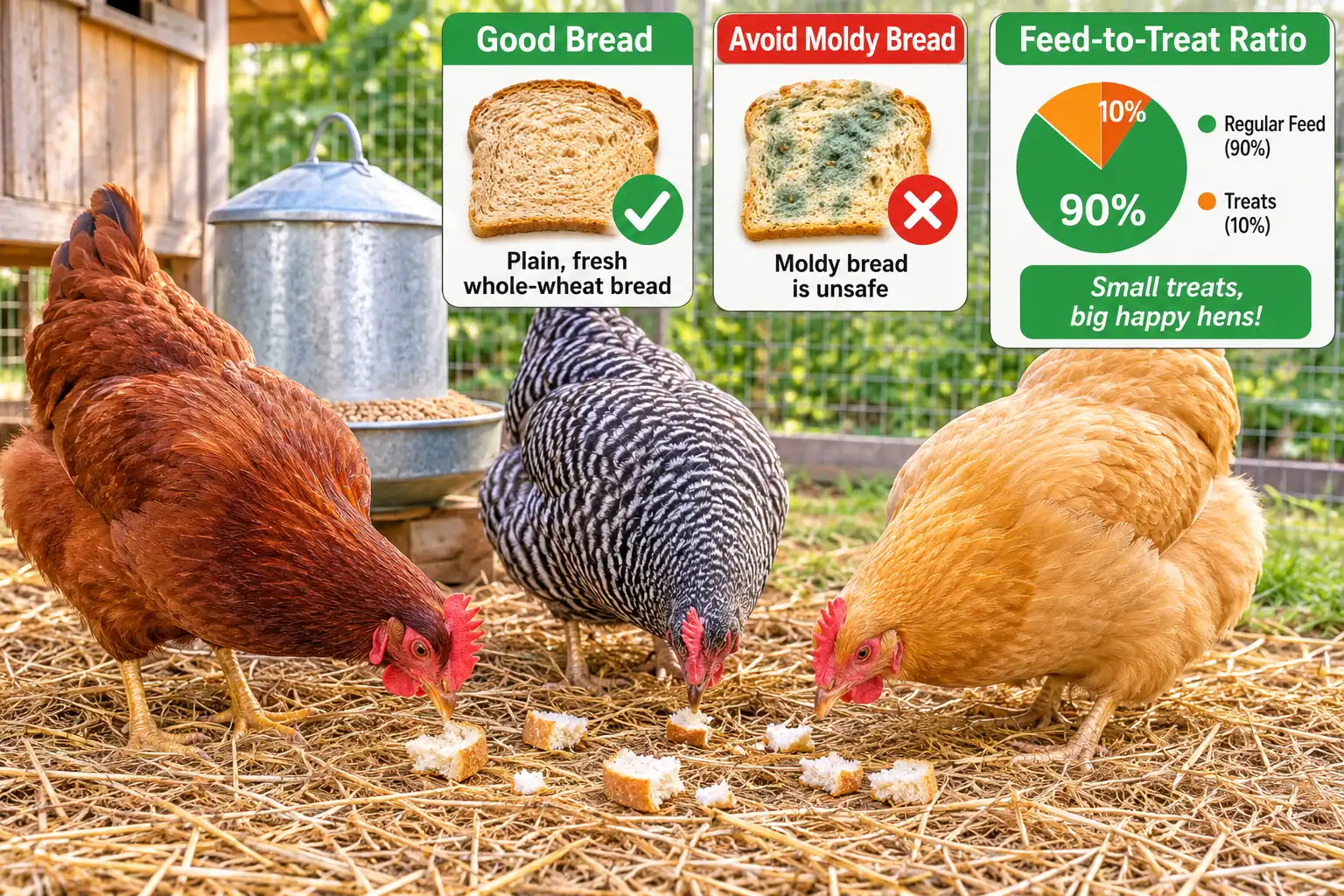
Bread is a common kitchen scrap for backyard hens. Whether chickens can eat bread safely depends on three things: the type, its condition, and how much of the diet it fills.
Yes, chickens can eat bread as an occasional treat. Plain white, whole-wheat, and sourdough bread are fine in small pieces. For laying hens, keep all treats under 10 percent of the diet, and never feed moldy bread.
Is Bread Safe for Chickens?
Plain bread is safe for chickens in small amounts. It’s baked grain, so it isn’t toxic. The trouble comes from what bread lacks and what gets spread on it.
Bread fills a hen up without giving her much protein or calcium. UF/IFAS Extension’s Holmes County office warns that hens who fill up on treats may miss the nutrients they need. As a result, egg production and health can suffer.
Sources also differ on how much room treats deserve. Mississippi State University Extension’s feeding guide advises a complete layer ration only for laying hens. It recommends no extra grain or other feedstuff. By contrast, the UF/IFAS Extension Holmes County feeding guide allows treats. It keeps them under 10 percent of a backyard flock’s diet.
Both agree that layer feed carries the diet. So for laying hens, treat 10 percent as a ceiling, not a goal. Toppings and spreads cause most bread problems. Several of them appear on the list of foods to keep away from your flock.
What Bread Lacks Compared With Layer Feed
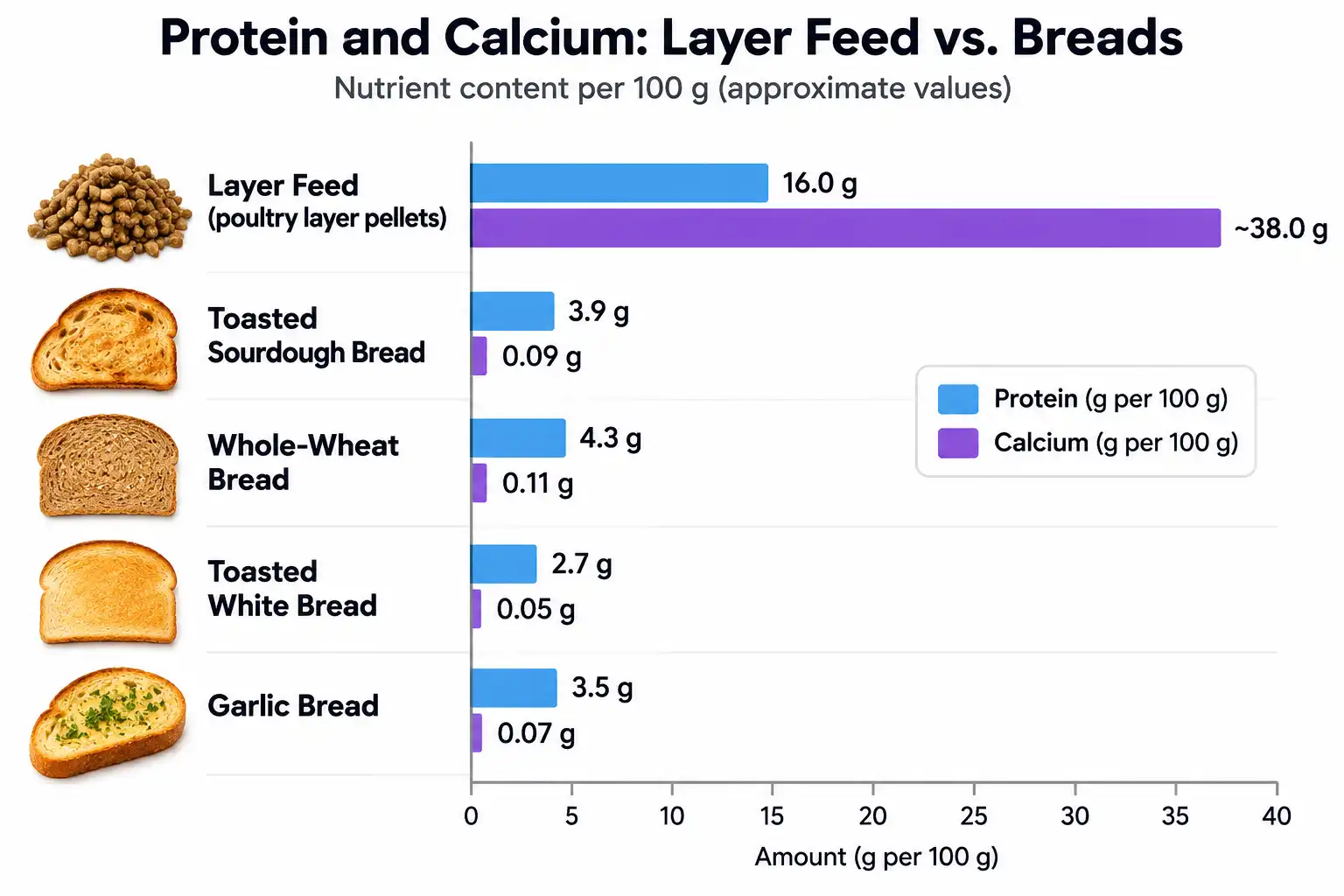
Bread falls furthest short on calcium. Mississippi State Extension sets the minimum for a laying hen ration at 16 percent protein and 3.0 percent calcium. USDA’s food composition data (Standard Reference, final 2018 release) shows how far common breads sit below that.
| Food | Protein (% by weight) | Calcium (% by weight) |
|---|---|---|
| Layer ration, minimum for laying hens | 16 | 3.0 |
| French or sourdough bread, toasted | 13.0 | 0.05 |
| Whole-wheat bread | 12.4 | 0.16 |
| White bread, toasted | 9.0 | 0.12 |
| Garlic bread, frozen | 8.3 | 0.03 |
We worked out the bread figures from USDA’s protein, calcium, and serving weight lists, converted to percent by weight.
In other words, layer ration carries roughly 20 to 100 times the calcium of these breads. That gap matters. Mississippi State Extension ties thin eggshells to laying hen diets built mostly on grains or mineral-poor feeds. Bread is exactly that kind of food.
So keep protein and calcium in layer feed as the base of the diet. Then set out free-choice oyster shell and grit in separate dishes, as UF/IFAS Extension’s Holmes County office suggests.
How Much Bread Can Chickens Eat?
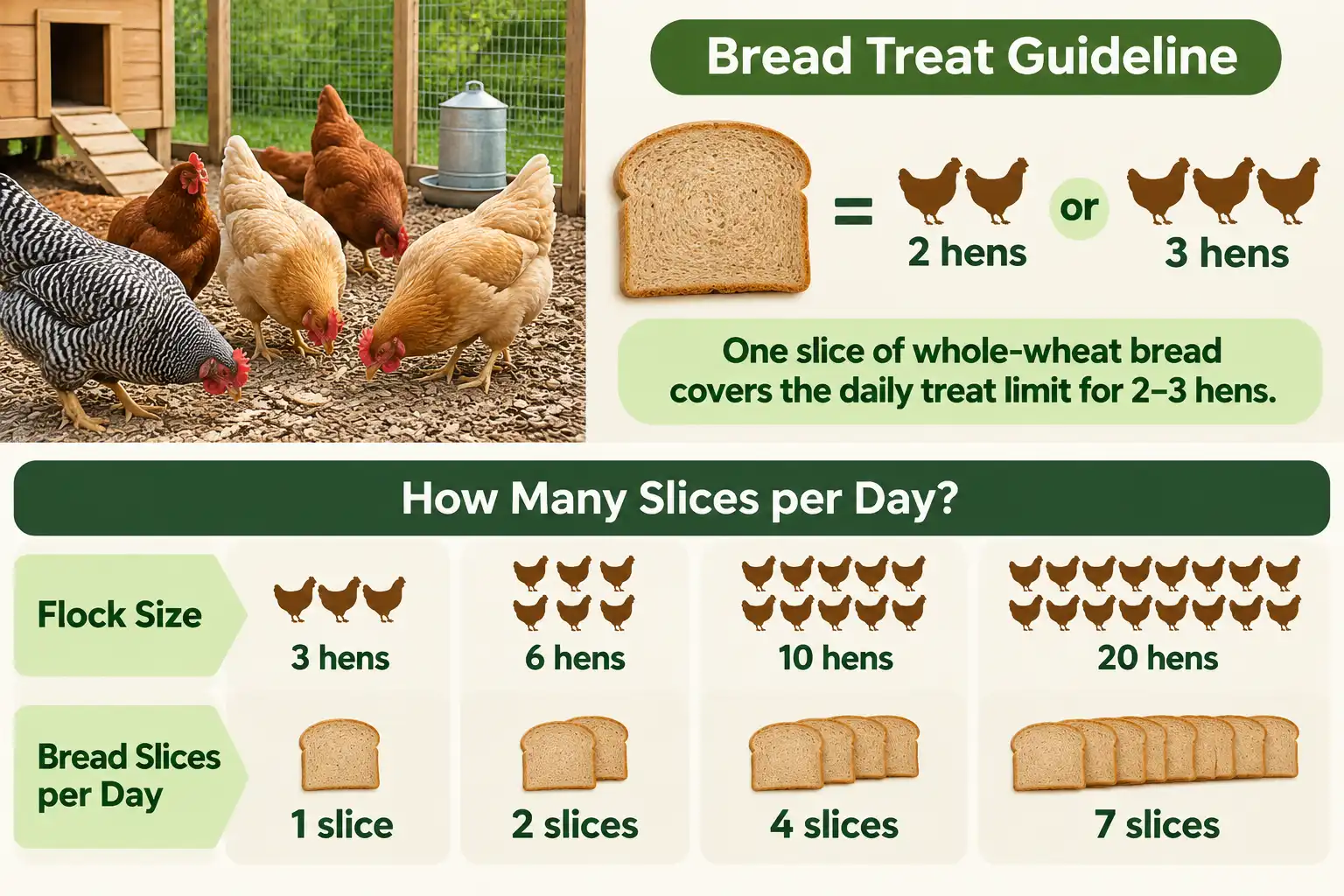
A laying hen can have about 0.4 to 0.5 ounce of bread a day. That holds only if bread is her only treat. Here is the math behind that figure.
An average laying hen eats about 1/4 to 1/3 pound of feed a day, or 4 to 5.3 ounces, per Mississippi State Extension. Ten percent of a hen’s daily feed is 0.4 to 0.5 ounce, and that ceiling covers every treat combined.
Next, USDA lists a slice of commercial whole-wheat bread at 32 grams, about 1.1 ounces. So one slice is the full daily treat allowance for two to three laying hens.
| Laying hens | Daily treat ceiling | Bread, if it’s the only treat |
|---|---|---|
| 3 | 1.2 to 1.6 oz | about 1 slice |
| 6 | 2.4 to 3.2 oz | about 2 to 3 slices |
| 10 | 4.0 to 5.3 oz | about 3.5 to 4.5 slices |
| 20 | 8.0 to 10.7 oz | about 7 to 9 slices |
To run your own number, multiply your laying hens by 0.4 to 0.5 ounce. Then divide by 1.1 to get slices. Feed intake also varies with weather, bird size, and rate of lay, per Mississippi State. For that reason, use the low end for bantams and light breeds.
Can Chickens Eat White Bread?
Yes, chickens can eat white bread, but it’s the least useful of the common breads. USDA data puts toasted white bread at about 9 percent protein and 0.12 percent calcium. That’s a little over half the protein of a laying hen ration.
Soft sandwich bread also turns gummy when wet. So tear it into small pieces that hens can swallow easily. When bread is on the menu, whole-wheat is the better pick.
Whole-Wheat and Multigrain Bread
Whole-wheat bread is the better bread choice for laying hens. USDA lists commercial whole-wheat bread at about 12.4 percent protein, well above white bread’s 9 percent. Still, it carries only about 0.16 percent calcium, so it doesn’t replace layer feed.
Multigrain loaves with seeds are fine too. However, skip any loaf with chocolate chips. UF/IFAS Extension’s Holmes County office lists chocolate as toxic to poultry because of its theobromine and caffeine.
Can Chickens Eat Sourdough Bread?
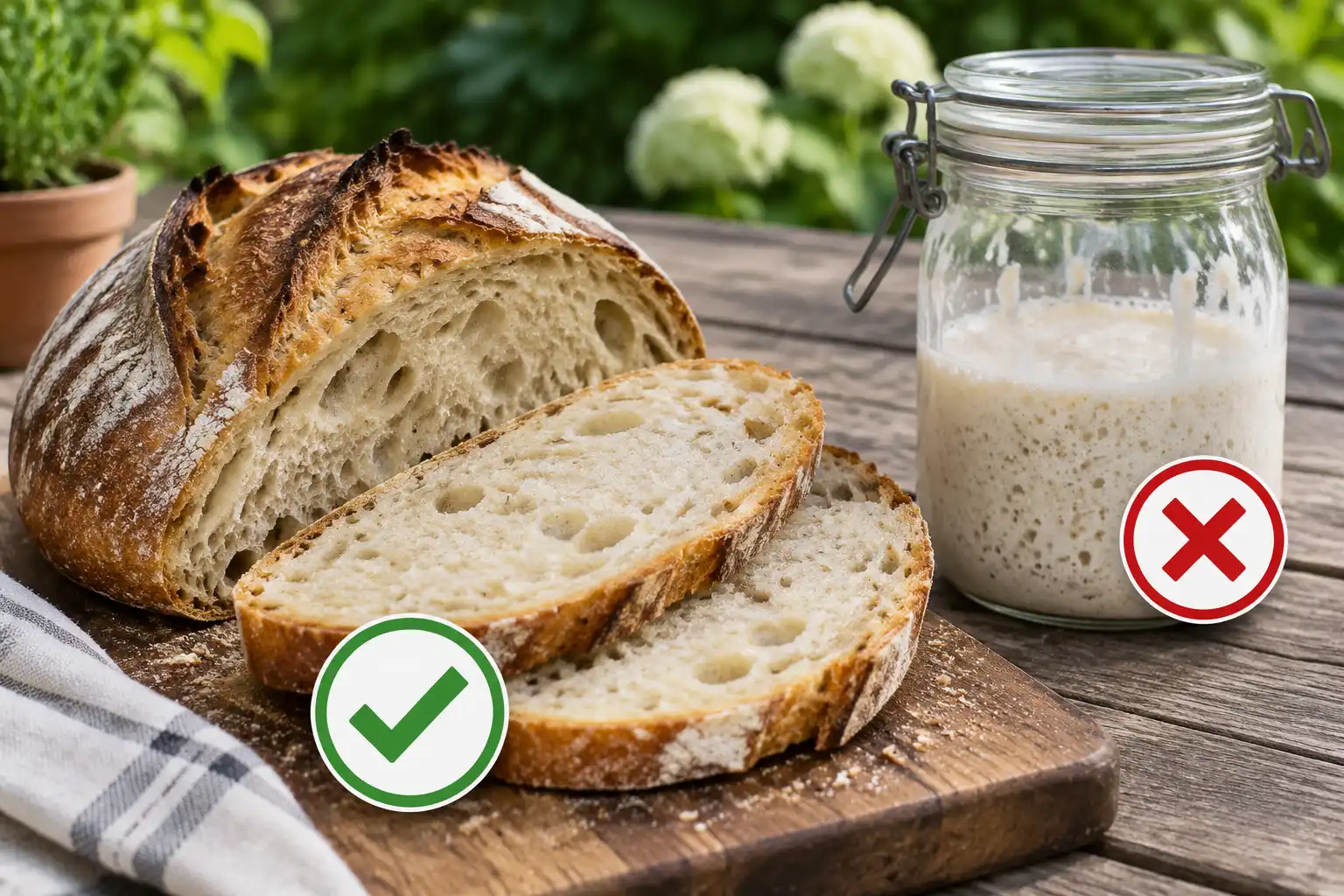
Yes, baked sourdough bread is safe for chickens in the same small amounts as other bread. Baking kills the starter’s yeast and bacteria, so a baked loaf is simply bread.
USDA groups sourdough with French and Vienna bread. Toasted, that entry runs about 13 percent protein but only 0.05 percent calcium, the lowest of the plain breads above. It’s also saltier, at 204 milligrams of sodium per ounce against 152 for toasted white bread.
Sourdough Starter and Raw Dough
Starter and raw dough are a different matter. Both are still fermenting, and wild yeast makes alcohol as it works. The UF/IFAS Extension Holmes County list of foods to avoid names alcohol as toxic to chickens. It extends that warning to heavily fermented foods.
Research is thin here. No extension service we checked publishes guidance on sourdough discard for hens. Until one does, bake the discard plain, without salt, before sharing it. Otherwise, compost it where the flock can’t reach.
Can Chickens Eat Moldy Bread?
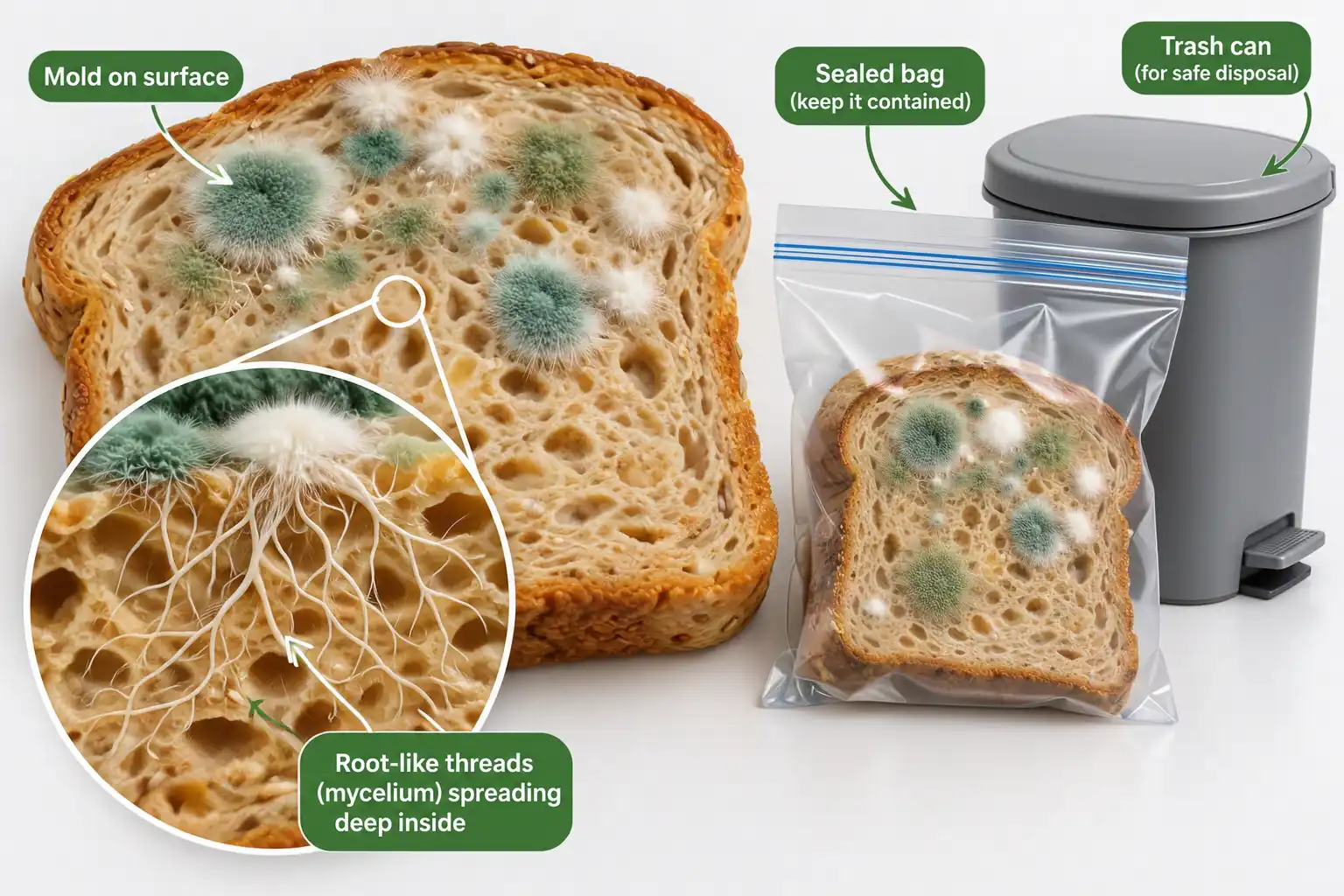
No. Never feed moldy bread to chickens, and don’t cut off the moldy spots and serve the rest.
USDA’s Food Safety and Inspection Service (FSIS) tells people to discard moldy bread. Its reason: mold can reach below the surface of porous foods. With heavy growth, mold sends root threads deep into the loaf. Some molds also produce poisons called mycotoxins, and invisible bacteria can grow alongside them, per FSIS guidance on molds.
Hens face the same risk. UGA Extension’s mycotoxin overview lists lower feed intake, poor nutrient absorption, and weakened immunity among common effects in poultry. It also advises never using grain or feed that shows mold. Toasting won’t fix moldy bread either, because UGA notes that typical feed processing doesn’t destroy mycotoxins once they form.
Instead, bag moldy bread and put it in a covered trash can that animals can’t open, as FSIS advises. Keep it out of any compost pile your flock forages in. And don’t sniff it, since FSIS warns that can cause breathing trouble.
What to Do If Hens Already Ate Moldy Bread
Watch the flock, but don’t try to name the cause yourself. Mycotoxin effects such as eating less and laying fewer eggs overlap with many diseases. USDA APHIS lists sudden deaths, low energy, and reduced interest in feed among signs that can point to avian influenza. Fewer or soft-shelled eggs are on that list too (guidance current as of November 2026).
If birds sicken or die, call a poultry veterinarian, your state veterinarian, or USDA at 1-866-536-7593 the same day. A state diagnostic lab can confirm the cause. Review the bird flu warning signs before you assume the bread was to blame.
Can Chickens Eat Garlic Bread?
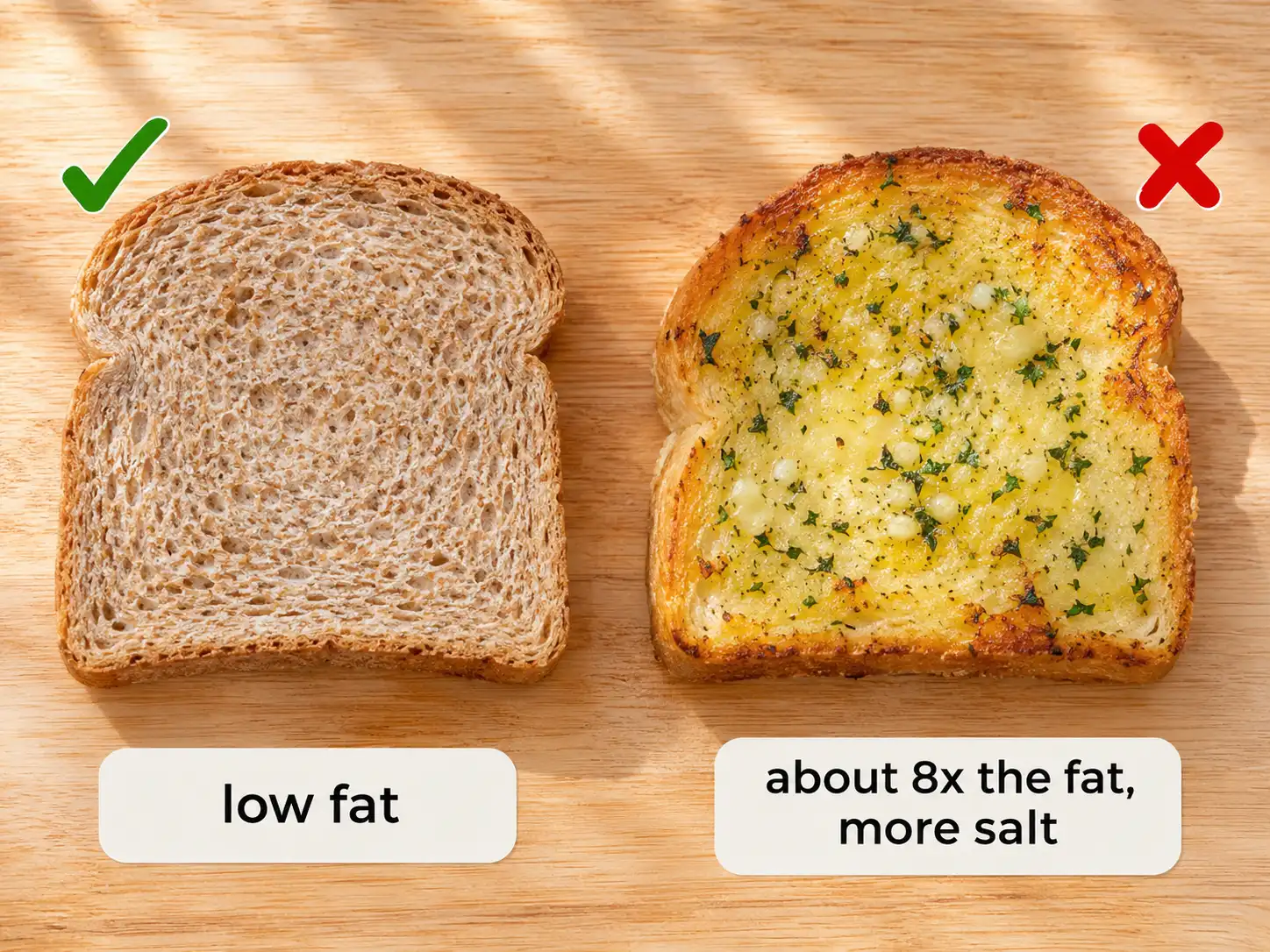
Skip garlic bread as a treat. It adds fat and salt without adding anything a laying hen needs.
USDA lists a 43-gram slice of frozen garlic bread at about 7.1 grams of fat and 234 milligrams of sodium. By comparison, an ounce of toasted French bread carries about 0.6 grams of fat. Ounce for ounce, that makes garlic bread roughly eight times fattier.
That matters for two reasons. First, UF/IFAS Extension’s Holmes County office warns that salty foods can cause dehydration and kidney damage in chickens. Second, Mississippi State Extension links high-energy diets in laying hens to fatty liver hemorrhagic syndrome. So rich, buttery scraps make a poor habit.
Also check the label for onion or cheese in the spread. UF/IFAS notes that large amounts of onion can damage red blood cells and may affect egg taste. Garlic itself has thin research behind it for backyard flocks. UF/IFAS doesn’t list it among foods to avoid, and no extension source we checked gives a safe amount.
Stale Bread, Toast, and Crusts
Stale bread is fine for chickens as long as it shows no mold. Dry, hard bread isn’t spoiled; it has only lost moisture. Crusts, heels, and plain toast count the same way, but skip buttered toast.
Still, check stale bread closely before you share it. Fuzz or colored spots of any size mean it goes in the trash. If you soften stale bread with water, offer only what hens finish in one short session. Wet bread spoils fast in a warm run.
Breads and Toppings to Keep Away From Chickens
Most bread problems come from what’s on it or in it. The UF/IFAS Extension Holmes County list of foods to avoid covers several common bread add-ons.
| Bread or topping | Why to skip it | Source |
|---|---|---|
| Moldy bread of any kind | Mold roots and mycotoxins | USDA FSIS, UGA Extension |
| Chocolate bread or chocolate chip loaves | Theobromine and caffeine are toxic to poultry | UF/IFAS Extension |
| Avocado toast | Persin in avocado can cause breathing and heart problems | UF/IFAS Extension |
| Onion bagels and onion rolls | Large amounts of onion can damage red blood cells | UF/IFAS Extension |
| Pretzels and heavily salted breads | Excess salt can cause dehydration and kidney damage | UF/IFAS Extension |
| Raw dough and sourdough starter | Active fermentation and alcohol | UF/IFAS Extension |
| Garlic bread and buttered bread | High fat and added salt | USDA nutrient data, UF/IFAS Extension |
Prefer to skip label checks? Packaged treats made for poultry state the bird type and nutrient content on the bag.
Can Baby Chicks Eat Bread?
Hold off on bread for chicks. Mississippi State Extension sets starter minimums at 20 percent protein for pullet chicks up to 8 weeks old. For broiler chicks up to 6 weeks old, it sets 23 percent. Bread, at 8 to 13 percent protein, dilutes that.
No extension source we checked names an age when bread becomes acceptable for chicks. So the safe course is chick starter alone during brooding. Any young bird eating more than starter also needs grit. UF/IFAS Extension’s Holmes County office recommends grit for birds without soil access.
Fast-growing broilers such as the Cornish Cross depend on a dense, high-protein ration as well. For that reason, bread has no place in a broiler grow-out.
How to Feed Bread to Chickens
- Check for mold first. Any fuzz or colored spot means the whole piece goes in the trash.
- Use plain bread only. Leave out butter, garlic spreads, chocolate, onion, and heavily salted loaves.
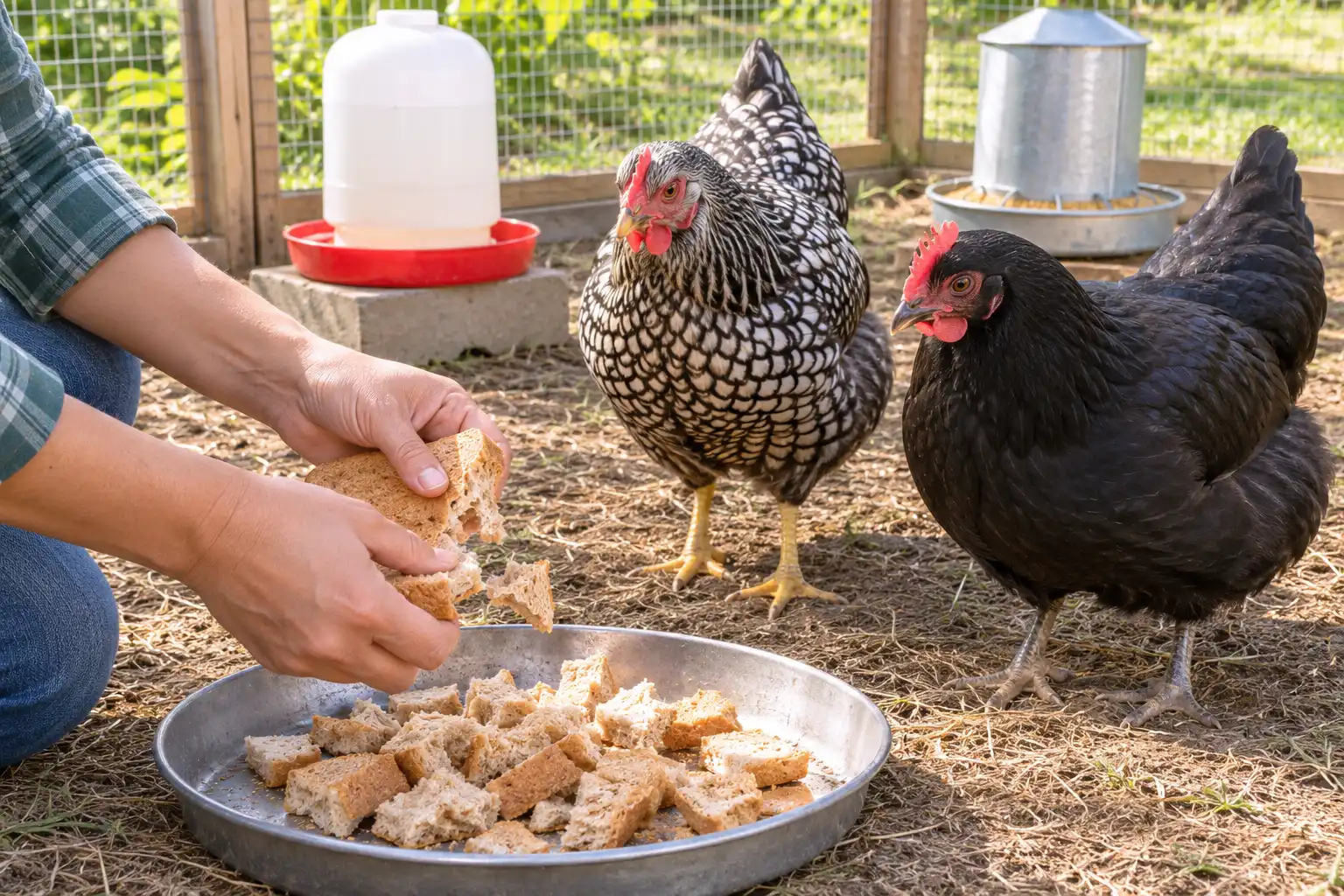
- Tear it small. Small pieces are easier to swallow, and they spread out so every hen gets a share.
- Offer it later in the day. That way, hens fill up on layer feed first.
- Use a shallow pan or scatter it on clean ground. Pick up leftovers before evening, since spilled food draws rodents and wild birds.
- Keep clean water out. Bread carries salt, and UF/IFAS warns that excess salt can dehydrate chickens.
Signs Your Flock Is Getting Too Much Bread
Watch the egg basket and the feeder. Thin shells, fewer eggs, and layer feed left uneaten all suggest that treats are crowding out the ration.
But the same changes can also come from disease, including avian influenza. So a sudden drop in laying, or any sick bird, calls for a poultry veterinarian, not just a diet change. If laying stays low after you cut bread back, call your county extension office or a veterinarian.
FAQs on Bread for Chickens
Can chickens eat bread every day?
Yes, laying hens can have a little bread most days, about 0.4 to 0.5 ounce per hen at most. Rotate bread with greens and other treats so it never crowds out layer feed.
Is bread bad for egg production?
Too much bread can lower egg production and weaken shells. Bread is low in calcium, and Mississippi State Extension links thin shells to laying hen diets built mostly on grains or mineral-poor feeds.
Can chickens eat bread crusts and heels?
Yes, crusts and heels are fine for chickens if they show no mold. Tear them small, because dry crusts are hard and bulky, and count them in the treat allowance.
Can chickens eat bread with butter?
Buttered bread isn’t toxic, but it isn’t a good treat either. Butter adds fat, and salted butter adds sodium, so offer bread plain and save the butter for your own toast.
Can chickens eat sourdough discard?
Not raw, because discard is still fermenting and can contain alcohol, which UF/IFAS Extension lists as toxic to chickens. Bake it plain without salt, or compost it where the flock can’t reach it.
Do chickens need grit if they eat bread?
Yes, if they eat anything besides complete feed, because chickens grind food in the gizzard with grit. UF/IFAS Extension’s Holmes County office recommends a dish of poultry grit for birds without soil access.
Key Points for Your Flock
Plain bread is a safe but low-value treat. Keep it plain, keep it mold-free, and keep it small. For laying hens, count it inside the 10 percent treat ceiling, or skip extras entirely as Mississippi State advises. Layer feed, oyster shell, grit, and clean water carry the diet, while bread stays a snack.