Can Chickens Eat Green Beans? Raw, Cooked, Canned and Fresh
Green beans grow in many home gardens and show up in kitchen scraps, so flocks see them often. Can chickens eat green beans? The safe answer depends on the form. Raw, cooked, canned, and frozen beans each carry a different risk, and each has a simple fix.
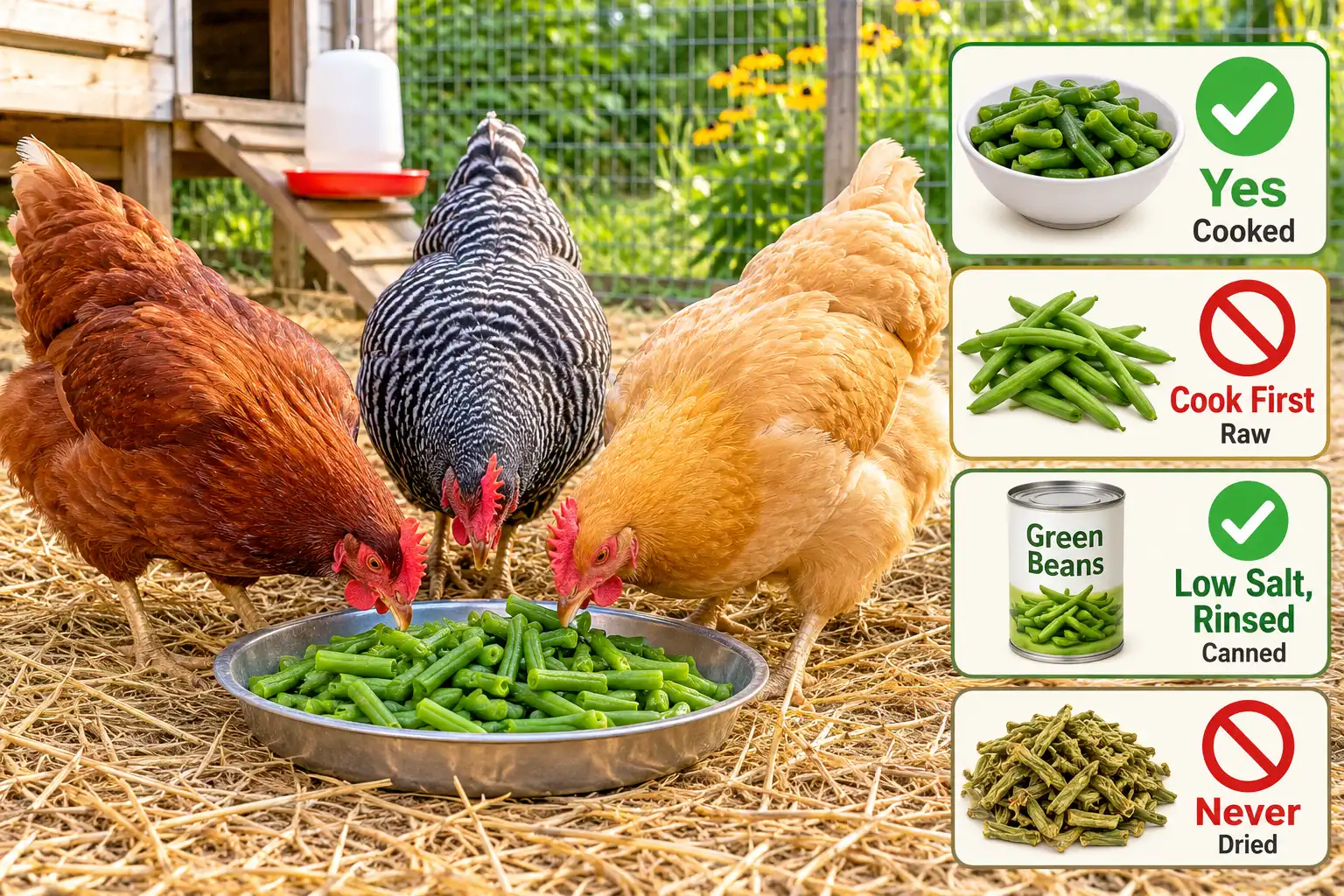
Yes. Chickens can eat green beans once they’re boiled plain until soft, which breaks down a natural bean lectin. Skip raw dried beans entirely, choose no-salt-added canned beans and rinse them, and keep all treats small.
Can Chickens Eat Raw Green Beans?
Raw green beans aren’t a safe bet for chickens, so cook them first. Green beans are the young pods of the common bean, Phaseolus vulgaris. That’s the same species as kidney, pinto, and black beans.
Those beans carry phytohaemagglutinin (PHA), a natural lectin. The FDA describes PHA as a lectin found in raw or undercooked beans. In people, high levels cause nausea, severe vomiting, and diarrhea. UF/IFAS Extension goes further for poultry. It warns that uncooked beans can be deadly to chickens because of PHA.
Fresh pods carry the lectin too
It’s easy to assume PHA is only a dried bean problem. It isn’t. A 2019 study in the International Journal of Food Properties measured PHA in fresh green bean pods. It reported that PHA from these fresh beans caused 40 percent of human poisonings from toxic plants in China from 2004 to 2013. The researchers also found that most of the PHA sat in the seeds inside the pod.
What the research doesn’t cover
We found no extension trial or poultry study that fed raw green bean pods to chickens. So no published figure tells you how many raw pods a laying hen can eat safely. A 10-minute simmer removes the question. That makes it the better trade every time.
If birds get into raw dried beans, such as a spilled bag or a spent garden bed, watch them closely. Any bird with diarrhea, or one that stops eating, needs a same-day call to a poultry veterinarian.
Read next: Grapes are safe for adult chickens
Can Chickens Eat Cooked Green Beans?
Yes. Plain cooked green beans are the safest way to feed them. UF/IFAS Extension notes that cooked beans are generally safe for chickens, while raw or dry beans should never be fed.
The catch is cooking time. The FDA says dried kidney beans need a soak of at least 5 hours. Then they need at least 30 minutes of boiling in fresh water to destroy PHA. Fresh pods need less. The 2019 study found that braising (cooking in liquid) for more than 10 minutes removed PHA, and so did stir-frying for more than 18 minutes.
So aim for green beans simmered at least 10 minutes, soft all the way through. Tender-crisp side dish beans may fall short of that. The study also tested Chinese bean cultivars, so treat 10 minutes as a floor, not a guarantee.
Plain only: leftovers and casseroles
Leftover green beans usually come with butter, bacon, salt, garlic, or sauce. Those stay in the kitchen. UF/IFAS Extension warns that too much salt can quickly lead to dehydration and kidney damage in chickens.
Green bean casserole is the common trap in November and December. Its cream soup base carries salt, and the fried onion topping adds more salt and fat. Compost it instead.
How to Cook Green Beans for Chickens
- Rinse the beans under running water. This washes off soil and surface residue.
- Trim the ends and cut the pods into short pieces. Short pieces cook evenly, and chickens swallow them easily. The trimmed ends can go in the pot too.
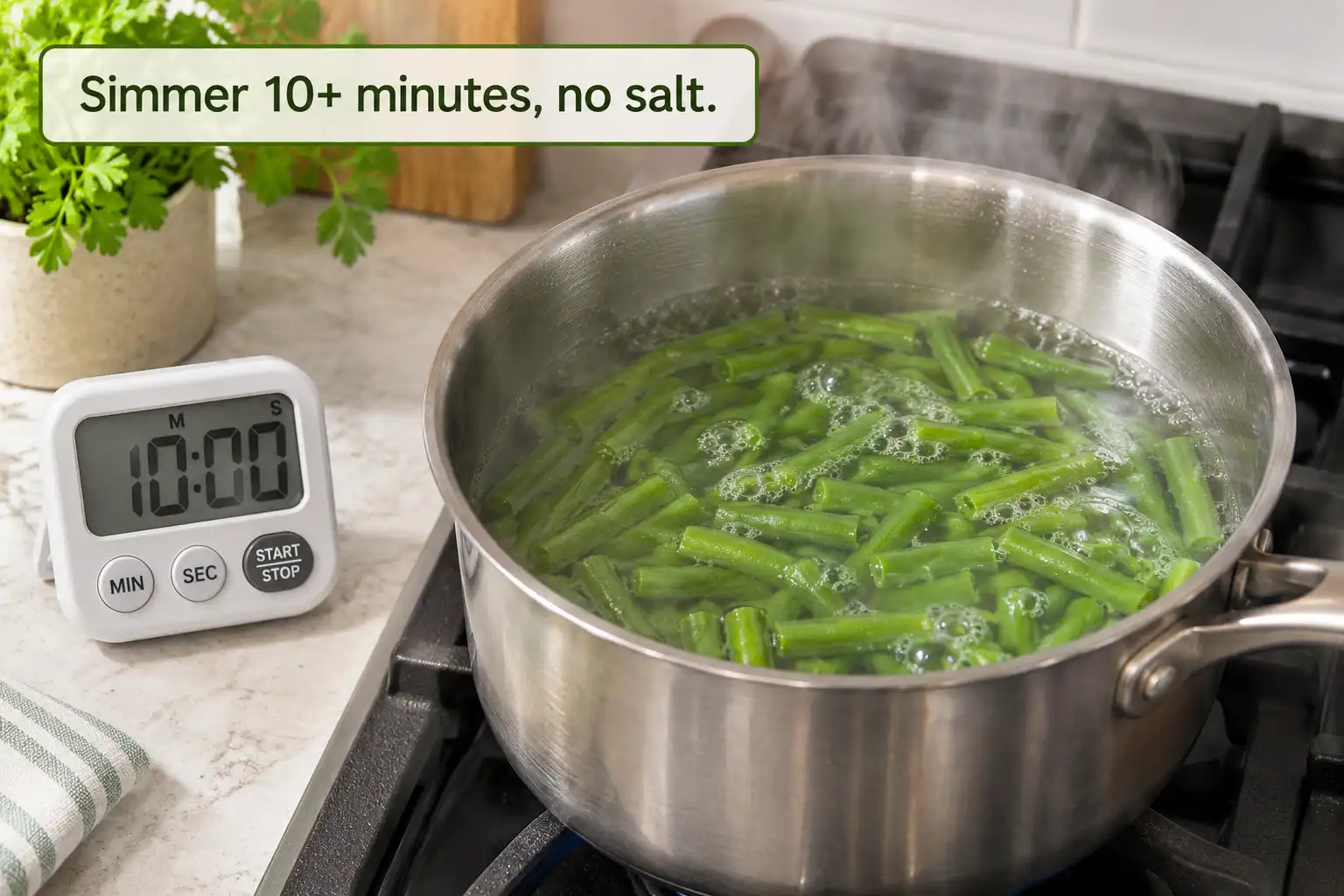
- Cover with plain water, bring to a boil, then simmer at least 10 minutes. Moist heat for that long is what removed PHA in the 2019 study. Add no salt.
- Test the thickest piece. If it still snaps, keep cooking until it mashes easily.
- Drain and cool to room temperature. Then the beans can go straight into the dish.
- Serve only what the flock finishes in about 20 minutes, the limit PNW Extension sets for scraps. Pick up the rest so it can’t sour or mold.
- Refrigerate extra beans in a covered container. Throw out any that turn slimy or moldy.
Serve beans in a shallow dish or a separate treat feeder rather than on the litter. That keeps them clean and makes leftovers easy to spot and remove.
Can Chickens Eat Canned Green Beans?
Yes, if the can is low in salt and you drain and rinse the beans first. Canned beans are already cooked. USDA’s MyPlate fact sheet calls canned green beans safe and ready to eat out of the can. The FDA also notes that the low PHA levels in canned kidney beans won’t affect people.
So lectin isn’t the concern with canned beans. Salt is. UF/IFAS Extension lists canned goods among the salty foods to keep from chickens. University of Kentucky Extension adds that excess salt raises water use and causes wet manure, which raises the risk of ammonia in the coop.
The difference shows up on the label. USDA Foods product sheets list 140 mg of sodium in a half cup of low-sodium canned green beans. A half cup of frozen no-salt-added green beans, cooked without salt, carries 1 mg. Regular cans usually carry more than low-sodium ones, so read the label.
To serve canned green beans:
- Buy cans marked “no salt added.”
- Pour off the liquid, and never let birds drink it.
- Rinse the beans. USDA notes that draining and rinsing canned vegetables reduces their salt.
- Skip bulging, leaking, or badly dented cans, and any home-canned beans that look or smell off.
What the Salt Adds Up To for One Laying Hen
University of Kentucky Extension puts a laying hen’s feed intake at about a quarter pound (4 ounces) a day. Its example layer diets carry 0.25 to 0.40 percent salt. Here’s the math:
- Feed per laying hen per day: about 4 oz (113 g)
- Salt in that feed: 113 g x 0.25 to 0.40 percent = 0.28 to 0.45 g
- Sodium in that salt: about 110 to 180 mg, since salt is about 39 percent sodium
A laying hen’s daily treat share, worked out in the portion section below, is about 0.4 to 0.6 ounces (11 to 17 grams). Filled entirely with low-sodium canned beans, that share adds about 13 to 19 mg of sodium. That’s roughly 7 to 17 percent more sodium than her feed already supplies.
That’s a modest bump, and rinsing trims it further. A heap of regular canned beans with the brine is where the salt adds up.

Can Chickens Eat Fresh Green Beans?
Yes, and fresh beans are the best starting point because you control the salt. Fresh still means raw, though. So they go in the pot before they go in the dish.
Pick firm, bright pods. Skip any that are slimy, spotted, or moldy. UF/IFAS Extension warns that mold can produce toxins that cause respiratory issues, digestive problems, or poisoning. Rinse store-bought beans too, since you can’t know what they met on the way to the shelf.
Yellow wax beans, purple pod beans, and flat Romano beans are the same species as green beans. The same rule applies to all of them: cook first. That sets green beans apart from cucumbers from the same garden, which chickens can eat raw.
Frozen Green Beans
Frozen green beans work well once you cook them. Bagged beans are blanched before freezing, and blanching is a short scald, not full cooking. So treat frozen beans like fresh ones and simmer them at least 10 minutes.
Some keepers toss frozen beans straight from the bag as a summer cooler. Those beans are still close to raw, though. For a cold treat on a hot day, cook the beans first, cool them, then freeze them.
Green Beans From the Garden: Plants, Leaves, and Dry Pods
The plants worry less than the dry seeds they leave behind. Little published research covers bean leaves and vines as chicken forage, so we can’t give a safe amount. Also, chickens let into a bean bed will strip leaves and pods fast. Fence the bed during the season if you want a harvest.
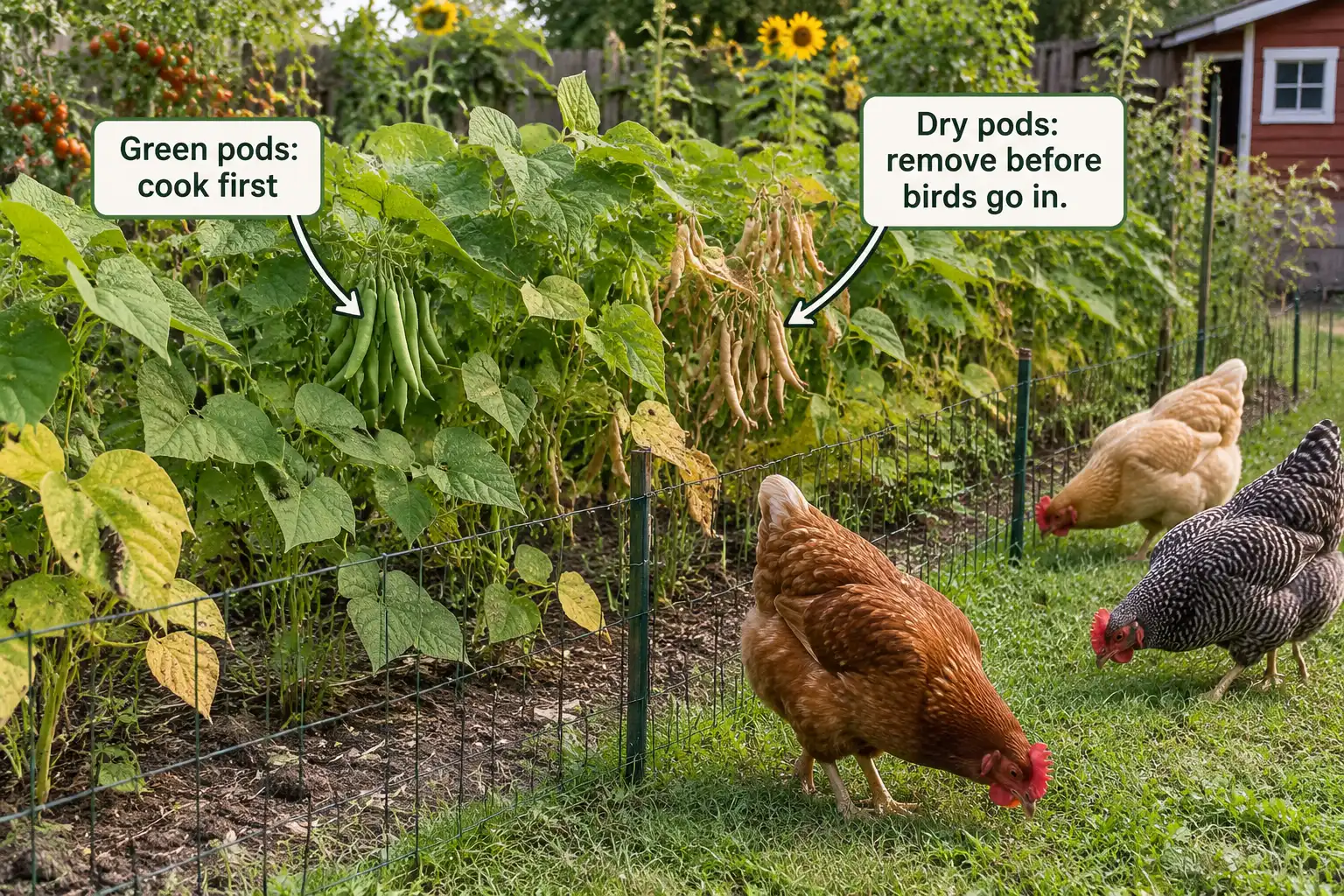
The real hazard comes at the end of the season. Pods left on the vine dry out and hold mature seeds. Those are the raw dry beans UF/IFAS Extension says chickens should never eat. Before you turn the flock onto a spent bed:
- Pick or pull every dry pod, including pods on the ground.
- Check the label of anything you sprayed, and follow its directions about animals.
- Then let the birds work the bed for weeds and insects.
Other crops follow their own rules. Our garden foraging and treat guidance covers what else a flock can safely work over.
Raw, Cooked, Canned, or Frozen: Which Green Beans Are Safe?
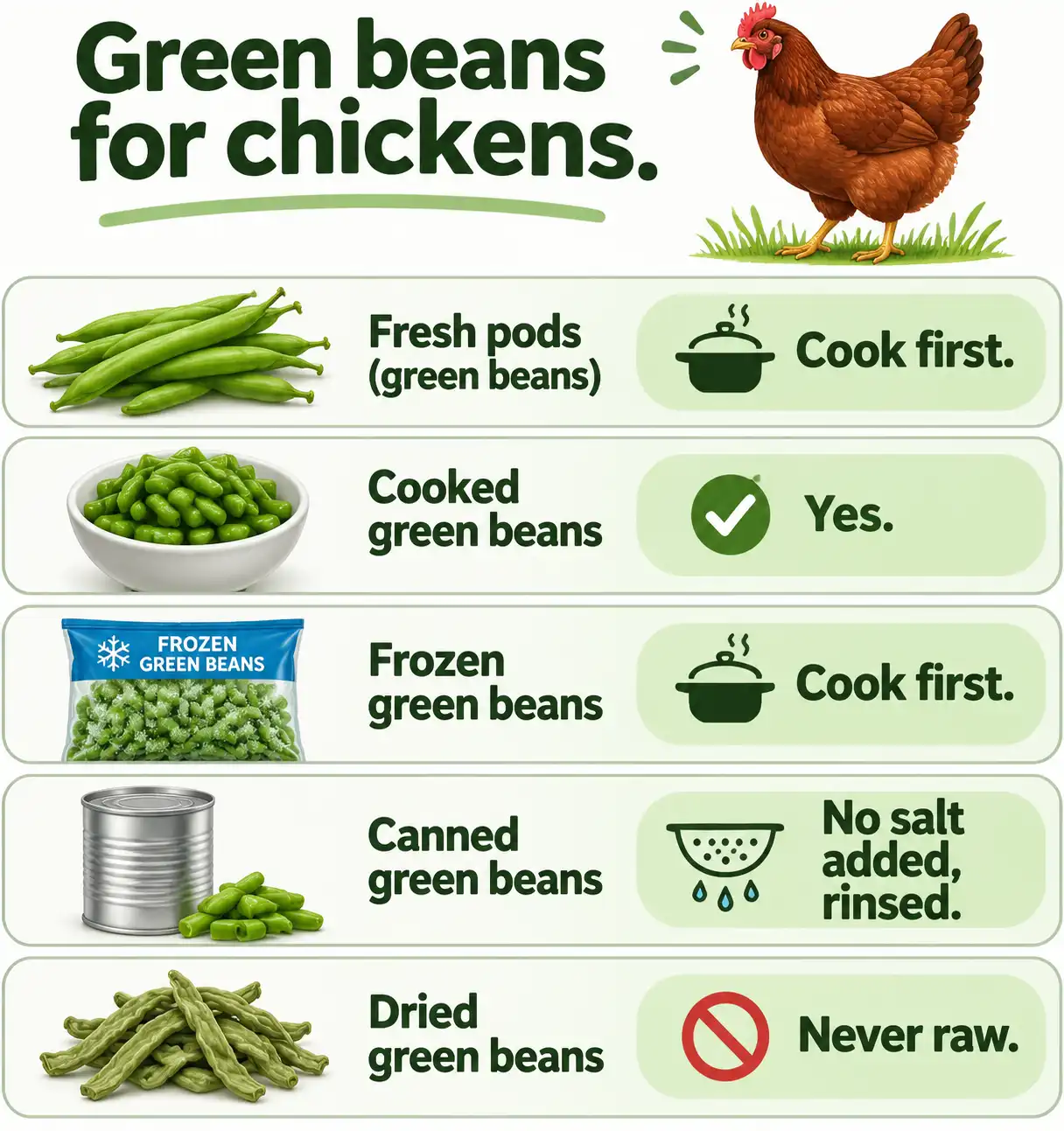
Cooked plain beans and rinsed no-salt-added canned beans are the two forms that need no extra caution. Every other form either needs cooking first or stays out of the run.
| Form | Verdict | Main concern | What to do |
|---|---|---|---|
| Fresh, raw | Cook first | PHA lectin, and no published safe raw amount | Simmer 10+ minutes until soft |
| Cooked plain | Yes | Portion size only | Cool, cut, serve in a dish |
| Frozen, from the bag | Cook first | Blanched, not fully cooked | Simmer 10+ minutes |
| Canned, no salt added | Yes | A little sodium | Drain, rinse, serve |
| Canned, regular | Avoid if you can | Salt in the beans and brine | Pour off liquid, rinse well, keep it small |
| Seasoned leftovers | No | Salt, butter, bacon, sauces | Keep them in the kitchen |
| Green bean casserole | No | Salty soup base, fried topping | Compost it |
| Dried mature beans, raw | Never | Highest PHA levels | Never feed raw |
| Dried beans, fully cooked | Yes, plain | Undercooking | Soak 5+ hours, boil 30+ minutes (FDA) |
How Many Green Beans Can Chickens Eat?
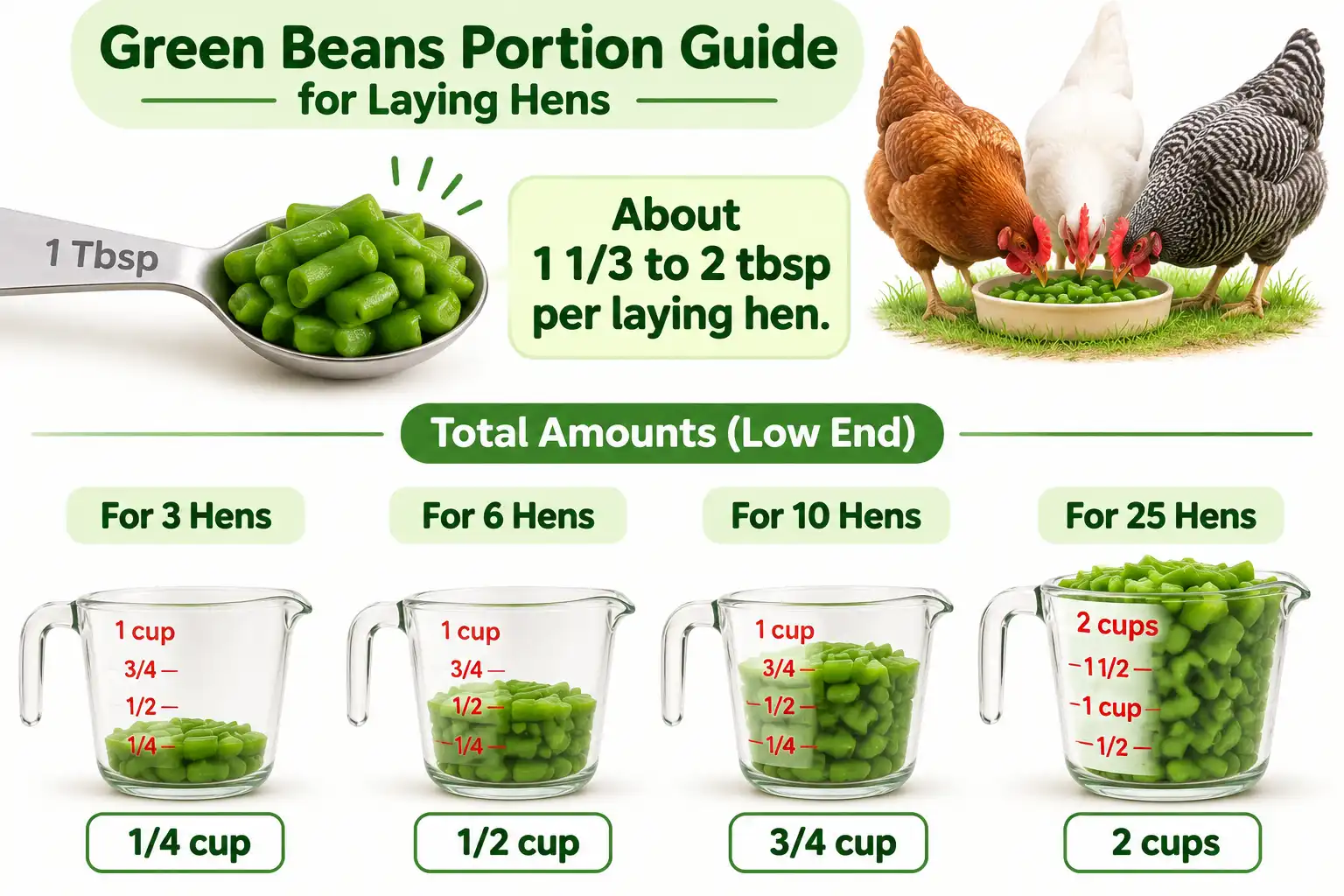
A laying hen’s green beans, plus every other treat that day, should total about 0.4 to 0.6 ounces. That’s roughly 1 1/3 to 2 tablespoons of cooked, cut beans per hen.
Here’s where that comes from. PNW Extension’s laying hen guide limits scraps and greens to what birds clean up in about 20 minutes. Oregon State, Washington State, and the University of Idaho publish it together. It applies the same rule to scratch and puts that at about 10 to 15 percent of daily food. Meanwhile, University of Kentucky Extension says a laying hen eats about 4 ounces of feed a day. Ten to 15 percent of 4 ounces is 0.4 to 0.6 ounces. Finally, USDA lists a half cup of cooked green beans at 68 grams, or 2.4 ounces.
Daily treat limit for laying hens = number of hens x 4 oz of feed x 0.10 to 0.15
| Laying hens | All treats per day | Cooked cut green beans, about |
|---|---|---|
| 3 | 1.2 to 1.8 oz | 1/4 to 3/8 cup |
| 6 | 2.4 to 3.6 oz | 1/2 to 3/4 cup |
| 10 | 4 to 6 oz | 3/4 to 1 1/4 cups |
| 25 | 10 to 15 oz | 2 to 3 cups |
For 6 laying hens, a 12-ounce bag of frozen green beans covers their whole treat allowance for about 3 to 5 days. Green beans are mostly water, so this weight math runs on the cautious side. The 20-minute cleanup check stays the practical test. Bantams and young pullets eat less feed, so scale their share down.
What Green Beans Add to a Hen’s Diet
Green beans add variety and fiber, but very little protein. USDA lists 1 gram of protein and 2 grams of fiber in a half cup (68 grams) of cooked green beans. That works out to about 1.5 percent protein by fresh weight.
Now compare that with the feed. PNW Extension puts layer feed at about 16 percent protein, with 3 to 4 percent calcium for strong shells. A laying hen that fills up on beans eats less of the ration that carries both. That’s why a complete layer ration stays the bulk of her diet.
There’s one small bonus. PNW Extension notes that some greens help keep egg yolks a deep orange. However, we found no study measuring whether green beans do this as well as leafy greens. So treat it as a possible extra, not a reason to feed more.
Green Beans for Chicks, Pullets, and Broilers
The bird’s age and type change the answer more than the bean does.
Chicks. A complete chick starter covers everything a chick needs, so treats add nothing nutritionally. Published guidance on when chicks can start vegetable treats is thin. If you offer green beans anyway, cook them soft, mince them fine, and give only a pinch once chicks eat starter well.
Pullets. Growing pullets follow the same rules as laying hens, in smaller portions. University of Kentucky Extension stresses matching the diet to the type and age of the bird, so grower feed stays the main ration.
Broilers. Fast-growing meat birds such as Cornish Cross run on dense feed. PNW Extension notes that diets for young meat-type chickens run about 22 percent protein to maximize growth. Cooked green beans, at about 1.5 percent protein by fresh weight, dilute that. So skip treats for broilers, or keep them tiny. Pasture-raised broilers already forage, which gives them variety.
Roosters. Roosters follow the same rules as laying hens.
Problems to Watch For
Most green bean problems come from the wrong form or too much of it.
| What you see | Common reason | What to do |
|---|---|---|
| Wetter droppings after a big serving | A large amount of a watery vegetable | Cut the portion and watch for a day or two |
| Hens eat beans and leave their feed | Too many treats | Hold to the 20-minute cleanup rule |
| Heavy drinking and wet litter after canned beans | Excess salt | Switch to no-salt-added cans and rinse them |
| Sour or moldy beans in the run | Leftovers sat too long | Remove uneaten beans after about 20 minutes |
| Birds got into dried beans or a spent bean bed | Raw mature seeds | Remove the beans and watch the birds closely |
Whatever a bird ate, some signs need a call. A bird with bloody droppings, or one that stops eating or drinking, needs a poultry veterinarian. Sudden deaths in the flock need a same-day call to your state veterinarian or USDA at 1-866-536-7593. Don’t assume a treat caused them, because reportable diseases have to be ruled out first. Keep the full list of unsafe foods handy so scraps never become the question.
FAQs About Chickens Eat Green Beans
Can chickens eat green bean casserole?
No, because its cream soup base and fried onion topping carry a lot of salt and fat. UF/IFAS Extension warns that too much salt can quickly lead to dehydration and kidney damage in chickens.
Can chickens eat the ends trimmed off green beans?
Yes, once they’re cooked, since the ends are raw bean pod like the rest. Toss them in the pot with the beans and simmer everything at least 10 minutes before serving.
Can chickens eat green bean leaves and vines?
No one has published a safe amount, because little research covers bean leaves and vines as chicken forage. The bigger risk in a bean bed is dry pods with mature seeds, so remove those before birds go in.
Do green beans need to be cut up for chickens?
Yes, cut pods into short pieces before cooking, because chickens swallow food whole and long pods are awkward to eat. Short pieces also cook through faster and more evenly in the pot.
Are yellow wax beans and purple beans safe for chickens?
Yes, once cooked, because wax beans, purple pod beans, and Romano beans are the same species as green beans and carry the same lectin. Cook them the same way, simmering at least 10 minutes in plain water.
Will green beans help hens lay more eggs?
No, since green beans carry about 1.5 percent protein by fresh weight (USDA), against roughly 16 percent in layer feed (PNW Extension). Hens that fill up on beans eat less of the ration that supports laying.
How often can chickens have green beans?
As often as you like, as long as all treats that day stay within the 20-minute cleanup limit PNW Extension recommends. Rotating beans with other vegetables keeps any one scrap from crowding out the feed.
Putting This Into Practice
Cook every green bean you feed, whether fresh, frozen, or from the garden, and simmer it plain for at least 10 minutes. Choose no-salt-added cans and rinse them. Keep all treats to what your hens finish in about 20 minutes. And keep raw dried beans, including dry pods in a spent garden bed, well out of reach.