What Should Chickens Eat? Feed by Age and How Much Per Bird
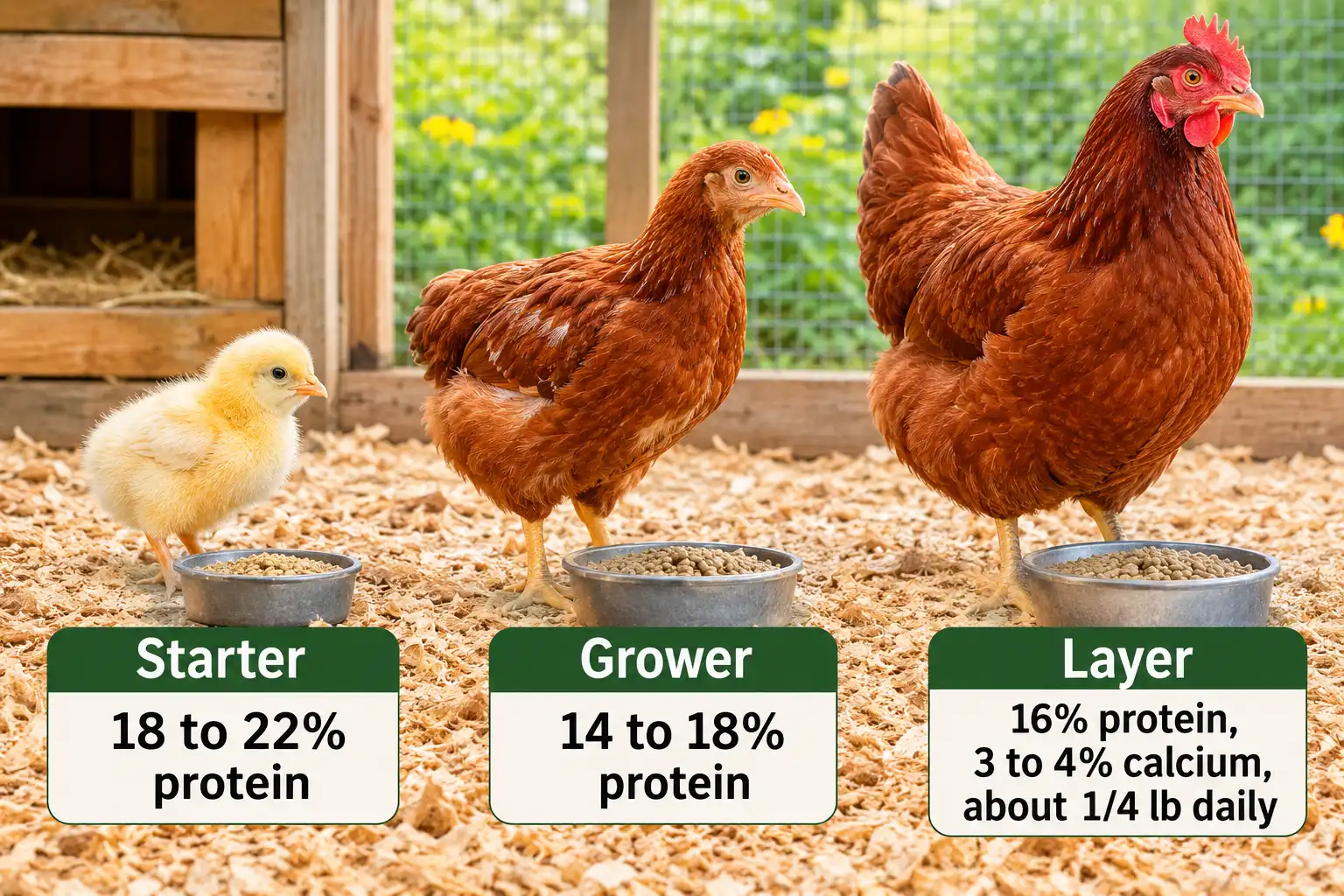
What should chickens eat? Mostly one thing: a complete commercial feed matched to the bird’s age and purpose. Scraps, scratch, grit, and oyster shell play small, specific roles. The figures below cover feed by age, protein and calcium, and how much each flock eats.
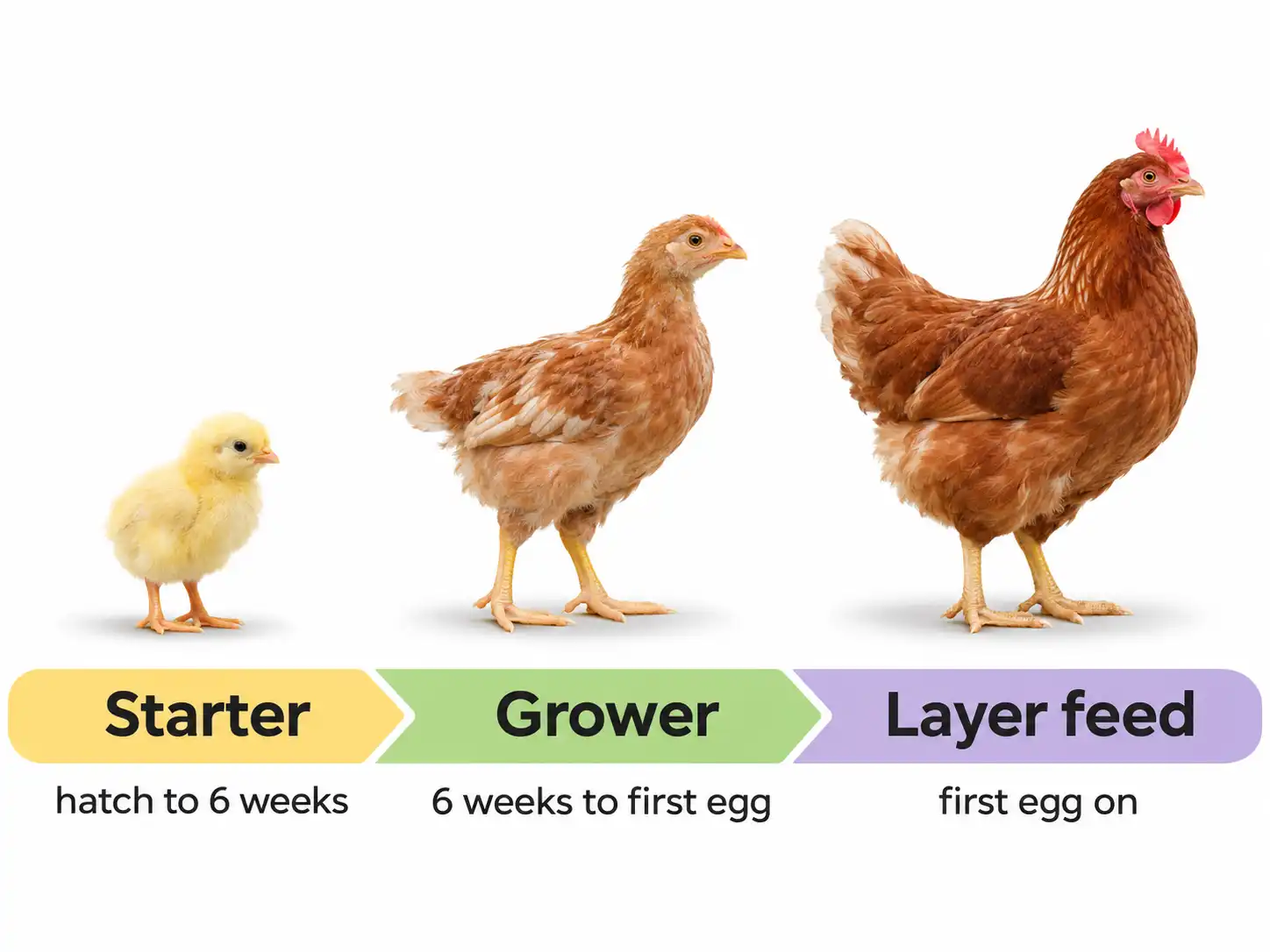
Chickens should eat a complete feed for their stage: chick starter for chicks to about 6 weeks, grower for pullets until laying, then layer feed. A laying hen eats about 1/4 to 1/3 pound of it a day, per Alabama Extension.
What Should Chickens Eat at Each Age?
Chickens should eat the complete feed made for their bird type and age, because protein and calcium needs change as birds grow. Layer-type chicks start on chick starter. Pullets then move to grower, and hens switch to layer feed at the first egg. Broilers follow their own higher-protein program.
| Bird type and age | Feed | Protein | Calcium |
|---|---|---|---|
| Layer-type chicks, hatch to about 6 weeks | Chick starter | 18 to 22% | About 1% |
| Pullets, 6 weeks to first egg | Grower, then developer | 14 to 18% | About 1% |
| Laying hens, from the first egg | Layer feed | 16 to 18% | 3 to 4.5% |
| Broiler chicks, hatch to 3 or 4 weeks | Broiler starter | 20 to 24% | About 1% |
| Broilers, 4 weeks to processing | Broiler grower or finisher | 15 to 22% | Under 1% |
These ranges combine UGA Extension, Oregon State, Alabama Extension, and Colorado State figures, which are shown one by one further down. Still, the tag on the bag names its bird type and age. That label governs what you buy.
Chicks: Starter Feed From Day One
Chick starter is the whole diet for layer-type chicks from hatch to about 6 weeks. Oregon State University Extension puts starter at 18 to 20 percent protein for these chicks. It also advises against meat-bird starter, near 22 percent protein, for layer-type chicks, since that level isn’t needed for egg-laying breeds.
Getting chicks to eat comes first. Alabama Extension suggests starting chicks on feed in a shallow cardboard box with sides cut to about 1 inch. It notes that chicks need about a week to learn a regular feeder.
Some starters are medicated with a drug that helps control coccidiosis. Whether your chicks need it, and how it fits with a coccidiosis vaccine from the hatchery, is a question for your hatchery or poultry veterinarian. The bag’s label governs its use.
Crumble size, brands, and the switch to grower are covered in our guide to chick starter by age.
Pullets: Grower Feed Until the First Egg
Pullets eat grower feed from about 6 weeks until they lay. Grower carries less protein than starter and far less calcium than layer feed. Oregon State lists grower at about 15 to 16 percent protein for pullets from 6 weeks, with an optional 14 to 15 percent developer feed after about 14 weeks.
So don’t rush layer feed. UF/IFAS Extension warns that the high calcium in layer feed can damage the kidneys of young, growing birds.
Timing the switch matters too:
- Oregon State moves pullets to layer feed at 18 to 20 weeks or at the first egg, whichever comes first.
- Alabama Extension says layer feed should start no more than 2 weeks before a pullet begins laying.
- Alabama Extension also notes that moving light-breed pullets to developer as early as 8 to 10 weeks can delay laying by 1 to 2 weeks.
Most pullets lay their first egg at 20 to 25 weeks, per Alabama Extension’s laying hen guide. Watch the nest boxes from about 18 weeks, then switch when eggs appear.
Laying Hens: Layer Feed With Added Calcium
Laying hens need layer feed, because every eggshell uses calcium the hen must replace each day. UGA Extension lists layer feed at 16 to 18 percent protein and 3.5 to 4.5 percent calcium for hens 19 weeks and older. Feed it as the main diet, with no grain mixed in.
Breed size shifts the protein need. Alabama Extension puts it at about 17 grams of protein a day for light-breed hens such as Leghorns and about 24 grams for heavy breeds. Dual-purpose breeds like Plymouth Rocks and Orpingtons fall in between.
Form matters a little, too. UGA Extension notes that layer feed is usually sold as mash, and that crumbles can help hens eat enough in hot months.
Label reading, protein choices, and organic options get their own page on choosing a layer feed.
Broilers and Meat Birds: Higher Protein, Faster Growth
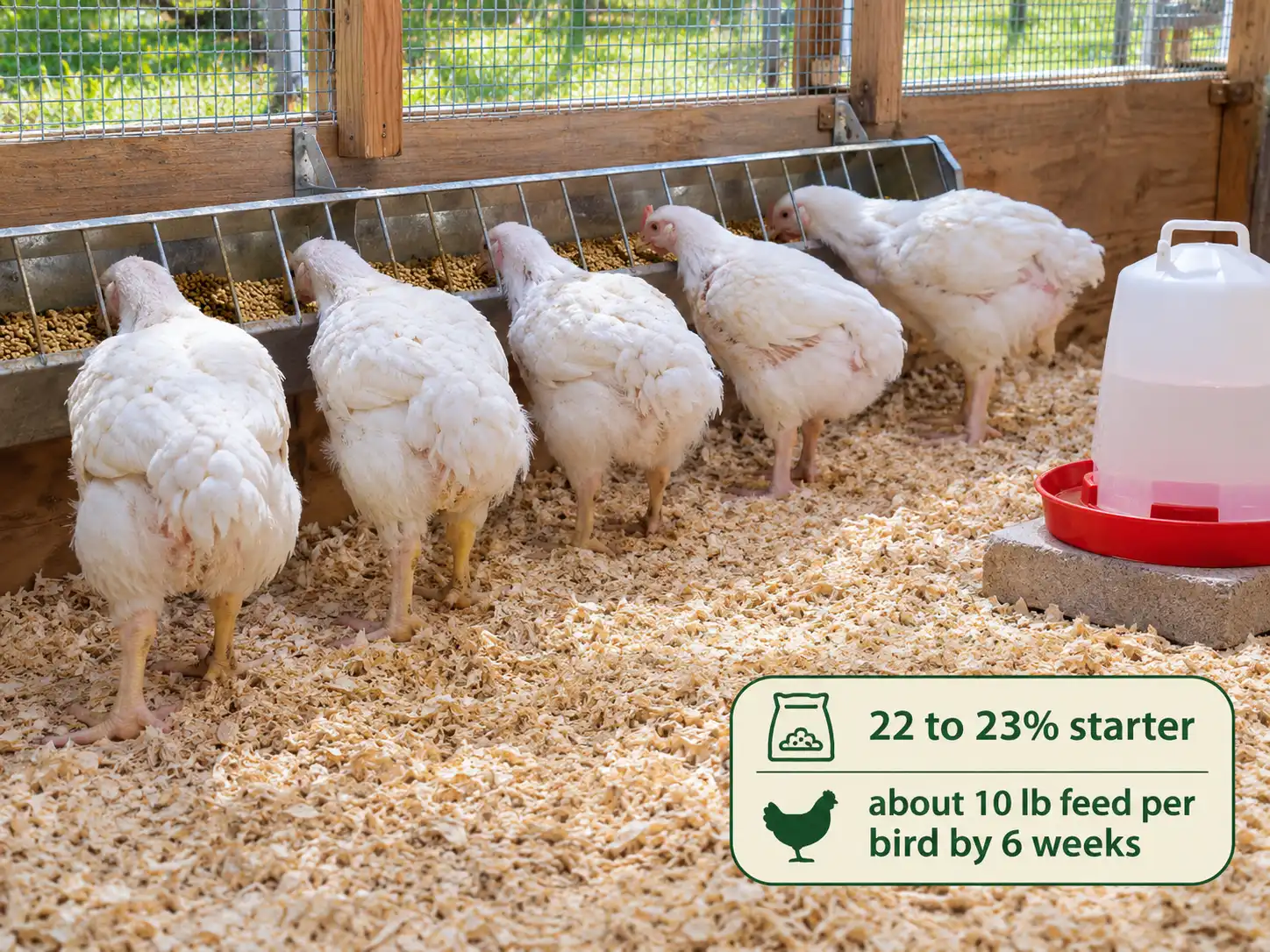
Broilers need more protein than layer-type chicks, starting on day one. Oregon State’s meat-bird guide puts starter for meat-type chickens at about 22 to 23 percent protein and grower at 18 to 20 percent. UGA Extension adds that pelleted feed for meat birds improves feed efficiency by about 4 percent.
Keep layer feed away from them. UGA Extension says the calcium in layer feed, upwards of 4 percent, can cause leg abnormalities and even death in young broilers. Alabama Extension also advises against feeding scratch grain to broilers.
Cornish Cross is the efficient case. Oregon State notes that heritage meat breeds eat the same types of feed, but the Cornish Cross grows faster on less of it. Independent feed figures for slower-growing hybrids such as Freedom Rangers are limited, though. If you raise them, budget from the hatchery’s own feed chart and treat those numbers as the hatchery’s.
Mixed Flocks, Roosters, and Hens Out of Lay
A mixed flock can’t eat from one bag without a trade-off. UF/IFAS Extension notes that high calcium can harm young birds and males, yet laying hens need it for shells.
There are two common ways to handle it:
- One all-flock feed, plus oyster shell. Oregon State notes that all-purpose feed is usually low in calcium, so laying hens on it need free-choice oyster shell in a separate dish.
- Separate feeding until the young birds lay. Keep chicks and growing pullets on their own feed and feeder, then move everyone to layer feed once the pullets start laying.
Roosters, older hens, and hens out of lay fit the first approach best, since none of them need a laying hen’s calcium.
Where the Sources Disagree on Protein and Calcium
Extension services print slightly different numbers, mostly because they set different age cutoffs and plan for different breeds. We give each figure rather than an average.
| Feed and bird type | UGA Extension | Oregon State | Alabama Extension | Colorado State |
|---|---|---|---|---|
| Starter for layer-type chicks, protein | 20% (1 to 6 weeks) | 18 to 20% (to about 6 weeks) | 20 to 22% (light breeds, to 6 weeks) | 20% (0 to 8 weeks) |
| Grower for pullets, protein | 17% (7 to 18 weeks) | 15 to 16%, then 14 to 15% developer after 14 weeks | 16 to 18% (6 to 14 weeks), then 14 to 16% (14 to 20 weeks) | 18% (8 to 12 weeks), then 14 to 16% (12 to 21 weeks) |
| Layer feed for hens, protein | 16 to 18% | About 16% | 16% or more | 17% |
| Layer feed for hens, calcium | 3.5 to 4.5% | 3 to 4% | 3 to 4% | Not listed |
| Starter for broiler chicks, protein | 22% (1 to 3 weeks) | 22 to 23% | 20 to 23% (0 to 4 weeks) | 22 to 24% (0 to 4 weeks) |
Alabama Extension explains part of the spread: protein needs depend on the feed’s energy level and on how much the birds eat. In practice, a commercial feed inside these ranges for the right bird type and age fits all four sources. Colorado State’s figures come from its guide to practical feeding methods for small flocks.
How Much Feed per Chicken Each Day?
A laying hen eats about 1/4 pound of feed a day. Alabama Extension puts it at 100 to 150 grams, or roughly 1/4 to 1/3 pound, and Colorado State lists 2.5 pounds a day for 10 laying hens. Weather, body size, and rate of lay move the figure.
Cold weather raises it. Alabama Extension notes that a laying hen may burn up to 340 calories of feed energy a day in winter but only about 260 in summer. So expect the feed bin to empty faster from November to March.
| Bird type and age | Feed eaten | Source |
|---|---|---|
| Laying hen, in production | About 1/4 to 1/3 lb a day | Alabama Extension |
| Light-breed pullet chick, hatch to 6 weeks | About 2 lb in total | Alabama Extension |
| Layer-type pullet, hatch to 21 weeks | About 18 lb in total | Colorado State |
| Cornish Cross broiler, hatch to 6 weeks | About 10 lb in total | Oregon State |
The two pullet figures cover different periods. Alabama’s 2 pounds covers only the first 6 weeks for light breeds. Colorado’s 18 pounds runs to 21 weeks: about 4 pounds to 8 weeks, 4 more to 12 weeks, then 10 more to 21 weeks.
How Long a 50-Pound Bag Lasts Your Flock
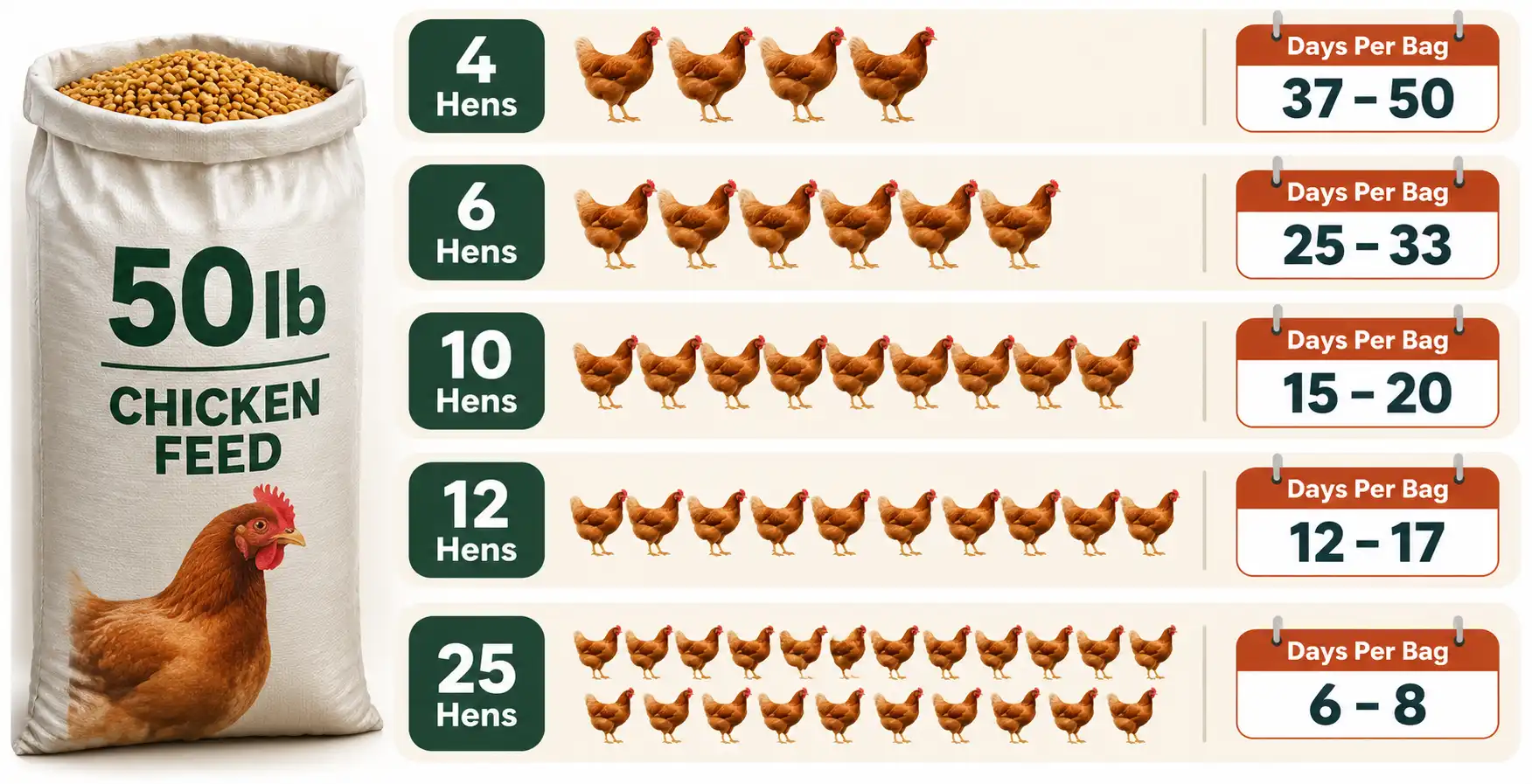
Multiply your hens by 1/4 to 1/3 pound to get daily feed, then divide 50 by that number. Alabama Extension runs the same math for 10 laying hens: 2.5 pounds a day, so a 50-pound bag lasts about 20 days.
| Laying hens | Feed per day (lb) | Feed per 30 days (lb) | One 50-lb bag lasts |
|---|---|---|---|
| 4 | 1.0 to 1.3 | 30 to 40 | 37 to 50 days |
| 6 | 1.5 to 2.0 | 45 to 60 | 25 to 33 days |
| 10 | 2.5 to 3.3 | 75 to 100 | 15 to 20 days |
| 12 | 3.0 to 4.0 | 90 to 120 | 12 to 17 days |
| 25 | 6.3 to 8.3 | 188 to 250 | 6 to 8 days |
Over a year, one laying hen eats roughly 90 to 120 pounds of feed. Spilled feed isn’t counted here, so round up when you buy.
The same math works for growing birds. For example, 25 Cornish Cross broilers at Oregon State’s 10 pounds each eat about 250 pounds by 6 weeks, or five 50-pound bags. Six layer-type pullets at Colorado State’s 18 pounds each eat about 108 pounds by 21 weeks, a little over two bags.
Feed Cost per Dozen Eggs
Feed cost per dozen equals the feed cost for a period divided by the dozens of eggs collected in that period. The egg count is your own number, so track it for a month.
Here is the working for 6 laying hens over 30 days:
- Feed used: 6 hens at 1/4 to 1/3 pound a day for 30 days is 45 to 60 pounds.
- Feed cost: at an example price of $25 per 50-pound bag, that’s $22.50 to $30.00. Use your own receipt, since feed prices vary by region and change often.
- Eggs: say your hens laid 12 dozen that month.
- Cost per dozen: $22.50 to $30.00 divided by 12 is about $1.88 to $2.50 in feed.
Published per-dozen figures run lower than this. Colorado State’s table puts a 3.5-pound hen laying 250 eggs a year at about 3.5 pounds of feed per dozen, and a 5-pound hen laying 200 eggs at about 5 pounds. By contrast, Alabama’s 1/4 pound a day works out to about 5.5 pounds per dozen at 200 eggs a year. That gap is why your own bag receipts make the best budget.
Free Choice or Measured Meals?
Both work for laying hens. Oregon State advises keeping feed available at all times. If you prefer meals, Alabama Extension says to feed twice a day and give only what the flock cleans up in 30 minutes to 1 hour.
Feeder setup cuts waste either way:
- Space: Oregon State calls for at least 1 linear inch of feeder space per chick and 4 linear inches per adult bird. For 10 hens, that’s at least 40 linear inches.
- Height: UF/IFAS Extension sets the feeder lip at the birds’ shoulder height, raised as they grow.
- Fill level: Alabama Extension advises filling troughs no more than half full.
When you compare a feeder that limits waste, check its feeding space against your flock size before its capacity.
Treats and Kitchen Scraps: How Much Is Too Much?
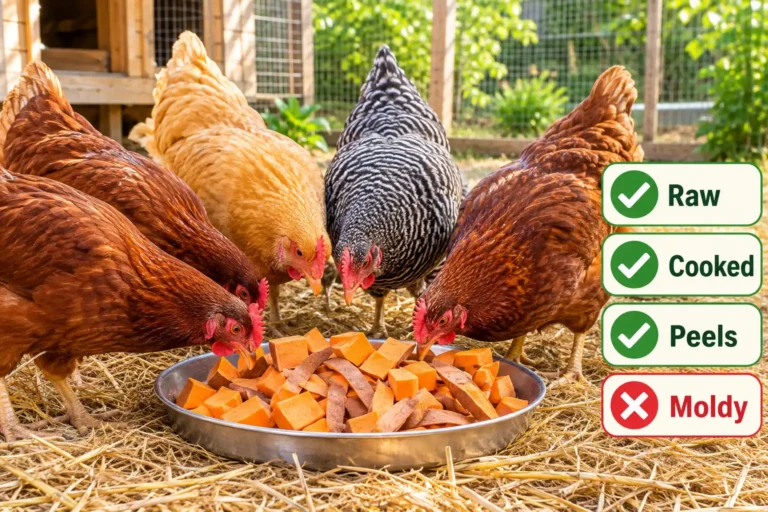
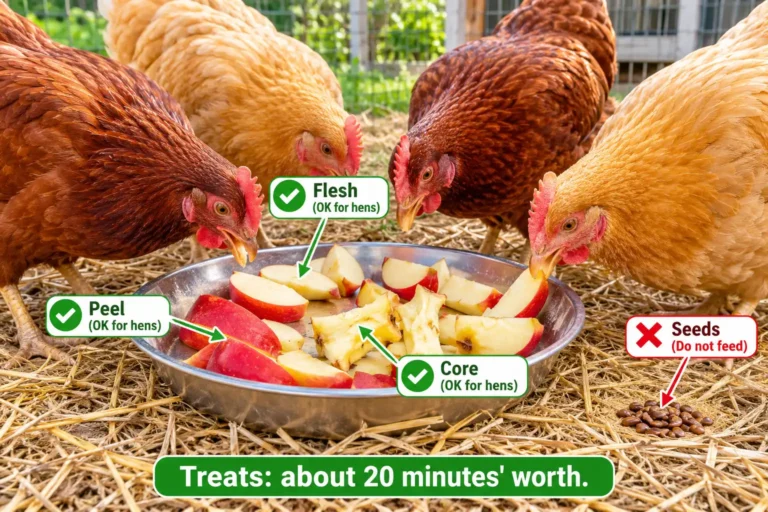
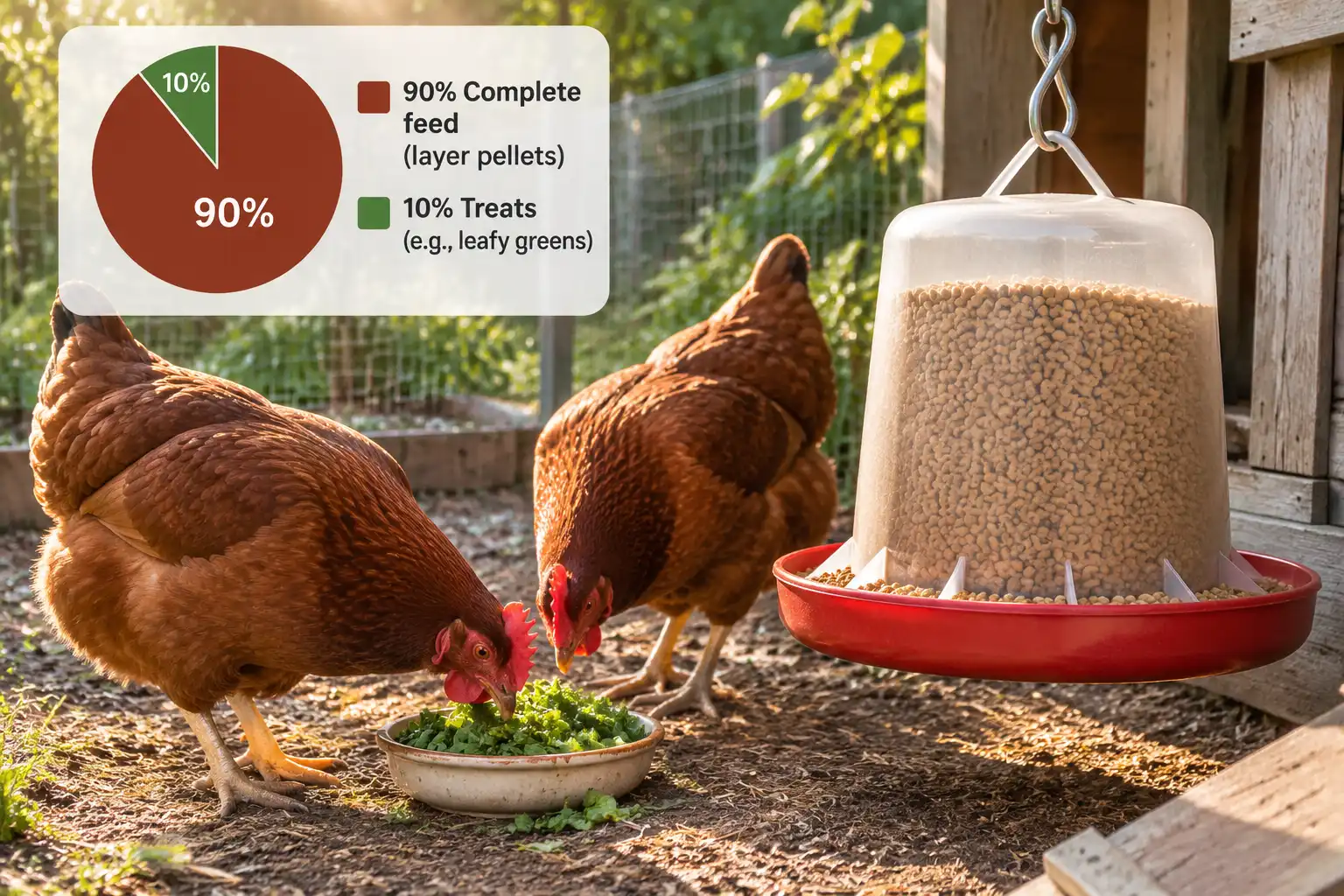
Keep treats and scraps to about 10 percent of what laying hens eat. Colorado State Extension sets that cap and says to give no more than the birds finish in 5 to 10 minutes, so leftovers don’t draw pests. Oregon State allows a little more: about 10 to 15 percent of daily food, limited to what birds clean up in about 20 minutes.
Here is what 10 percent looks like. Ten laying hens eat about 2.5 pounds of feed a day, so their treat limit is about 1/4 pound, or 4 ounces, for the whole flock. That’s under half an ounce per hen.
Greens are a sound pick, and Oregon State notes they help keep yolks deep orange. On the other hand, Colorado State lists foods to keep out of the run:
- Avocado skins and pits
- Undercooked or dried beans
- Onions and rhubarb
- Salty, citrus, or moldy food
- Potato peelings, with caution
The full list of foods to keep from a flock covers more items and the reasons behind each.
Scratch Grains and Free-Range Forage
Scratch is a treat, not a feed. UGA Extension says scratch should never be mixed into a complete feed, because it throws the nutrient balance off. UF/IFAS Extension agrees that diluting a complete ration with grain creates an imbalanced diet.
Forage doesn’t replace the bag either. UF/IFAS puts the most nutrition a bird can get from range at 15 percent, and often much less. That means free-range hens still need complete feed available every day. Forage quality also swings with the season, so a green spring pasture and a bare winter yard aren’t the same diet.
Grit and Oyster Shell: Who Needs Which
Grit grinds food, while oyster shell supplies calcium. One can’t stand in for the other, according to both UF/IFAS and Oregon State.
Grit. UF/IFAS Extension says granite grit is needed when birds eat whole grains, weed seeds, grass, or insects. Commercial feed alone generally makes it unnecessary. Grit also comes in chick and hen sizes, so match it to the bird.
Oyster shell. Oregon State says to offer it in a separate feeder to laying hens whose shells are thin, crack easily, or feel rough. Alabama Extension calls it probably unnecessary when hens eat a high-quality layer feed. It also says never to add extra calcium to feed for growing pullets.
Eggshells. Crushed eggshells can supply calcium, too. Colorado State says to dry and bake them before breaking them up, so hens don’t learn the taste of eggs. Alabama Extension gives two methods: dry them in the sun for 1 or 2 days, or bake them at 350°F for 10 minutes.
Sizes, dishes, and feeding setups are covered under grit and oyster shell for a laying flock.

Water: About Twice the Feed by Weight
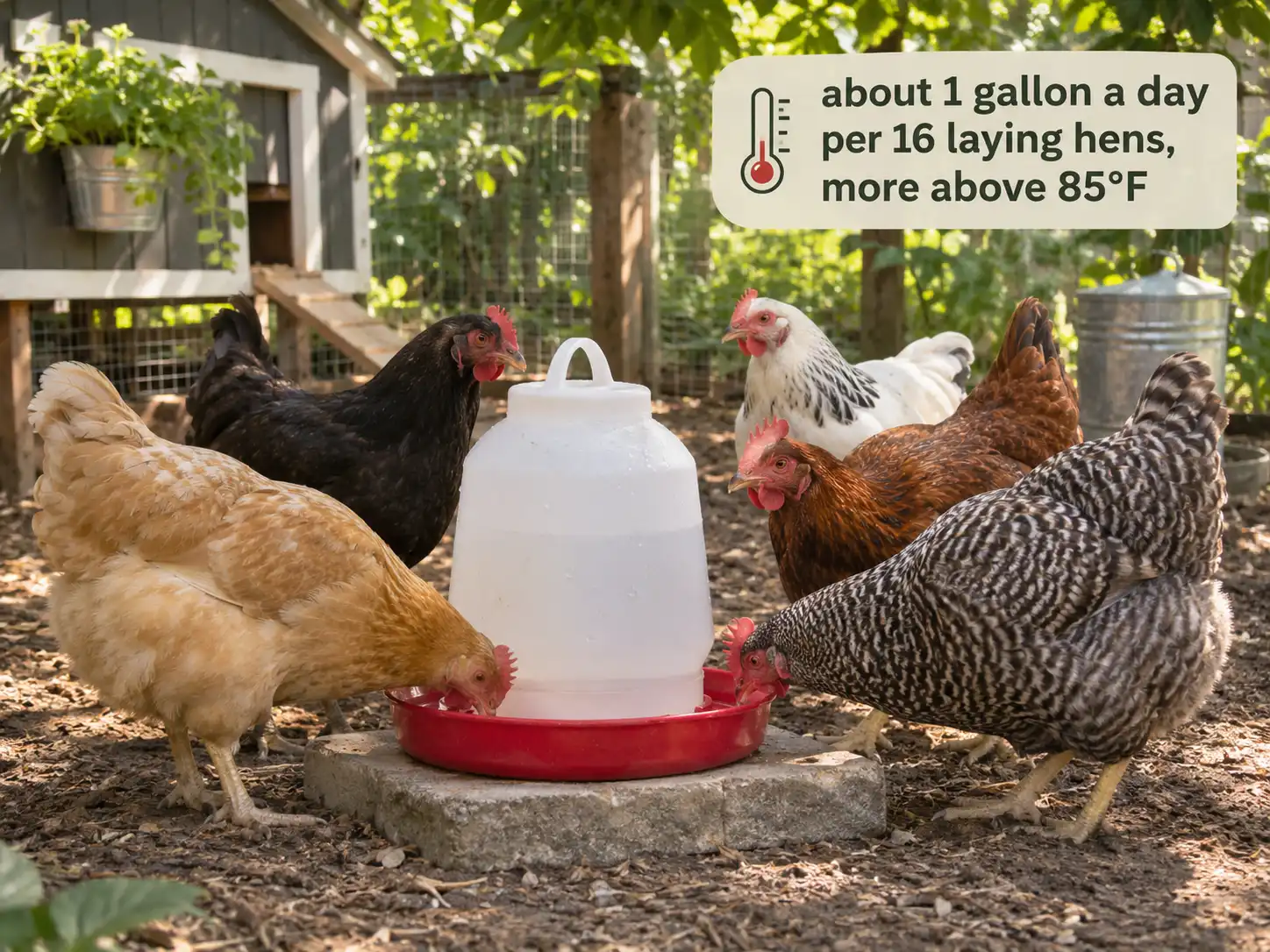
Laying hens drink about twice as much water as they eat in feed, by weight. UGA Extension adds that birds won’t eat if they can’t drink. Oregon State puts intake at two to three times feed weight, rising in warm weather and especially above 85°F.
Alabama Extension carries that through: about 0.5 pound of water per hen a day, so one gallon covers about 16 laying hens. Here is the flock math for mild weather:
- 6 laying hens: about 0.4 gallon a day
- 10 laying hens: about 0.6 gallon a day
- 25 laying hens: about 1.6 gallons a day
At Oregon State’s three-times figure, though, 10 hens need closer to 0.9 gallon. So size waterers for hot days, not average ones. Seasonal needs and freezing weather are covered in our page on water needs by season.
Storing Feed So It Stays Fresh
Buy only what your flock finishes in 1 to 2 months. Oregon State says to keep feed no more than 2 months, in a cool, dry place, inside solid containers that shut out rodents. Alabama Extension is stricter in summer: no more than 1 month in summer and 2 months in winter. It also suggests checking the bag for a manufacture date.
Bag size follows from that. Four laying hens take 37 to 50 days to finish a 50-pound bag, which runs past Alabama’s summer limit. A 25-pound bag, gone in about 19 to 25 days, fits better. Throw out any feed that smells musty, cakes, or shows mold.
Can You Mix Your Own Chicken Feed?
You can, but balancing it is hard. Alabama Extension calls homemade layer feed a challenge without in-depth nutrition knowledge. It warns that an imbalanced diet can have lasting effects, and it suggests talking with a poultry nutrition specialist first.
The detail explains why. UF/IFAS Extension notes that methionine is the first limiting amino acid in poultry diets, and that trace minerals such as selenium have tight upper limits. A home mix has to get those right every batch. For most backyard flocks, a commercial complete feed is the simpler and safer choice.
When Eggs or Growth Drop: Feed Checks and When to Call
Feed explains some problems, but not all. Call your poultry veterinarian or state veterinarian the same day, or USDA at 1-866-536-7593, if birds die suddenly, stop eating or drinking, or egg production falls sharply. USDA APHIS lists sudden death, low energy and appetite, a drop in egg production, and soft-shelled or misshapen eggs among the signs of avian influenza, which must be reported. Don’t move birds off the property while you wait.
For slower, flock-wide changes in otherwise healthy birds, check the feed first:
| What you see | Feed check | Other causes to rule out |
|---|---|---|
| Thin, rough, or soft shells | Layer feed in use, oyster shell offered | Disease, especially if sudden or with sick birds |
| Fewer eggs, hens look healthy | Treats over 10%, scratch mixed into feed | Short days, molt, age, disease |
| Pullets not laying by 25 weeks | Developer started early, feed type | Breed, hatch season, light hours |
| Slow-growing chicks or broilers | Right starter, no layer feed by mistake | Disease; send sick or dead birds to a diagnostic lab |
| Feed disappearing fast | Overfilled troughs, spillage | Rodents and wild birds at the feeder |
A poultry veterinarian or your state diagnostic lab confirms the cause before anything is treated.
FAQs on Food for Chickens
Can chickens live on kitchen scraps alone?
No, because scraps can’t supply the protein and minerals a laying hen needs. Colorado State Extension caps treats and scraps at 10 percent of the daily diet, with complete layer feed making up the rest.
Can chicks eat layer feed?
No, layer feed carries too much calcium for growing birds. UF/IFAS Extension warns that the high calcium in layer feed can damage the kidneys of young and growing birds, so keep chicks on starter.
Can roosters eat layer feed?
Roosters can share a flock’s feed, but layer feed’s calcium is more than they need. UF/IFAS Extension notes high calcium can harm males, so an all-flock feed with oyster shell on the side is one option for mixed flocks.
When should pullets switch to layer feed?
Switch at the first egg or at about 18 to 20 weeks, whichever comes first, per Oregon State Extension. Alabama Extension adds that layer feed shouldn’t start more than 2 weeks before a pullet begins laying.
Do chickens need grit if they only eat pellets?
Usually not, because commercial feed is already ground. UF/IFAS Extension says granite grit becomes necessary once birds also eat whole grains, weed seeds, grass, or insects, as free-ranging and treat-fed flocks do.
Do free-range chickens still need feed?
Yes, free-range hens still need a complete feed available every day. UF/IFAS Extension puts the most nutrition a bird can get from range at 15 percent, and often much less, so forage supplements feed rather than replacing it.
How much feed does a laying hen eat in a year?
A laying hen eats roughly 90 to 120 pounds of feed a year. That carries Alabama Extension’s 1/4 to 1/3 pound a day across 365 days, so a 6-hen flock needs about 550 to 730 pounds.
Key Points for Your Flock
Buy the complete feed made for each bird type and age, and let the bag’s tag settle the details. Then budget 1/4 to 1/3 pound a day per laying hen, so 10 hens finish a 50-pound bag in about 15 to 20 days. Keep treats near 10 percent, give grit when birds eat more than feed, and offer oyster shell when shells weaken. Finally, supply about twice as much water as feed, and buy only what the flock eats in 1 to 2 months.